AI Coding Tool Costs: What You Actually Pay Per Month
What AI coding tools cost per month in 2026, why subscription and API pricing diverge, where your tokens go, and habits that cut spend without cutting output.
· Justin Boggs

Photo by Jakub Żerdzicki on Unsplash
A solo founder shipping steadily with AI coding tools should expect to spend $20 to $200 a month, and the spread is almost entirely about which billing model you're on. On a flat subscription — Claude Pro at $20/month, Cursor Pro at $20/month — your cost is fixed and your usage limits are the constraint. On pay-per-token API billing, Anthropic's own documentation puts enterprise Claude Code usage at around $13 per developer per active day, which lands between $150 and $250 a month for someone coding daily. Same work, wildly different bill. Knowing which side of that line you're on is the first cost decision, and most founders make it by accident.
TL;DR
- Subscription plans cap your bill and cap your throughput. API billing does neither. Pick deliberately.
- Anthropic's docs put enterprise Claude Code at ~$13 per developer per active day and $150–250/month, with 90% of users under $30 per active day.
- Output tokens cost 5x input tokens on every Claude model, and cache reads cost about a tenth of base input — so context reuse is the single biggest lever.
- Long sessions are the number one source of surprise bills.
/clearis free; a stale 200k-token context is not.- Match the model to the job. Sonnet handles most coding work; Opus is for architecture decisions, not for renaming variables.
Subscription or API: the decision that sets your bill
Every AI coding tool now sells the same thing two ways, and the two ways produce different numbers for identical work.
Subscription means a flat monthly fee with usage limits. Claude Pro is $17/month billed annually or $20 monthly and includes Claude Code and Cowork. Max starts at $100/month for 5x or 20x Pro's usage. Cursor's published plans run Pro at $20/month, Pro+ at $60, and Ultra at $200. When you hit the ceiling, you wait for the window to reset or you upgrade. Your finance question is answered in advance.
API / pay-per-token means you're billed for every token in and out, with no ceiling. This is where the $150–250/month figure comes from. It's also where the horror stories come from, because nothing stops a badly-managed session from costing $40 in an afternoon.
The honest guidance for a bootstrapped founder: start on a subscription. Not because it's always cheaper — for very light use, API billing genuinely costs less than $20/month — but because a subscription makes your worst month knowable. When you're pre-revenue, a predictable $20 is worth more than a possible $12 that might be $180. You can always move to API billing later, once you know your own usage shape.
The case for API billing is throughput. Subscription limits reset on rolling windows, and when you hit one mid-task you stop. If you're doing a two-week sprint where the work is bounded and the deadline isn't, paying per token to never be interrupted can be the right trade. Anthropic's docs note that Claude Code usage on a subscription shares one pool with your chat usage, so heavy terminal work and heavy chat work compete for the same allowance.
There's a middle path worth knowing about: usage credits let a Pro or Max subscriber keep working past the plan limit at standard API rates, with a monthly spend cap you set yourself. That combination — subscription floor, credit ceiling — is the setup I'd recommend to most founders who've been coding with AI for more than a couple of months.
Where the money actually goes
If you're on token billing, the pricing table is the whole game. Here's what Anthropic charges per million tokens as of September 2026:
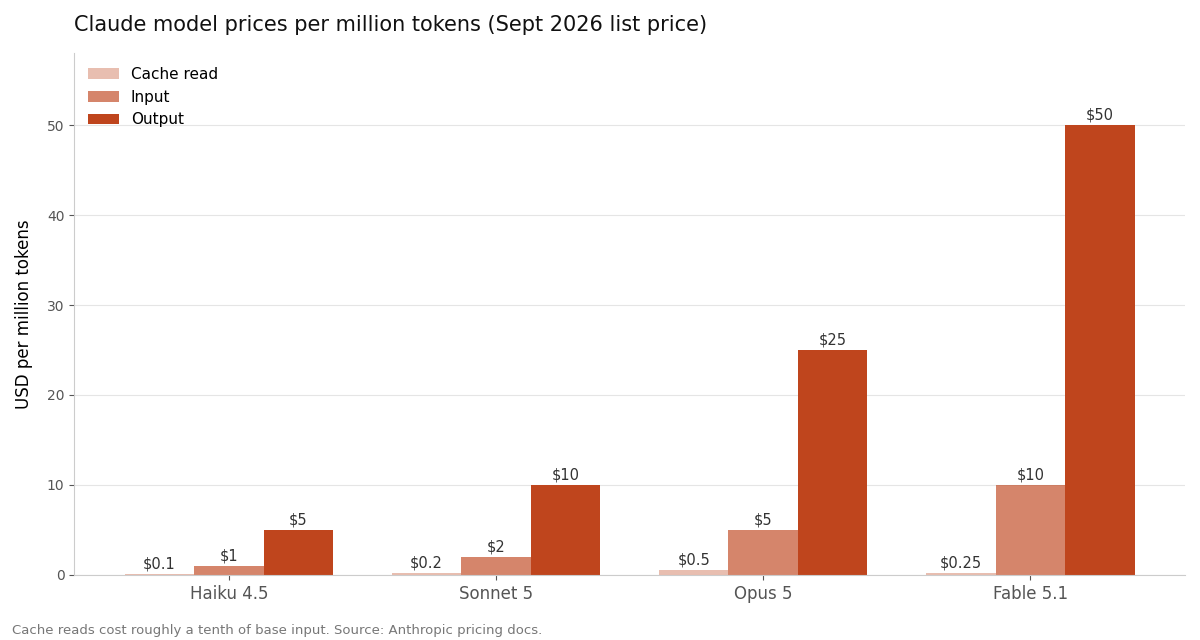
Three things in that chart matter more than the absolute numbers.
Output costs 5x input. On every model. Sonnet 5 is $2 per million in and $10 per million out. This means a session where Claude writes a lot of code costs disproportionately more than a session where Claude reads a lot of code. It also means asking for a full file rewrite when you needed a three-line diff is a real, measurable expense.
Cache reads cost roughly a tenth of base input. Anthropic's pricing docs put a cache hit at 0.1x the standard input price. Prompt caching is why a long conversation doesn't cost linearly more with every turn — the history gets re-read at the cached rate. It's also why a cache miss is expensive: you reprocess the entire context at full price.
The model spread is 10x. Haiku 4.5 at $1/$5 versus Fable 5.1 at $10/$50. Running your default at the top of that range for routine work is the single easiest way to pay ten times what you need to.
Beyond the raw token price, a few line items surprise people:
| Cost source | What it costs | Why it surprises you | | --- | --- | --- | | Extended thinking | Billed as output tokens | Default budgets run to tens of thousands of tokens per request | | Web search (API) | $10 per 1,000 searches | Charged on top of the tokens the results consume | | Long context | Standard per-token rate | Not a premium — but 900k tokens at standard rate is still 900k tokens | | Idle sessions | Under $0.04 per session | Small, but nonzero even when you're not typing | | Agent teams | ~7x a standard session | Each teammate runs its own context window |
That last row deserves emphasis. Anthropic's cost documentation states that agent teams use approximately 7x more tokens than standard sessions when teammates run in plan mode, because every teammate maintains a separate context. Multi-agent workflows are genuinely powerful and genuinely expensive. Reach for them when the task decomposes cleanly, not because it feels productive to have four things running.
Why a long session quietly costs more than a long day
The most common way founders blow their budget isn't picking the wrong model. It's leaving one session open for eight hours.
Here's the mechanic. Claude Code sends your full conversation with every request. Every time it uses a tool, that's another request carrying the whole accumulated history plus the new tool results. Prompt caching softens this — the history gets re-read at the cached rate rather than full price — but "softened" isn't "free." A one-line question typed into a session that's been open since breakfast still draws usage proportional to the entire day's conversation.
Then the cache expires. Anthropic's docs put the cache lifetime at one hour on a subscription, dropping to five minutes once you're drawing on usage credits, and five minutes by default on an API key. Come back from lunch, type one message, and you've just reprocessed your entire 180k-token context at full input price. That single message can cost more than the previous hour of active work.
The fix is embarrassingly simple and almost nobody does it consistently: /clear between unrelated tasks. It costs nothing. It resets your context to zero. Anthropic's own guidance names stale context as the primary cause of unexpectedly high spend, alongside leaving Opus as the default model.
Two habits make clearing painless:
/renameyour session before clearing, so you can/resumeit later if the thread turns out to matter.- Use
/compactwith instructions when you need continuity but not the whole transcript —/compact Focus on the schema changes and the failing testkeeps what matters and drops the rest. Note that compaction itself reads the conversation it summarizes, so compacting a huge context is itself a large request. When you want a clean slate rather than continuity,/clearis the cheaper move.
There are quieter drains too. A scheduled task fires on its interval and sends your full context each time, even while you're not at the keyboard. Agent teammates keep consuming tokens until they exit. If your bill looks higher than your activity, those are the first places to look.
I go deeper on the mechanics of keeping context small in managing your context window while coding with AI — the cost angle and the quality angle turn out to be the same problem, because a bloated context makes the model worse and more expensive.
Six habits that cut spend without cutting output
None of these require you to work less. They're all about not paying for tokens that never had a chance of helping.
Match the model to the job. Sonnet handles most coding tasks well and costs a fraction of Opus. Reserve Opus for architectural decisions and genuinely multi-step reasoning. For simple subagent work, specify Haiku explicitly. Switching mid-session with /model is free, and the discipline of asking "does this need the expensive model?" before a task is worth more than any other habit on this list.
Write specific prompts. "Improve this codebase" triggers broad scanning — Claude reads dozens of files trying to figure out what you meant. "Add input validation to the login function in auth.ts" reads one file. The token difference between those two prompts is enormous, and the second one produces a better answer.
Use plan mode before big changes. Shift+Tab into plan mode, let Claude explore and propose an approach, approve it, then let it build. This costs a little up front and saves a lot when the initial direction was wrong. Expensive re-work is the most avoidable cost in AI coding.
Keep CLAUDE.md short. Your CLAUDE.md loads into context at every session start, which means every token in it is a token you pay for on unrelated work. Anthropic's guidance is to aim for under 200 lines. Detailed workflow instructions belong in skills, which load only when invoked. If you haven't set one up, the CLAUDE.md file guide covers what belongs in it and what doesn't.
Audit your MCP servers. MCP tool definitions are deferred by default now, so only names and server instructions enter context until a tool is actually used — but the servers you've configured and forgotten still add overhead. Run /mcp and disable the ones you're not using. CLI tools like gh and aws are more context-efficient than the equivalent MCP servers because they add no per-tool listing at all. My MCP servers for founders post has the ones I actually keep enabled.
Turn thinking down for simple work. Extended thinking is on by default because it meaningfully improves complex reasoning, and thinking tokens bill as output tokens — the expensive kind. For a rename, a formatting pass, or a straightforward bug fix, lowering the effort level with /effort is free money.
Run /usage regularly. It shows what your current session has consumed and, on paid plans, flags behaviors accounting for 10% or more of your recent usage. Reading that screen once a week for a month will teach you more about your own spending pattern than any general advice, including mine.
What this should actually cost you
Rough shapes, from my own experience and the published figures:
| Your situation | Sensible setup | Expected monthly | | --- | --- | --- | | Evaluating, a few hours a week | Claude Pro, single tool | $17–20 | | Shipping part-time around a job | Claude Pro + usage credits with a cap | $20–60 | | Full-time solo, daily sessions | Max 5x, or Pro + generous credit cap | $100–150 | | Full-time, multiple agents, no interruptions | API billing or Max 20x | $150–250+ |
The row people get wrong is the third one. Founders coding full-time often stay on the $20 plan, hit limits daily, and lose an hour a day to waiting — which is a far more expensive way to save $80. If you're shipping every day, price your own hour and do the arithmetic honestly.
The other row people get wrong is the first. Two AI coding subscriptions plus a couple of API keys "just to compare" is $60/month of tools you're using at 20% capacity. Pick one, learn it properly, and revisit in three months. I wrote up how I actually chose between them in Cursor vs Claude Code vs Cowork, and the short version is that the tool you know well beats the tool with the better feature list.
Worth keeping in perspective: even the $250 month is cheap relative to what it replaces. That's the part of the ledger the cost-cutting conversation tends to skip. The goal isn't to minimize this line item — it's to stop paying for tokens that never had a chance of producing anything, so the money you do spend goes to work that ships.
Frequently asked questions
Is a subscription or API billing cheaper for AI coding tools?
For most solo founders, a subscription. Anthropic's figure of ~$13 per developer per active day on API billing works out to $150–250/month for daily use, well above the $17–20 Pro subscription. API billing wins for light, sporadic use or when uninterrupted throughput matters more than a predictable bill.
What is the average monthly cost of Claude Code?
Anthropic's documentation puts enterprise deployments at around $13 per developer per active day and $150–250 per developer per month on token billing, with 90% of users staying under $30 per active day. On a Pro subscription, Claude Code is included at $17–20/month with plan usage limits.
Why did my AI coding bill spike this month?
The two usual causes are a long session that was never cleared and Opus left as the default model. A stale context gets re-sent with every request, and a cache miss after a break reprocesses the whole thing at full input price. Run /usage — on paid plans it flags any behavior accounting for 10% or more of recent usage.
Do output tokens really cost more than input tokens?
Yes, 5x on every Claude model. Sonnet 5 is $2 per million input and $10 per million output. This is why asking for a targeted diff instead of a full-file rewrite is a genuine cost decision, not just a style preference.
Are multi-agent workflows worth the token cost?
Sometimes. Anthropic's docs put agent teams at roughly 7x the tokens of a standard session in plan mode, because each teammate carries its own context window. Use them when a task decomposes into genuinely independent pieces, keep teams small, and shut teammates down when their work is finished.
How do I track what I'm spending without an enterprise dashboard?
/usage inside Claude Code shows session token counts and a plan-usage breakdown, including attribution to skills, subagents, and individual MCP servers. On API billing, the Claude Console usage page is authoritative. Check one of them weekly for a month and you'll know your own pattern.
Spend deliberately, not defensively
AI coding tool costs are one of the few software line items where your behavior moves the number more than your plan choice does. Pick a subscription so your worst month is knowable, clear your context between unrelated tasks, keep the expensive model for the work that needs it, and read /usage often enough to notice when something changes. That's most of it. The founders I see with runaway bills aren't using the tools more than I am — they're carrying a 200k-token context around all day and running Opus to rename a function.
If you're shipping a SaaS with AI coding tools and want the plumbing already built — auth, Stripe, email, the file structure that keeps a model from wandering — Coding Capybaras is the free boilerplate I built for exactly this workflow.