Should You Quit Your Job for SaaS? | Coding Capybaras
Whether to quit your job for a SaaS side project comes down to a runway number and a feeling. Here's the math I used, and the part nobody says out loud.
· Justin Boggs

You should not quit your job for a SaaS side project until the product has paying customers and you have enough saved to be wrong about the timeline. That's the honest answer, and it's unsatisfying, because the question people are actually asking isn't financial. It's "how much longer do I have to feel like this?" The math is the easy half — a burn number, a runway number, a revenue floor. The feelings are the half that actually decides it, and almost nobody writes about those without dressing them up as a triumph. This is my attempt at both halves, unflattering parts included.
TL;DR
- Run the real burn number first: rent, health insurance, self-employment tax, and a buffer. Most people forget the last three.
- Quitting is a growth lever, not a survival plan — MicroConf found full-time founders grow 2.2x faster than part-time ones, which is a reason to go, not a reason to go early.
- Set a revenue trigger and a date trigger before you're emotionally invested, and let them decide instead of your Tuesday-night mood.
- The feeling that you're behind is not information. About 70% of micro-SaaS products earn under $1,000 MRR — the quiet middle is the normal place to be.
- The hardest part of staying isn't the hours. It's explaining, repeatedly, why you haven't quit yet.
The number that actually matters
Start with burn, not savings. Everyone gets this backwards — they look at the balance in the account, divide by some vague sense of monthly spending, and produce a runway figure that's about 40% too optimistic.
Your real monthly burn as a self-employed founder is not what you spend now. It's what you spend now, plus the things your employer is currently paying for on your behalf and you've never had to see.
The biggest one in the US is health insurance. If you're on an employer plan, you're seeing a payroll deduction, not a price. The actual price is what the individual market charges, and that market moved sharply in 2026: KFF reports insurers raised ACA Marketplace premiums by an estimated 26% on average for 2026, with the increase in states using Healthcare.gov averaging 30%. Whatever you had penciled in from a friend's experience two years ago is stale. Go pull a real quote for your zip code and your age before you do any other arithmetic.
The second forgotten line is self-employment tax. You're currently splitting Social Security and Medicare with your employer. Alone, you pay both halves. Whatever you assumed your effective tax rate would be, it's higher.
The third is the buffer, and it's the one that separates the people who make it from the people who go back to work in month nine. Your product will take longer than you think. Not because you're bad at this — because everyone is wrong about the timeline, every time. Build the buffer into the number, not into your optimism.
So the real calculation looks like:
Runway = savings ÷ (current spend + real health insurance + tax set-aside + buffer)
Run that honestly and the number you get is usually a third smaller than the one you had in your head. That's not a reason to give up. It's the first useful piece of information you've generated.
For what it's worth, the indie community's rough consensus lands around 12 to 18 months of expenses before going full-time — and the point of a number that large isn't comfort. It's that panic is a terrible pricing strategy, a terrible support strategy, and a terrible product strategy. A founder with four months left makes different decisions than a founder with fourteen, and the four-month decisions are almost always worse.
What quitting actually buys you
Here's the case for going, stated fairly: full-time is faster, and the difference is not small.
MicroConf's State of Independent SaaS survey found that companies with full-time founders grow 2.2x faster than those with part-time founders. That tracks with the arithmetic I laid out in the honest schedule for building with a day job — about ten genuinely focused hours a week is what the side-project life gives you, and ten hours is enough to build a product but not enough to build a business around it.
What the extra hours buy is not more code. Code is the part AI has made cheapest. What they buy is everything else: talking to customers during business hours, following up on a support thread the same day instead of three days later, being awake and coherent when someone wants a call, and — the one that quietly matters most — having enough slack to think.
Part-time founding compresses you into execution mode. You get your ten hours, you spend them shipping the thing already on the list, and you almost never spend them asking whether the thing on the list is the right thing. The strategic work gets squeezed out first because it doesn't feel like progress.
But read that 2.2x carefully, because it's easy to misuse. It says full-time founders grow faster. It does not say quitting causes growth. The founders in that sample who went full-time mostly did so because something was already working — revenue, traction, a waitlist that wouldn't stop filling. Quitting didn't create their traction. Their traction justified quitting.
If you invert that and quit in order to manufacture traction, you've bought speed on a product that may not have a market, and you've bought it with the only asset that lets you find out: time.
The triggers, set in advance
The single most useful thing I did was write down my exit conditions while I was still calm about it.
Pick two triggers and commit to them before you're emotionally invested in the answer:
A revenue trigger. A specific MRR number, sustained for a specific number of months. Not a spike, not a launch week, not one enterprise-ish customer who might churn. Something like: three consecutive months at $X, where $X covers at least your real burn number, or a meaningful fraction of it if you have savings you're deliberately willing to spend down.
A date trigger. A deadline where, if the revenue trigger hasn't fired, you stop and honestly reassess. This one is harder to write and far more important. Without it, the side project becomes a permanent state, and permanent states erode you quietly for years.
Write both down somewhere you'll actually see them. Then stop relitigating the decision every Tuesday night at 11pm when the build is broken and you hate everything. That nightly relitigation is the real tax of the side-project phase — not the hours, the constant low-grade referendum on your own life. Triggers end the referendum. The decision is already made; you're just waiting to see which branch fires.
A useful middle path that gets too little airtime: don't go from 40 hours to zero. Going to four days a week, or taking a contract at 60% time, converts the binary into a dial. You lose some income, you gain a full day of focused time, and you keep the health insurance. It's less dramatic than quitting and it's a better trade for most people.
The part nobody says out loud
Now the feelings, which is the half this decision actually turns on.
You will feel behind. Constantly. Everyone on X is launching, everyone's revenue chart goes up and to the right, everyone quit six months ago and it worked out great. This is a sampling problem, not reality. The people whose side projects went nowhere don't post a thread about it.
Here's the actual distribution:
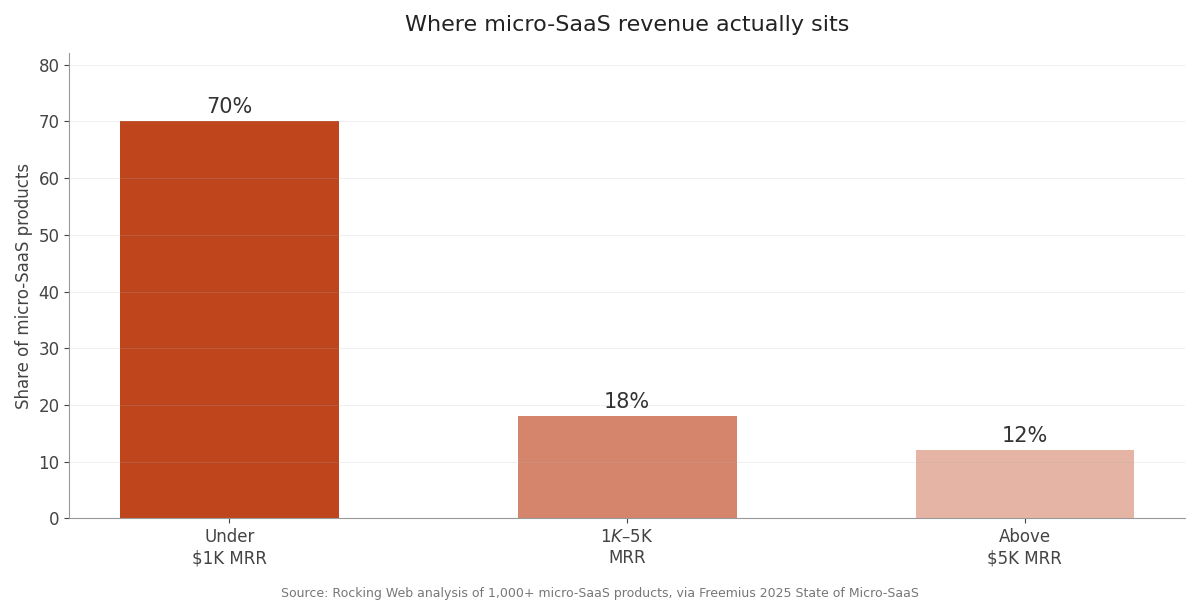
Seventy percent of micro-SaaS products sit under $1,000 MRR, and the median profitable one lands around $4.2K MRR, according to analysis cited in Freemius's 2025 State of Micro-SaaS. The comparison set in your head — the loud, successful, already-quit founders — is the top few percent of a very long tail. Measuring yourself against the tip of a distribution and concluding you're failing is a category error, and I've done it approximately every month I've been at this. I wrote about where that leads in the week I almost gave up.
You will feel dishonest at work. Not because you're doing anything wrong — you can build on your own time with your own equipment and be completely above board — but because you're carrying a whole second life into standup every morning and not mentioning it. That splitting is tiring in a way that doesn't show up on any schedule.
You will get tired of the question. "So when are you going to do this full-time?" People ask it kindly. It lands like a performance review. Having a written trigger helps here too: the answer becomes "when it hits $X for three months," which is a fact rather than a confession.
And the one nobody admits: the job might be the thing keeping the project good. A salary means you can say no to the wrong customer, hold your price, and refuse the feature that would take the product somewhere you don't want to go. Founders who quit before revenue often end up doing consulting to survive, and the consulting eats the hours they quit to get. The job you're desperate to leave may be a better funding source than the freelance work that replaces it.
None of this argues for staying forever. It argues for choosing on purpose rather than on exhaustion — which is what I got wrong more than once, and what I've come to think is the actual skill. I've written elsewhere about what six months of shipping Coding Capybaras taught me, and the throughline is the same: the decisions that held up were the ones I made on a good day, in advance, about a bad day.
Frequently asked questions
How much runway do I need before I quit my job for SaaS?
The common guidance in the bootstrapped community is 12 to 18 months of real expenses — real meaning your current spend plus individual health insurance, self-employment tax, and a buffer for being wrong about the timeline. If you have paying customers covering part of your burn, you can reasonably run thinner, but not much.
Should I quit when I hit ramen profitability?
Ramen profitability — revenue covering your bare minimum living costs — is a defensible trigger if the revenue is stable and growing, not if it's one customer or one launch spike. Ask whether the number would survive losing your largest account. If not, it's not a floor, it's a coincidence.
Is building part-time just a slower version of the same path?
Mostly yes, with one real cost: compressed time crowds out strategic thinking before it crowds out shipping. You'll keep building, but you'll spend less time questioning what you're building. Guard a little unstructured thinking time deliberately, because it won't happen on its own.
What if I never hit my trigger?
Then the date trigger fires and you decide with clear eyes: extend it with a specific reason, change the product, or stop. Stopping is a legitimate outcome and it isn't a verdict on you. The failure mode is neither — the project that stays half-alive for four years because nobody ever set a date to look at it honestly.
Does AI change the math on quitting?
It changes the build cost, not the demand risk. AI tools mean a solo founder can ship what used to need a small team, which shortens the time to launch. It does nothing about whether anyone wants the product, and that's the risk your runway is actually paying for.
Choose on a good day
Whether to quit your job for a SaaS side project is two questions wearing one coat. The financial one has a real answer: run the honest burn number, add the lines your employer has been quietly covering, and don't go until you have enough room to be wrong about the timeline. The emotional one has no clean answer, only a method — decide the conditions in advance, while you're calm, and then let the conditions decide instead of your worst Tuesday.
I'm still on the side-project side of that line as I write this, which is exactly why I wanted to write it down now rather than later, from the other side, with the edges sanded off.
I write about this stuff on the Coding Capybaras blog most weeks — the boilerplate itself is free if you want to see what I've actually been building on those ten hours.