Founder-Led Customer Support: Lessons From the Queue
What running founder-led customer support taught me about indie SaaS: what to automate, what to handle yourself, and why early tickets are your best product research.
· Justin Boggs

Photo by Petr Macháček on Unsplash
Founder-led customer support means answering your own tickets in the early days instead of outsourcing them to a tool or a hire — and for an indie SaaS, it's not a chore to survive but the single richest source of product insight you'll ever have. The lesson I keep relearning: do support by hand for far longer than feels efficient, automate only the parts that are genuinely repetitive, and never automate away the conversation itself. Every ticket is a customer telling you exactly where your product, your docs, or your positioning is broken. That signal is worth more than any analytics dashboard, and it's free.
TL;DR
- Answer your own support tickets in the early days; it's product research disguised as customer service.
- Automate the repetitive scaffolding (templates, FAQs, routing) but keep the human reply human.
- Speak as "I," not the "Royal We" — being a real solo founder is an advantage, not something to hide.
- The follow-up ping ("still working on it") is where adequate support becomes loyalty.
- Set a daily time cap so support doesn't eat the product work that keeps the business alive.
Why founders should do support themselves (for longer than feels comfortable)
The instinct, the moment tickets start arriving, is to make them someone else's problem — a chatbot, a help desk tool, eventually a hire. Resist it. The best-known argument for doing the unscalable work yourself comes from Paul Graham's 2013 essay Do Things That Don't Scale, which reshaped how a generation of founders thought about early growth. Graham's point: at the start, you should do things "in a sort of handmade, artisanal, painstaking way" that you know won't work at a thousand customers — because it's precisely that hands-on effort that gets you to a thousand customers.
His examples are famous now. Stripe's founders didn't email prospects a signup link; they sat down and integrated the payments themselves. Airbnb's founders flew to New York to photograph hosts' apartments by hand. These weren't scalable tactics. They were how the founders learned what the product actually needed.
Support is the same move. When you answer a ticket yourself, you don't just resolve one customer's problem — you find out that your onboarding has a confusing step, that a feature everyone assumes exists doesn't, that your pricing page says something people misread. I've fixed more of Coding Capybaras from support threads than from any roadmap planning session. The customer who writes in frustrated is doing your QA for free.
There's a counterintuitive truth buried in this. As Tyler Tringas put it in his widely-shared piece on customer support for solo founders, your worst customer isn't the one emailing you every day for two weeks. It's the one who signs up, hits a wall silently, cancels, and never says a word. The person taking the time to complain has a vested interest in your product working. They're the ones you can still save — and some of Tringas's most loyal, longest-tenured customers were people who hit a nasty bug early and stuck around while he fixed it. Founder-led support is how you earn that.
What to automate, and what to never touch
Doing support yourself doesn't mean doing everything by hand. The skill is knowing which parts are genuinely repetitive scaffolding and which parts are the actual relationship. Automate the first; protect the second.
Automate the scaffolding. If you're typing the same install instructions for the fifth time, that's a template. Tringas's honest advice for a one-person team is almost anti-tool: for the first several months, a plain help@yourapp.com inbox plus a text-expansion tool for canned answers gets you "95% of the value of a help desk app without any of the overhead." Save a one-to-two-sentence explanation plus a link to a docs page as a snippet, and blast through common questions in seconds. A simple FAQ or knowledge-base page does double duty: it deflects tickets and gives you something to link.
Modern AI makes this scaffolding even cheaper. The 2025 SaaS Capital survey found that 69% of SaaS teams now use AI to eliminate operational bottlenecks, and customer support — first-line replies, ticket routing, summarizing long threads — is one of the most common uses. Drafting a reply with AI and then editing it in your own voice is a legitimate speed-up. Having AI auto-summarize a rambling three-paragraph ticket into "user can't find the export button" saves real time.
Never automate the conversation. Here's the line I won't cross: the customer should never feel like they're talking to a wall. A fully automated support experience — bot answers a bot-shaped question, closes the ticket, no human ever reads it — throws away the exact signal that makes founder-led support valuable. Use AI to draft, summarize, and route. Don't use it to replace you reading what your customers say. The moment you stop reading tickets, you go blind to your own product.
The practical test: automation should reduce your typing, not your attention. If a tool is saving you keystrokes, keep it. If it's saving you from knowing what's wrong with your product, kill it. My fuller rundown of the actual tool stack is in customer support tools for solo founders.
The tactics that turn support into loyalty
Once you've decided to answer your own tickets, a handful of small habits separate support that merely retains customers from support that turns them into people who recommend you. Most of these I learned by getting them wrong first.
Drop the Royal We. Early on I wrote "we're working on that for you" — as if there were a team. There wasn't. Tringas made the same mistake and reached the same fix: use "I," and be exactly what you are. Customers respond better to a real solo founder, not worse. Some will choose you specifically because they'd rather support an independent maker than a faceless company. Your smallness is a feature. Don't hide it behind a fake support desk.
Send the follow-up ping. This is the highest-leverage habit in the whole list. When several customers hit the same bug and you know the fix will take a day or two, the instinct is to go heads-down, fix it, and return triumphant. Don't. Email them first to say you got the message and you're on it. If it drags, ping again: "haven't forgotten you, still working on it." Silence is what customers hate — not slowness.
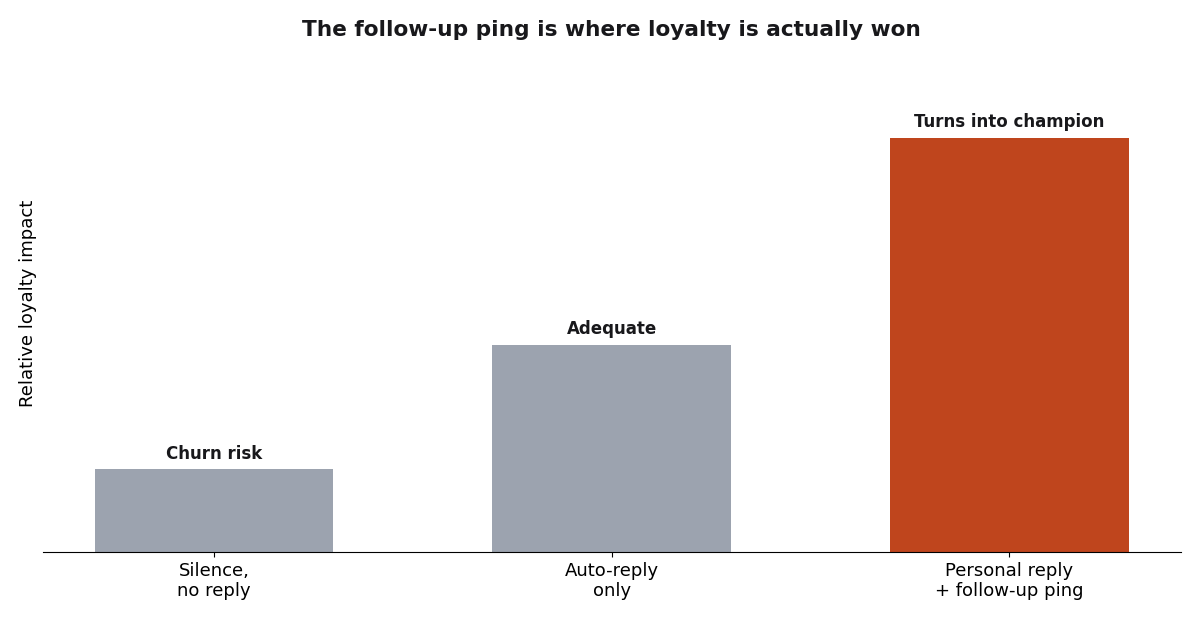
That follow-up ping is the difference between adequate support that retains most customers and excellent support that creates champions. It costs thirty seconds.
Do it, don't just show it. Email is a terrible medium for "click the gear icon, then…" One of the most valuable features to build right after your MVP is a safe admin login that lets you see what the customer sees. When someone's stuck, fix it for them, then explain how for next time. A marked-up screenshot or a 60-second screen recording beats three paragraphs of instructions and is reusable. (If you build that impersonation feature, gate it carefully — I cover the access-control side in building an internal admin dashboard.)
Apologize early and empathetically, even on the fifteenth email. Staying calm and saying "I'm sorry, I can see how that's frustrating" defuses almost everything. It's cheap and it works.
Staying sane so support doesn't eat the business
Founder-led support has a failure mode: you wake up, spend sixteen hours clearing the queue, have nothing left for product, and do it again tomorrow. That's not sustainable, and a queue you can't fully clear is actually a good sign — it means people care about your product. The goal isn't zero tickets. It's a system that keeps support from swallowing everything else.
Three rules keep me functional:
- Set a daily time cap on support, then switch to product. Do product work first, when your focus is fresh, and open the support queue in the afternoon. Being proactive on product beats being purely reactive on tickets. If you spend every waking hour reacting, the business stops moving forward.
- Answer newest-first. Tringas calls this "Last In, Last Answered," and it's counterintuitive but right: customers who fired off a question an hour ago have often since figured it out themselves. Clearing the freshest tickets first means you skip questions that already resolved on their own.
- Remember you can only do your best. A deluge feels like failure; it's usually traction. Remind yourself — and, when honest, remind the customer — that you're one person doing your genuine best. Most people respond to that with patience.
There's a real transition point ahead, too. Founder-led support is a phase, not forever. As volume grows you'll templatize more, then eventually bring in help. But the instinct that serves you is to make that handoff late rather than early, and to keep reading a sample of tickets yourself even after you hire — because the day you fully delegate support is the day you lose your clearest line to what customers actually experience. I've written about how close I came to walking away from all of this in the week I almost gave up; support, oddly, was part of what pulled me back — every solved ticket was proof someone cared.
Reading tickets as product signal, not just problems
The habit that changes everything is learning to read a support queue as a ranked list of what to fix, not a list of fires to put out. Every ticket is data. Handled one at a time, they're annoying. Read in aggregate, they're a roadmap you didn't have to build.
The practical move is to tag tickets by root cause as you answer them. Not elaborate categories — just enough to spot a pattern. When I started tagging Coding Capybaras tickets, a few clusters jumped out immediately. A run of "how do I connect Stripe" messages wasn't a support problem; it was a docs problem, and a better onboarding step killed most of them. A cluster of "does it do X" questions where X did exist told me the feature was buried, which is a UX problem masquerading as support volume. And the tickets I couldn't answer without logging in myself pointed straight at the parts of the product that weren't self-explanatory.
Here's the reframe that took me too long to internalize: a recurring ticket is a recurring bug, even when nothing is technically broken. If ten people ask the same question, the product failed to answer it ten times. The fix usually isn't a better canned reply — it's a change to the product, the docs, or the copy so the question stops arriving. Answering the ticket resolves one customer. Fixing the cause resolves everyone who would have asked next.
This is also where founder-led support pays for itself against the "just hire someone" instinct. A support hire optimizes for closing tickets fast. A founder reading the same tickets optimizes for making them stop happening — because the founder is the one who can change the product. That feedback loop only works while you're close enough to the queue to feel the patterns. It's the same reason I keep pushing people toward doing this by hand: the insight-per-ticket is highest exactly when you're least tempted to preserve it.
One warning: don't over-rotate on a single loud customer. One person demanding a feature is an anecdote; ten people tripping on the same step is a signal. The discipline is telling the difference — and tagging is how you keep yourself honest instead of building whatever the most recent angry email asked for.
Frequently asked questions
When should a solo founder stop doing support themselves?
Later than you'd think. Keep doing it yourself while the product is still changing fast, because that's when ticket-driven insight is most valuable. Start templatizing and deflecting with docs as volume grows, and only bring in help once support is consistently crowding out product work you can't afford to skip. Even then, keep reading a sample of tickets personally — you never want to go fully blind to the customer's experience.
What support tools does an indie SaaS actually need at the start?
Almost none. A dedicated help@ inbox and a text-expansion tool for canned replies covers a one-person team for months. Add a simple FAQ or knowledge-base page to deflect repeat questions. Full help-desk platforms like Zendesk or Intercom are usually overkill until you have a team sharing an inbox — adopt them when coordination, not typing speed, becomes the bottleneck.
How do I use AI for support without making it feel robotic?
Use AI as a drafting and triage assistant, not as the face of your support. Let it draft a first-pass reply, summarize long tickets, and route or tag incoming messages — then edit every customer-facing reply into your own voice before it goes out. The rule is that AI reduces your typing, never your attention. If customers can tell they're talking to a bot that never reaches a human, you've automated away the thing that made founder-led support worth doing.
How fast do I need to respond to support tickets?
Speed matters less than acknowledgment. A quick "I got this, looking into it now" beats a perfect answer that arrives in silence two days later. Set an honest expectation — even "I'm a solo founder, I reply within one business day" — and then hit it. The follow-up ping while a fix is in progress does more for loyalty than raw response time.
Does founder-led support actually reduce churn?
It can, dramatically, because it converts frustration into loyalty. Customers who have a great support experience during a rough patch often become more loyal than customers who never had a problem at all. Tringas ran a micro-SaaS with churn hovering around 1% while doing his own support. The mechanism is simple: personal, responsive support signals that a real human is invested in your success, and that's hard to churn away from. It also compounds — a customer you saved during a bad week is disproportionately likely to refer you, because they have a story to tell about the time a real founder actually helped them.
The takeaway
Founder-led support isn't a stage to rush through on your way to a "real" support team. It's the phase where you learn your product's true failure points from the people living them. Automate the repetitive scaffolding, keep the conversation human, send the follow-up ping, and cap your hours so the queue doesn't consume the product work that matters. Do that, and support stops being the cost of having customers and becomes the reason you keep them.
If you're building an indie SaaS and want a foundation with support-friendly plumbing — lifecycle email, an admin view, and audit logging — already wired in, Coding Capybaras is the free boilerplate I built for exactly this kind of hands-on, one-person operation.