The Maker's Loneliness: Building a SaaS Solo
Solo founder loneliness is the quiet cost of building a SaaS alone. What the research says, why it hits non-tech founders harder, and what actually helps.
· Justin Boggs

Photo by Sasha Freemind on Unsplash
Solo founder loneliness is the gap between how connected your work looks from the outside and how alone it feels from the inside. You ship in public, you reply to customers, you post on X, and your calendar looks busy. But there's no one in the building who carries the thing with you. The decisions are yours, the dread is yours, and the wins land in an empty room. This isn't a character flaw or a sign you picked the wrong path. It's a structural feature of building something alone, and naming it accurately is the first step to handling it without letting it run the company.
TL;DR
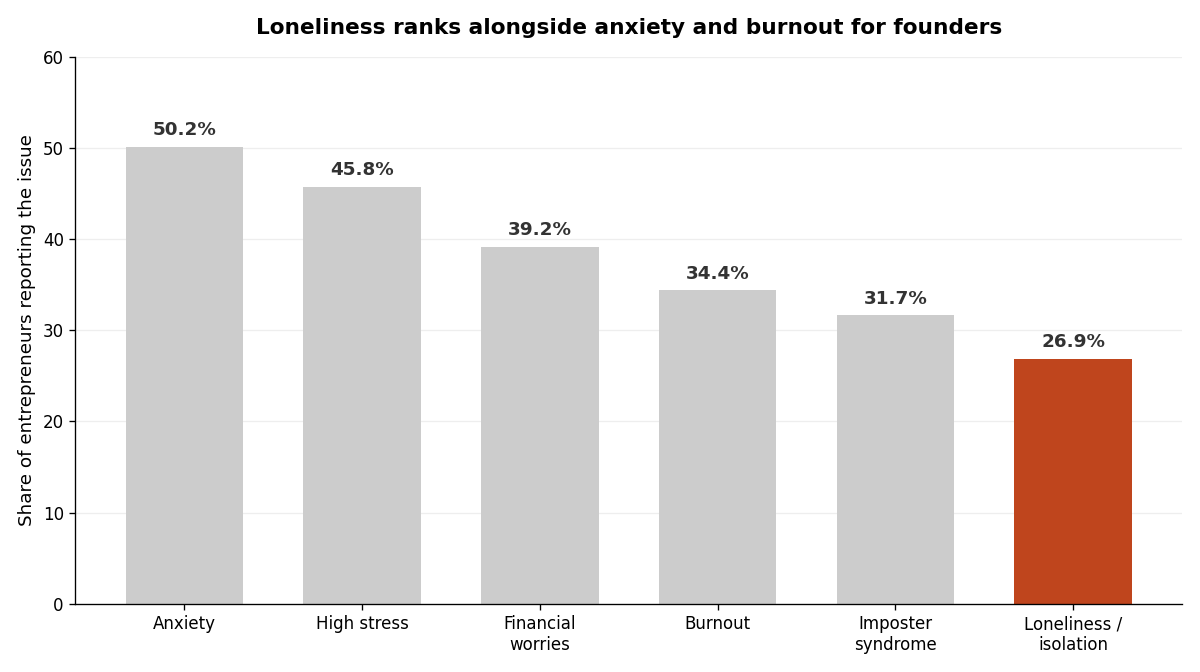
- Loneliness is one of the most common and least-discussed founder problems: in one survey of 227 entrepreneurs, 26.9% named loneliness or isolation as a struggle, and it skewed younger.
- It's not just "in your head." A 2025 WHO commission estimates 1 in 6 people worldwide experience loneliness, with real health consequences.
- Non-tech founders get a specific version: you can't even vent to a co-founder about the code, because there is no co-founder and you didn't write the code.
- What helps isn't "network more." It's a small set of structural habits: a peer or two who get it, customer contact as connection, and separating the feeling from the business decision.
What solo founder loneliness actually is
Solo founder loneliness is the chronic sense of carrying full responsibility for something nobody else is inside of. It's not the same as being an introvert, and it's not cured by being around people. You can feel it in a coworking space surrounded by other founders. The defining feature is responsibility without a peer — every call routes back to you, and there's no one whose stake in the outcome matches yours.
That matters because the usual advice ("get out more," "join a community") treats loneliness as a social-volume problem. For founders it's usually a social-depth problem. You have plenty of contacts. What you're missing is someone who can hold the specific weight of your situation: the runway math, the feature you're not sure about, the customer who churned and took your confidence with them.
I felt this most sharply in the months building Coding Capybaras. I'd have a genuinely hard day — a payment bug in production, a launch that underperformed — and realize there was no one to debrief with who had skin in the game. My partner could listen. My friends could sympathize. But nobody else woke up the next morning owning the problem with me. The work was connecting me to customers and strangers online while quietly isolating me from anyone who shared the load.
The loneliness also has a time signature. It's worst in two moments: right after a setback, when you most want a teammate to absorb some of the hit, and right after a win, when you want someone to actually understand why it mattered. Telling people "I made my first sale" gets a nice reaction. It rarely gets the reaction that lands, because the months of context that made that sale meaningful live only in your head.
What the research says (and why it's not just you)
Two findings reframed this for me, so I want to give them with sources rather than vibes.
First, it's common and under-reported. A 2025 survey of 227 entrepreneurs across 46 countries by Founder Reports found that 26.9% named loneliness or isolation as a mental-health struggle — putting it in the same tier as burnout (34.4%) and imposter syndrome (31.7%). The same survey found loneliness skewed younger: 30.7% of founders 34 and under reported it, versus 21.2% of those 35 and over. Notably, only 18.5% of respondents were even aware of mental-health resources built for entrepreneurs. The problem is widespread, and most people facing it think they're facing it alone — which is its own grim joke.
Second, the broader stakes are real. A 2025 World Health Organization commission on social connection reported that roughly 1 in 6 people worldwide experience loneliness, and connected it to serious health outcomes rather than treating it as a soft, vague mood. You don't need to catastrophize your own situation to take the signal seriously: chronic isolation is a health input, not a personality quirk, and founders have a structurally high dose of it.
There's also a darker cluster of founder-specific data worth knowing. As StartupNation reported, a widely cited Startup Snapshot study found that 72% of founders reported their venture had affected their mental health, and the large majority weren't talking about it. The loneliness isn't separate from the stress, the anxiety, and the money pressure — it's the multiplier on all of them. A hard week is harder when there's no one to split it with.
I'm careful with this data for a reason. None of it says solo founding is a mistake, and none of it is a diagnosis. It says the feeling you have is a normal response to an abnormal amount of solo responsibility. That's strangely freeing. If isolation is built into the structure, then the fix is also structural — not "be tougher," but "change the structure a little."
Why non-tech founders get a specific version
If you're a non-technical founder building with AI tools, the loneliness has an extra wrinkle. The core artifact of your business — the code — is something you work with through an interpreter. So even the one outlet other founders have (talking shop about the build) is muffled.
A technical co-founder team can sit at a whiteboard and argue about schema design. That argument is connection. It's two people who both fully understand the thing, disagreeing about how to make it better. As a solo non-tech founder, my "co-founder" for the build is an AI assistant. It's genuinely useful — I've written about treating it like a pair-programming partner — but it doesn't worry about the company at 2am, and it doesn't celebrate. It resets every session.
This stacks on top of non-tech founder syndrome, the persistent feeling that you're not a "real" technical founder. Loneliness and that imposter feeling feed each other. The imposter voice says you can't talk to engineers, you'll be found out. The loneliness says there's no one to talk to anyway. Together they build a small prison where you stop reaching out precisely when reaching out would help most.
The honest part: AI tools made it possible for me to build at all, and they made the isolation slightly worse at the same time. I have fewer reasons to need another human in the build loop, which means fewer of the incidental relationships that used to come with making software. That's a real tradeoff of this era of solo building, and pretending it away doesn't help anyone. Recognizing it lets you deliberately add back the human contact the workflow no longer forces on you.
What actually helps (and what doesn't)
Here's what I've found moves the needle, ranked roughly by impact. None of it is "hustle harder."
Find one or two peers who get the exact thing. Not a 5,000-person Slack. One or two founders at a similar stage, building similar things, who you talk to honestly and regularly. The value is depth, not volume. A single peer who's also debugging Stripe webhooks and wondering if their launch flopped is worth more than a hundred LinkedIn connections. I treat these relationships as infrastructure, not nice-to-haves.
Use customer contact as connection, not just support. Paul Graham's "Do Things That Don't Scale" is usually read as growth advice, but it doubles as loneliness advice: talking directly to your earliest users is some of the best human contact the job offers. Real conversations with people who use your product remind you the work connects to other humans. When I'm isolated, an hour of customer conversations does more for my head than an hour of scrolling founder X.
Separate the feeling from the decision. Loneliness lies about the business. After a flat week it whispers this isn't working, you're alone because the idea is bad. That's the feeling talking, not the data. I keep the two on separate tracks: I let myself feel the isolation, and I evaluate the business on its actual numbers, which is exactly what a first-month metrics dashboard is for. The dashboard doesn't care how lonely Tuesday was.
Ship on a cadence, in public, with a witness. Building in public gives the work an audience, and an audience is a mild antidote to the empty-room problem. It's not a substitute for real peers, but a few people watching you ship — even loosely — reduces the sense that you're shouting into a void.
What doesn't help: generic "self-care" advice divorced from the actual problem, performative networking that produces contacts but no depth, and pretending the loneliness is a weakness to hide. The Founder Reports data is blunt about that last one — most founders suffer this silently, and silence is what makes it compound.
How I run a company without out-running it
I've stopped trying to eliminate the loneliness and started managing it like any other recurring cost. The goal isn't to never feel alone; it's to keep the feeling from making decisions.
My actual practice is small. A standing weekly call with one founder friend. A habit of replying to customers like they're people, not tickets. A rule that I don't make strategy calls on my worst days — I write the feeling down and revisit the decision when my head is clearer. And a deliberate effort to share the work publicly so the wins have at least a few witnesses. None of it is heroic. All of it is repeatable.
I also try to remember the loneliness is partly a sign I'm doing something that matters to me. The reason it stings to win in an empty room is that the win is real and I care. That's not nothing. The same intensity that makes solo founding isolating is the intensity that makes it worth doing. I'd rather feel the full weight of something I chose than be comfortably disengaged from something I don't care about.
If you're feeling this right now, I want to be clear about one thing: it's common, it's structural, and it is not evidence that you're failing. The shipping record is the evidence. The loneliness is just the tax.
Frequently asked questions
Is solo founder loneliness a sign I should find a co-founder?
Not necessarily. A co-founder can reduce isolation, but a bad co-founder fit creates worse problems than loneliness. If you're solo by choice or circumstance, the better fix is usually a small set of peer relationships plus regular customer contact — the connection without the equity entanglement. Decide on a co-founder based on complementary skills and trust, not loneliness alone.
Does building with AI tools make the isolation worse?
It can. AI assistants remove a lot of the incidental human contact that used to come with building software, so a non-tech solo founder may have fewer natural reasons to talk to other people during the build. The tools are genuinely enabling, but the tradeoff is real — you have to deliberately add back the human contact the workflow no longer forces on you.
How is founder loneliness different from regular loneliness?
The defining feature is responsibility without a peer. It's not about how many people are around you; it's about whether anyone shares the actual weight of the company. That's why being in a room full of people, or even other founders, doesn't automatically fix it. The missing piece is depth and shared stakes, not social volume.
What's the single most effective thing I can do about it?
Find one or two founders at a similar stage and talk to them honestly and regularly. Depth beats volume every time. One real peer relationship does more than any large community, conference, or networking push, because it provides the shared-context connection that the work itself strips away.
Is it normal to feel lonely even when the business is going well?
Yes, and it's one of the more disorienting versions. Wins can intensify loneliness because there's no one who fully understands why the win mattered — the months of context live only in your head. The feeling isn't a verdict on the business. It's a normal byproduct of carrying meaningful work alone.
The work is worth the weight
Solo founder loneliness is real, common, and mostly structural — and you can run a healthy company alongside it without waiting for it to disappear. The research is clear that you're not uniquely broken for feeling it, and the practical fixes are small and repeatable: a peer or two who get it, customer contact as genuine connection, and a firm line between the feeling and the decision. The loneliness is the tax on building something that matters to you. The building is still worth it.
I write about the unglamorous side of solo founding regularly here on the Coding Capybaras blog — and the boilerplate itself is free if you want to see exactly how a non-tech founder shipped a real SaaS.