Product Hunt Launch Playbook for Non-Tech Founders
A non-tech founder's Product Hunt launch playbook — timing, pre-launch list, hunter strategy, day-of cadence, and the mistakes I'd skip next time.
· Justin Boggs

The Product Hunt launch playbook for a non-tech founder is this: build a small but real pre-launch audience for 30 days, schedule the launch for 12:01 AM Pacific on a Tuesday or Wednesday, ship a tight first comment and a clear demo video, then spend 18 straight hours replying to every comment and DMing your supporters in waves. I launched Coding Capybaras on June 1, 2026 — a Monday — and got roughly half of what a Tuesday slot would have produced. The mistakes were avoidable. Here's the playbook I wish I'd had the week before, written for founders who aren't engineers and don't have a 30,000-follower X account to pull from.
TL;DR
- Launch at 12:01 AM PST on Tuesday or Wednesday. The Product Hunt day runs 24 hours on Pacific time. Mondays and Fridays underperform.
- The first six hours decide your ranking. The algorithm uses early engagement to set the initial leaderboard slot.
- You need a list before you launch. 400–500 people who already said yes is the difference between top-10 and invisible. Don't try to build it on launch day.
- Reply to every comment within 30 minutes for the full day. Comments and maker engagement are now bigger ranking inputs than raw upvotes.
- The maker comment is your most important asset. Write it 48 hours in advance. Tell the founder story; don't list features.
Why Product Hunt still matters in 2026 for indie SaaS
A common take from founders who launched in 2018 is that Product Hunt is dead. It isn't — but it is different. In 2026, raw upvote count carries less weight than it did, and Product Hunt's algorithm now rewards comment volume, maker reply speed, and time-on-page far more than the leaderboard fights of 2019. The community is smaller and noisier, but the buyers who do hang out there are higher-intent.
For a non-tech founder, the realistic value of a Product Hunt launch is three things, in this order. First, it generates a short burst of qualified traffic — typically a few thousand visits if you crack top-10, less if you don't. Second, it creates a permanent backlink and a launch page you can point to in cold outreach forever. Third, it forces you to write the founder story you've been avoiding. The third one is the most valuable.
What it isn't: a viral launch channel. If your only marketing plan is "post on Product Hunt and hope," you'll be disappointed. Treat it as one node in a launch week, not the whole launch.
Justin Jackson made this point years ago about launches and it still holds: the products that win are the ones where the founder has been building an audience for months. The launch is the payoff, not the start.
The 30-day pre-launch: what to actually do
You need to be visible to enough people that 400–500 of them will say "tell me when you launch" before you click ship. For a non-tech founder without a built-in following, here's the realistic 30-day version.
Day -30 to -21: pick a date and a maker account. Your maker account needs to be at least 30 days old before launch — anti-spam rule. Create it now. Choose a target launch day on a Tuesday or Wednesday three to five weeks out, so you have time to actually do the work.
Day -28 to -14: write four short build-in-public posts. One per week on X, LinkedIn, Indie Hackers, or Reddit r/SideProject. Not screenshots of metrics — actual posts about a problem you hit and how you solved it. The goal is to seed the people who'll later vote for you. Generic launch teasers (big launch coming!) don't convert; specific stories do.
Day -14 to -7: build the "upcoming" page. Product Hunt lets you create an upcoming page that collects email subscribers before launch. Get yours up. Share it in every relevant Discord and Slack. The people who subscribe here are your highest-quality early supporters — they explicitly raised their hand.
Day -7 to -2: do the asset work. Hero gallery (1270×760), three to five product GIFs, a 60-second demo video, the maker comment. The video matters more than people realize — it's the thing the algorithm gives a long dwell-time bonus for.
Day -2 to -1: warm up your DMs. Don't blast. Make a list of 80–150 people in your network you've actually had a real conversation with, and send each one a personal message: "Hey, I'm launching X tomorrow at 12:01 AM PT. Would mean a lot if you took a look." That's it. No upvote ask in the DM — Product Hunt's terms forbid that, and the algorithm penalizes it.
I shaved the pre-launch list step on my own launch and got 47 supporters who'd been waiting, not 400. That single decision cost me a top-10 slot.
The day-of cadence: hour-by-hour from 12:01 AM PT
Product Hunt's "day" runs from 12:01 AM Pacific to 11:59 PM Pacific. If you're East Coast that's 3:01 AM. If you're in Europe that's 9:01 AM. Plan for it; don't accidentally launch at noon Eastern and waste your first 11 hours.
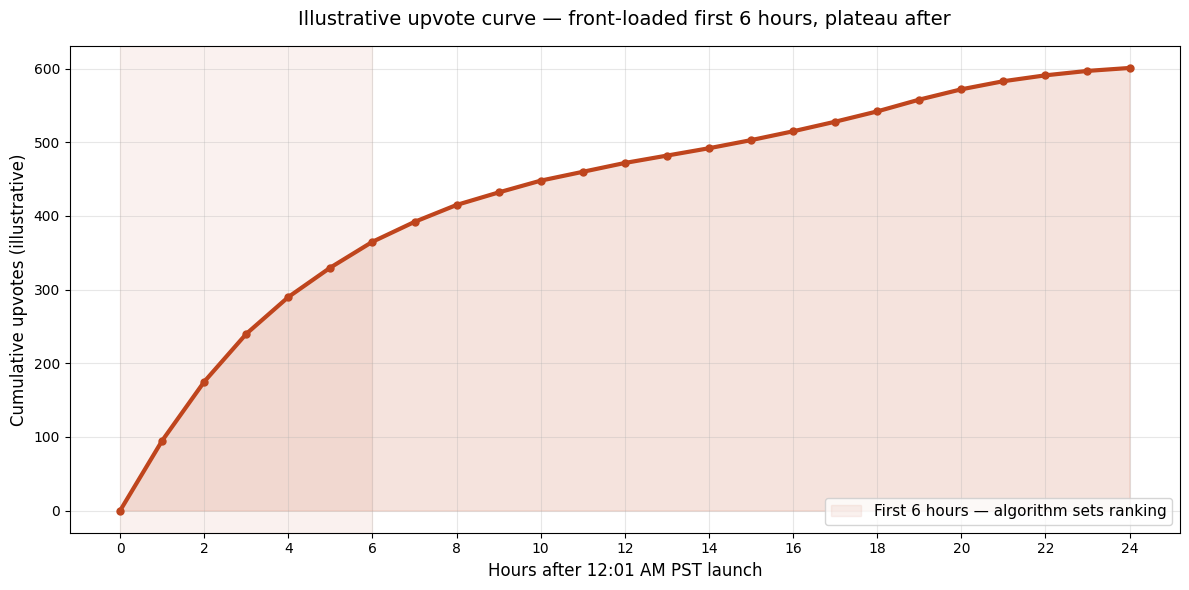
Here's the cadence that worked when it worked, illustrated above. The first six hours are the algorithm window — that's where the initial leaderboard slot gets set. After that, you're defending position, not gaining it. Plan for one continuous 18-hour shift.
12:01 AM PT — ship and post the first comment immediately. The "maker's first comment" is pinned at the top of your page and is the first thing visitors read. It should be three short paragraphs: the problem you saw, what you built, and a single specific question for the reader. Not a sales pitch. People reply when you ask a real question.
12:05 AM to 2:00 AM PT — first batch of DMs. Wave one: your closest 25 supporters who you know will show up. Send the launch link. No upvote ask in writing — just "we're live, would love your eyes on it."
2:00 AM to 6:00 AM PT — sleep four hours. You can't reply to comments at 4 AM and at 4 PM both. Pick a window. Set a wake alarm.
6:00 AM to 9:00 AM PT — second DM wave. This is when the EU is awake. Send the next 60–80 supporters. Reply to every comment that came in overnight. Average reply time matters — aim for under 30 minutes.
9:00 AM to 12:00 PM PT — third DM wave + LinkedIn post. US East Coast is fully online. Post on LinkedIn with the launch link — LinkedIn is one of the highest-ROI channels per hour on launch day. X post too, if you have a real following there. Reddit is hit-or-miss; only post if you're already an active participant in the sub.
12:00 PM to 6:00 PM PT — defend. Reply to every comment. Don't start side projects, don't ship hotfixes, don't go to lunch with a friend. Just sit there and reply. Your fight on the leaderboard happens here. Most products that fade between 11 AM and 5 PM PT do so because the maker stopped engaging.
6:00 PM to 11:59 PM PT — final push and gratitude posts. Asia-Pacific is in their morning. Send the final DM wave to anyone in that region. Reply to every comment from the day. At 11 PM, post a thank-you message — not a victory lap, just a thank-you. It compounds for the next day's secondary traffic.
The day will end. You will be tired. Don't read the leaderboard until tomorrow.
What I'd do differently on my Coding Capybaras launch
I shipped Coding Capybaras' Product Hunt page on Monday, June 1, 2026 at 12:01 AM PT. I picked Monday because I wanted the launch to align with the start of a new month for a clean marketing-narrative beat. That was a vanity decision — Tuesday or Wednesday traffic would have been notably stronger, and the algorithm rewards the day better. The "neat date" framing cost me upvotes I won't recover.
I also under-built the pre-launch list. I had 47 people on the upcoming page when the algorithm checked, not the 400 the playbook calls for. The build-in-public posts I wrote in the four weeks prior were too tutorial-y and not personal enough — they generated traffic to the boilerplate site but not actual saved-the-date subscribers. The lesson there is concrete: if a pre-launch post doesn't end with "save the date" or a subscribe link, it isn't doing the job of a pre-launch post.
The maker comment is the thing I'd write completely differently. I led with the product — "Coding Capybaras is a free SaaS boilerplate for non-tech founders" — when I should have led with the moment. A maker comment that opens with "Three months into trying to ship a SaaS, I realized AI coding tools had moved the bottleneck from 'can I write code' to 'can I navigate the infrastructure' — so I built this" gets more replies than a feature list. The replies are what the algorithm rewards.
The thing that worked: an honest hero video showing the actual journey UX, not a polished marketing spot. The 60-second demo I recorded at 11 PM the night before, off a single take, drove three of the day's highest-engagement comments. People can tell when a demo is real. That's worth more than production value.
Comparing your launch options
A common question I got from other non-tech founders the week of launch: should I do Product Hunt or AppSumo or BetaList or all three? Here's the honest cut.
| Channel | Cost | Time investment | Best for | What you get | | --- | --- | --- | --- | --- | | Product Hunt | Free | 30 days prep + launch day | Audience-building products, dev tools, SaaS | Burst traffic, permanent backlink, founder credibility | | AppSumo | 30% revenue share | Multi-week negotiation | Lifetime-deal-ready products | Cash, but at deep discount and high refund rate | | BetaList | Free or paid tier | Hours | Pre-launch lists and waitlist building | Email signups, no traffic spike | | Hacker News (Show HN) | Free | Hours | Technical-audience products | High-quality replies, sharp critiques, modest traffic | | Indie Hackers | Free | Hours | Founder-narrative content | Trust capital, network, no purchase intent |
For Coding Capybaras specifically, the right move would have been BetaList three weeks before Product Hunt to seed the upcoming list, then Product Hunt as the main event, then Indie Hackers retrospective post two days after. I did Product Hunt cold — that's the mistake.
Worth noting: if you're already deep into a specific community — say you've been an active participant in Hacker News for years or a moderator of a relevant subreddit — your home channel might beat Product Hunt for your specific launch. Indie Hackers founder Courtland Allen has written about this for years: the best launch channel is the one where you've already built trust.
Hunter strategy: do you actually need one in 2026
The "hunter" — someone with high karma who posts your launch on your behalf — used to be a make-or-break factor. In 2026 the math is different. The algorithm doesn't weight a hunter's account power the way it did in 2017. Self-hunted products win all the time now. Marc Lou has self-hunted multiple #1 launches without a "famous" hunter.
That said, a relevant hunter still gives you three things: the credibility of someone known in your niche endorsing the product, a small first-hour bump from their followers, and a network effect if they engage in the comments. The downside: if your hunter posts and then disappears, you look orphaned. The first-comment thread is yours regardless, so the upside is capped.
My rule of thumb for non-tech founders: if you can get a hunter with genuine credibility in your space who'll actually comment and reply during the day, take it. If your only option is paying a hunter you've never spoken to, self-hunt. The risk of an inauthentic relationship is bigger than the upside.
If you want to learn more about getting Claude Code or Cursor wired up before your launch — so you can keep shipping during the launch week without the cognitive load of full-stack debugging — the Claude Code for non-developers guide and the Cursor vs Claude Code comparison cover the workflows that let me ship product changes during launch without breaking anything.
Frequently asked questions
What time should I launch on Product Hunt?
Launch at 12:01 AM Pacific. The Product Hunt day runs on a 24-hour Pacific clock — if you launch at any other time, you're handing the leaderboard a head start. The exception is if you have a strong reason to capture a specific timezone's morning, but most indie SaaS launches are general-audience and Pacific midnight is the right call.
What day of the week is best for a Product Hunt launch?
Tuesday or Wednesday. Monday is for catching up on inboxes and the leaderboard underperforms. Friday and weekends see lower engagement. Thursday is acceptable but slightly worse than Tuesday or Wednesday because the leaderboard reset overlaps with weekend wind-down.
How many upvotes do you need to be #1 of the day on Product Hunt in 2026?
Reports from recent launches suggest roughly 500–1,200 upvotes for #1 of the day, with significant day-to-day variance. The number alone isn't the goal — comment volume, maker reply speed, and time-on-page now weight heavily, so you can lose with 800 upvotes if you're not engaging.
Do I need a famous hunter to launch on Product Hunt?
No. Self-hunted launches win regularly in 2026. A relevant hunter with real engagement can help, but a disengaged "famous" hunter can actually hurt by making your page look unsupported. If you don't have a real hunter relationship, hunt yourself and put your energy into pre-launch list-building and day-of replies.
Should I ship my launch even if my product isn't perfect?
Yes, with a caveat. The version you launch needs to deliver the core promise — if the headline says "free SaaS boilerplate" and the download is broken, you've burned a permanent launch opportunity. But cosmetic bugs, missing features, and rough edges in onboarding are fine. The post-launch comment thread will surface them and you can ship fixes the same day. That's part of the show.
What's the single biggest mistake non-tech founders make on launch day?
Going dark for hours. The algorithm weights maker engagement, and a maker who replies to every comment in under 30 minutes for the full day beats a maker with a bigger network who treats the launch as a fire-and-forget. If you can only do one thing on launch day, be physically present and replying.
Wrapping up
A Product Hunt launch is one day inside a launch week inside a launch quarter. Treating it as the whole strategy is the mistake almost every non-tech founder makes the first time. The playbook above won't make you #1 of the day on its own — what makes you #1 is whether you spent the previous 30 days building the audience that shows up when you ship. The launch itself is the visible part of work you did weeks earlier.
If you're shipping a SaaS with AI coding tools and want a starting point that handles auth, billing, and email so you can spend launch week on customers instead of webhooks, Coding Capybaras is the free boilerplate I built specifically for this workflow. Same stack that powers this site. Same playbook that ran the launch above — including the parts I got wrong.