Sleep, Ship, Repeat: The Unglamorous Truth of Indie SaaS
The indie SaaS reality most founders never post about: slow revenue, repetitive days, and the quiet grind behind every overnight-success story.
· Justin Boggs

Photo by Vitaly Gariev on Unsplash
The indie SaaS reality is that most days look nothing like the launch-day screenshots. There is no confetti, no viral thread, no MRR chart bending toward the sky. There is a support email you answer before coffee, a bug you half-understand, a marketing task you keep postponing, and a slow trickle of numbers that don't move much week to week. The work is repetitive, the feedback loop is long, and the wins are small enough that you'd miss them if you weren't paying attention. That's not a sign you're failing. That's the job. Sleep, ship, repeat.
TL;DR
- The public story of indie SaaS is survivorship bias. The private story is a slow, repetitive grind that rarely gets posted.
- The revenue math is humbling: in a large analysis of Stripe-verified indie products, 54% made exactly zero, and half made under ~$169/month.
- The daily reality is maintenance, support, and marketing — not the "building" most founders romanticize before they start.
- What sustains you isn't motivation. It's a repeatable routine dull enough to survive the weeks when nothing works.
- The unglamorous version is the real version. Making peace with it is what lets you keep going long enough to get somewhere.
The version nobody posts
Open any indie-maker feed and you'll see the highlight reel: the $10K MRR month, the acquisition announcement, the launch that hit number one. What you won't see is the eighteen months of flat lines before the good month, or the four abandoned projects that came before the one that worked.
This isn't dishonesty. It's selection. People post wins because wins are postable. A Tuesday where you fixed a webhook, answered three emails, and shipped nothing visible doesn't make a good screenshot. So the median experience — the actual texture of building a small software business — gets edited out of the record entirely.
The numbers make the gap concrete. A widely-cited ScrapingFish analysis of Stripe-verified Indie Hackers products found that 54% made exactly zero in revenue, and that half of all listed projects made under roughly $169 a month. The same data set discussed on Indie Hackers shows the winners aren't the norm — they're statistical outliers who dominate the visible conversation precisely because they're rare.
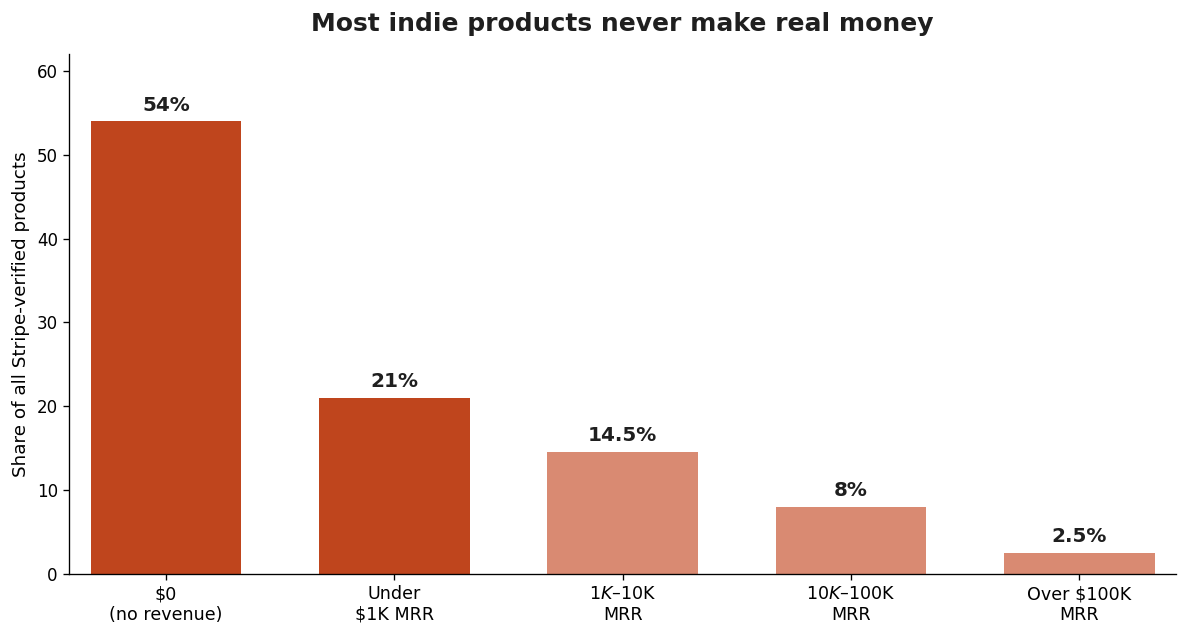
I'm not showing you this to be discouraging. I'm showing it because knowing the shape of the distribution changes how you read your own results. If your product is at a few hundred dollars a month after a year, you are not doing something uniquely wrong. You are in the fat part of the curve with almost everyone else, and the question isn't "why am I failing" — it's "what's the smallest repeatable thing that moves this a little."
What the days actually look like
Before I shipped Coding Capybaras, I pictured founding as building. Long, focused sessions creating features, watching an idea take shape. Some days are that. Most aren't.
A typical day is maintenance and communication. Something broke overnight and needs a look. A customer replied and needs an answer that's honest but doesn't take an hour to write. A marketing task — a blog post, a reply on X, an email to the list — sits on the calendar, and I either do it or feel bad about not doing it. The "building" I romanticized is maybe a quarter of the week, and even that quarter is half debugging things I already built.
The repetition is the part that surprises people. You do not launch a SaaS and then move on to something exciting. You launch it and then you keep it alive, every single day, forever, or until you shut it down. The dashboard doesn't check itself. The payments don't reconcile themselves. The support inbox refills the moment you empty it.
Non-tech founders get a specific flavor of this. When something breaks and I don't fully understand the code, the maintenance work carries a low hum of anxiety that a trained engineer might not feel. I've written about the debugging workflow that keeps that anxiety manageable, but the honest truth is that "manageable" is the goal, not "gone." Some weeks the unglamorous truth is that you're keeping a machine running that you couldn't have built without your AI assistant, and that's fine — but it's a particular kind of tired.
There's also a context-switching tax that nobody warns you about. In a company, support is someone's job, marketing is someone's job, and the code is someone's job. Solo, all three are your job on the same afternoon, and each one wants a different part of your brain. You go from writing a warm reply to a confused customer, to reasoning about a payment edge case, to trying to make a landing-page headline less generic — three completely different modes in ninety minutes. The switching itself is exhausting in a way that pure building never was. By evening you've been busy for eight hours and you'd struggle to name a single thing you "finished," because most of the day was keeping plates spinning rather than stacking anything new.
Why "motivation" is the wrong engine
Everyone starting out asks how to stay motivated. It's the wrong question, because motivation is a feeling, and feelings are exactly what disappear during the flat months. If your ability to keep shipping depends on feeling excited, you will stop the first week nothing works.
What actually sustains the work is routine dull enough to run on autopilot. A schedule you can execute on a bad day. I've described my actual time-blocking system elsewhere, and the point of it isn't productivity theater — it's removing the daily negotiation with myself about whether I feel like working. The block says work happens now, so it happens now, whether or not today is inspiring.
This is the "repeat" in sleep, ship, repeat. Not a grind for its own sake, but a rhythm boring enough to be durable. The founders who make it aren't the most motivated. They're the ones who built a process that keeps producing output even when motivation is at zero.
The trap is treating each day's willingness as a fresh decision. If every morning you re-litigate whether today is the day you feel like doing SEO or answering the boring email, you'll lose that argument often enough to stall. The fix is to decide once — pick the handful of things that actually move the business, put them on a recurring schedule, and then execute them the way you brush your teeth, without a vote. Autopilot gets a bad reputation, but for the repetitive core of a solo business it's the feature, not the bug. The interesting, creative work still happens; it just rides on top of a boring foundation that doesn't depend on how you feel.
Patrick McKenzie, who spent years documenting the reality of running small software businesses, has made a version of this point for over a decade: the compounding comes from showing up consistently on the unglamorous work — support, SEO, small improvements — long after the launch dopamine is gone. The boring consistency is the strategy. It only looks like an overnight success from the outside because the outside never watched the two years of Tuesdays.
The wins are real — they're just quiet
Here's the part that keeps me going, and it's not in the highlight reel either. The wins are real. They're just small and quiet enough that you have to train yourself to notice them.
The first time a stranger paid me $97 without me ever talking to them, I felt it in my chest — and it barely registered as an event to anyone else. A support email that turns into a genuinely nice conversation. A week where churn is zero. A blog post that starts quietly ranking and brings in signups while I sleep. None of these are threads. All of them are the actual reward.
I nearly missed all of it during the week I almost gave up, because I was measuring my progress against the highlight reel instead of against last month. When you compare your Tuesday to someone else's launch day, you lose every time. When you compare this month's boring numbers to last month's boring numbers, you can actually see the slope — and the slope is the whole game.
The imposter feeling never fully leaves, and I've stopped expecting it to. What changed is that I stopped needing the work to feel glamorous to be worth doing. A small, real, boring business that pays for itself and helps a few hundred people is not a consolation prize. For most of us, it's the actual prize, and it's a good one.
Frequently asked questions
Is indie SaaS actually worth it if most founders make so little?
It depends on what you want from it. If you need it to replace a senior developer's salary quickly, the odds are against you — most indie products never get close. If you want a small, owned business that compounds slowly and teaches you an enormous amount, it can absolutely be worth it. Set the expectation to match the data, not the highlight reel.
How long before an indie SaaS makes real money?
Longer than you hope, almost always. Many profitable products took years of consistent work before the revenue became meaningful, and a large share never get there at all. Plan for a long, flat runway and treat any early revenue as confirmation you're pointed the right way, not as the finish line.
How do you stay consistent when nothing is working?
Replace motivation with routine. Build a schedule you can execute on your worst day, then let the schedule — not your mood — decide whether you work. Consistency during the flat months is what separates the founders who eventually get somewhere from the ones who quit during a normal slow patch.
What's the hardest part of solo indie SaaS?
For me it's the combination of full responsibility and no one to share the weight with — the maintenance never stops and every decision routes back to you. The revenue grind is hard, but the psychological grind of carrying it alone is harder. It's worth planning for deliberately, not just gritting through.
Should non-technical founders even attempt this?
Yes, with clear eyes. AI coding tools genuinely lowered the barrier, but they didn't remove the grind — they moved it. You'll spend less time unable to build and more time on maintenance, support, and marketing. If that trade sounds acceptable, the door is more open than it's ever been.
The unglamorous truth is the real one
The reason "sleep, ship, repeat" matters is that it's the honest description of the job. Not the launch, not the viral moment, not the acquisition — the repetition. The founders who last are the ones who make peace with the boring version early, because the boring version is the one that's actually available to you most days.
If you're building a SaaS as a non-technical founder and you want to see how the whole unglamorous machine fits together — the maintenance, the config, the payments plumbing — Coding Capybaras is the free boilerplate I built for exactly this workflow, and this blog is where I keep writing about the parts nobody screenshots.