Newsletter Sponsorship for SaaS on an Indie Budget
How newsletter sponsorship works for indie SaaS: finding the right lists, what placements actually cost, writing ad copy that converts, and measuring it.
· Justin Boggs

Photo by Anna Keibalo on Unsplash
Newsletter sponsorship is paying a writer to run your ad inside an email their audience already opted into. It works at indie budgets for one structural reason: the unit of purchase is a single send, not a monthly minimum. A 5,000-subscriber newsletter in your niche will take $125 to $250 for a primary placement. That is a real, bounded experiment you can run this week and read the result of within 72 hours. It's the closest thing to a paid channel a bootstrapped SaaS can actually afford — but only if you pick the list carefully, write the ad like a recommendation instead of a banner, and instrument the click before you send the money.
TL;DR
- Small niche lists beat big general ones. Paved's own benchmark data shows tightly-defined B2B audiences out-earning much larger lists per subscriber.
- A defensible starting price is 2.5–5% of the list's subscriber count per primary placement. Use it to sanity-check any rate card you're quoted.
- Budget three placements minimum before you judge a list. One send is a coin flip.
- Write short, lead with the benefit, and make the ask frictionless — Paved found signups and downloads outperformed everything else in 2025.
- Instrument with a dedicated UTM and a landing page you can read in isolation, or you will never know whether it worked.
Why newsletter sponsorship works at indie budgets
Most paid channels have a floor. Meta and Google want you spending enough per day for their optimizers to find a pattern, which for a $97 product means weeks of burning money to learn nothing. Newsletter sponsorship has no floor. You buy one send, for one price, on one date. If it doesn't work, you're out $200 and you have a data point.
The channel is also growing in a way that suggests advertisers are getting something out of it. Paved reported that in 2025, publisher earnings on its marketplace grew 30% year over year, total campaigns grew 40%, and advertiser rebooking intent grew 53%. Rebooking is the number I care about. Anyone can buy a first placement. People buy a second one because the first one paid.
Meanwhile the supply side got much bigger. beehiiv's State of Newsletters 2026 report puts 28 billion emails sent through its platform in 2025, reaching more than 255 million unique readers, with open rates above 41%. That's a lot of inventory, and a lot of it belongs to writers with two to ten thousand subscribers who have never sold an ad and will happily talk to you directly.
That last part is the actual indie advantage. The 100,000-subscriber newsletters have media kits, agencies, and four-week lead times. The 4,000-subscriber newsletter written by someone who works in your exact niche has a Twitter DM and a Stripe link. You will get a better audience match, a lower price, and a writer who reads your product before they write the ad.
The tradeoff is honest: this channel does not scale smoothly. You can't turn a dial and 3x your spend. Every incremental placement is a separate negotiation with a separate human, and the good lists in a narrow niche run out fast. Treat newsletter sponsorship as a way to find your first few hundred customers and validate messaging, not as a growth engine you'll still be pulling on at $50k MRR. If you're at the very beginning of that arc, my writeup on getting your first 100 customers as an indie SaaS covers the unpaid channels that should run alongside this one.
How to find newsletters worth paying
Skip the marketplaces on your first pass. Marketplaces are useful for scale, but they optimize for inventory availability, not for the specific overlap between your product and someone's readers. Start with the lists you already read.
Write down every newsletter you personally subscribe to that a customer of yours might also read. For Coding Capybaras that's indie-hacker newsletters, non-technical-founder newsletters, and a couple of AI-tooling roundups. If your list is under five, you have a research problem before you have an advertising problem — go read for two weeks first.
Then apply four filters, in this order:
Audience overlap, not audience size. The question is not "how many people" but "what fraction of these people have my problem right now." A 3,000-person list where 40% are trying to ship a SaaS is worth more than a 50,000-person general-tech list where 2% are. Paved's benchmark data makes this concrete: it found HR, career, and B2B audiences command the highest revenue per subscriber, while some of the largest lists on its marketplace rank near the bottom.
Evidence the writer's recommendations land. Read the last ten issues. Does the writer link to tools with an opinion attached, or just aggregate links? Do readers reply in the comments or the "reply to this email" section? A newsletter where the author says "I switched to X and here's why" has built the kind of trust that transfers to your ad. A link-dump does not.
Ad load. Count sponsorships per issue. Three ads in a 900-word email means your placement is one of three things competing for a skimmer's eye. One ad means the writer is protecting the reader experience, which usually correlates with better performance.
Willingness to talk. Email the writer directly. Ask what they've run before, what performed, and whether they'll share click numbers from a past sponsor. Writers who track this and will tell you are the ones worth buying from. Writers who won't share anything are asking you to buy blind.
You are looking for three to five lists, not thirty. You're going to run each one multiple times, so depth beats breadth.
What newsletter sponsorship actually costs
There is no published rate card for the whole market, but there is a defensible anchor. Paved's guidance to its publishers is to charge 2.5–5% of subscriber count per placement, leaning to the high end when the audience skews toward executives, tech, or finance. That's a publisher-side pricing rule, which makes it useful to you as a buyer: it tells you what a fair ask looks like.
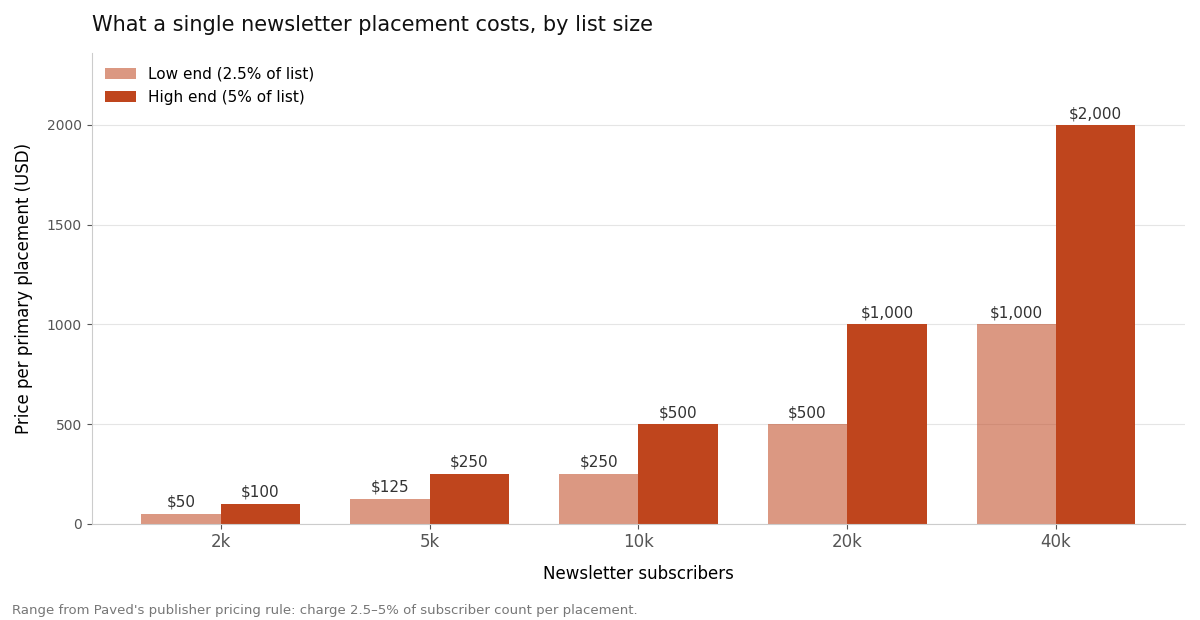
So a 5,000-subscriber list quoting you $200 is inside the band. A 5,000-subscriber list quoting you $900 is asking for a premium they need to justify with click data.
Placement type matters as much as list size. The standard structure has three tiers, and the discount between them is steep:
| Placement | Where it sits | Typical price vs primary | When it's worth buying | | --- | --- | --- | --- | | Primary | Top of the issue | 100% (full rate) | Testing a new list; launches | | Secondary | Mid-content | ~50–65% | Repeat buys on a list that already worked | | Classifieds | Footer / link block | ~25–35% | Cheap persistent presence, low expectations | | Dedicated send | The entire email | 2–5x primary | Only for a real event: launch, major release |
The classifieds tier is where a lot of indie founders should start, and almost nobody does. At 25–35% of the primary rate, a $60 footer link on a well-matched 5,000-person list is not a serious financial decision. Buy four of them across four lists, see which one produces any clicks at all, then buy the primary slot on that one.
Dedicated sends are the trap. They cost 2–5x a primary placement and they feel important, which is exactly why founders overbuy them. A dedicated email is worth it when you have a genuine event — a launch, a price change, a major feature — and worth almost nothing when you're just describing your product at greater length.
One more budgeting rule: plan for at least three placements on any list before you decide whether it works. Newsletter performance varies wildly by issue, by send day, by whatever else was in the reader's inbox that morning. One send is noise. Three sends is a signal. If you can't afford three placements on a list, you can't afford to test that list — pick a cheaper one.
Writing an ad that reads like a recommendation
The best-performing newsletter ads do not look like ads. Paved's review of every 2025 sponsorship on its marketplace, drawn from feedback across more than 1,500 advertisers, found three patterns in the top-rated placements: short copy wins, the benefit shows up in the first line, and clean layouts that blend into the newsletter beat designed banners.
That maps to a structure I've used and would use again:
Line one is the problem, in the reader's words. Not your product category. Not your company name. The thing they were annoyed by yesterday. "You've got a Next.js app and Stripe webhooks that fail silently in production."
Line two is what you do about it, concretely. One sentence, with a specific noun in it. "Coding Capybaras ships a signature-verified webhook handler and the Claude Code prompt to wire it in."
Line three is the frictionless ask. Paved's data was clear here: signups and downloads outperformed everything else, and the easier the ask, the more people completed it. "Free download, no card." Not "book a demo." Not "start your trial." The lower the commitment, the more the ad earns its placement.
Three lines. Maybe a fourth for a proof point if you have a real one. Under 60 words total.
Two things to avoid. Don't send a designed image banner unless the newsletter's format demands one — Paved specifically found that simple image-and-text combinations outperformed polished layouts, and a banner reads as "external advertiser" in a way that plain text does not. And don't write in the newsletter author's voice unless they ask you to; a fake first-person endorsement from a writer who hasn't used your product is the fastest way to burn a relationship with both the writer and their readers.
Write two or three variants and let the writer pick the one that sounds most like their newsletter. They know their readers. You don't, yet.
Measuring it without lying to yourself
This is where most indie newsletter sponsorships fall apart. You send $200, you see a traffic bump, you feel good, and you have learned nothing you can act on. The instrumentation has to exist before the send goes out.
One UTM per placement, not per list. ?utm_source=newslettername&utm_medium=newsletter&utm_campaign=2026-09-primary. Change the campaign value for every single send. When you run the same list three times, you need to be able to tell send one from send three, because the second and third placements on a list often outperform the first — readers recognize you.
Send to a page you can read in isolation. Not your homepage. A homepage's traffic is too noisy to attribute anything to. Either a dedicated landing page or, at minimum, a page whose baseline traffic you know cold. Every one of my analytics setups routes through PostHog for exactly this reason; the PostHog and Next.js analytics walkthrough has the setup if you don't have one.
Measure the second step, not the click. Clicks tell you whether the ad copy worked. Signups tell you whether the audience match worked. Those are different failures with different fixes. A high-click, low-signup placement means you found the right people and made the wrong promise. A low-click placement means the copy died in the inbox, or the audience was never a fit.
Give it a decision rule before you spend. Write down, in advance, what result makes you buy a fourth placement and what result makes you stop. Mine is crude and it works: if three placements on a list haven't produced a single paying customer or 20+ email signups, that list is done. Without the rule written down beforehand, you will rationalize a fourth buy because you liked the newsletter.
The uncomfortable part is that a lot of placements will produce nothing, and you will not always know why. That's the cost of the channel. Budget for the misses the way you budget for the hits — if you can only afford one $200 test, you can't really afford this channel yet, and your time is better spent on the distribution channels that cost time instead of money.
Frequently asked questions
How much should a first-time SaaS advertiser budget for newsletter sponsorship?
Enough for three placements on one list, or one placement each on three lists — roughly $400 to $800 at the 3,000–8,000 subscriber range. Below that, you're buying a single coin flip. If that number is uncomfortable, start with footer classifieds at 25–35% of the primary rate.
Should I use a newsletter marketplace or contact writers directly?
Direct for your first few buys. You get a better price, a real conversation about what's worked before, and often a writer willing to tweak placement or timing. Marketplaces make sense once you know your numbers and want to buy volume without twelve separate email threads.
What's a good click-through rate for a newsletter sponsorship?
There's no honest single number — it varies enormously by placement type, list, and offer, and any specific figure you see quoted is usually one publisher's average presented as an industry standard. Judge a placement against the other placements you've bought, not against a benchmark. That's why the three-send minimum matters.
Is it better to sponsor one big newsletter or several small ones?
Several small ones, when you're starting. Small lists in a tight niche give you better audience match at a price where a miss doesn't hurt, and Paved's benchmark data shows well-defined audiences out-earning much larger general lists per subscriber. You can consolidate onto the winner once you know which one it is.
How far in advance do newsletters book sponsorships?
Small independent newsletters often have slots two to four weeks out; established ones can be booked a quarter ahead. Ask about the calendar in your first email — a list with next-week availability is either new to sponsorships or not in demand, and it's worth knowing which.
Can I negotiate the rate?
On a first buy with a small newsletter, usually yes — especially if you'll commit to three placements up front. Writers value predictable revenue more than a single higher-priced send. Ask for the multi-placement rate rather than haggling on a one-off.
The channel is small, and that's the point
Newsletter sponsorship for indie SaaS is not a scalable growth engine and anyone selling it as one is selling you something. What it is: the only paid channel where a bootstrapped founder can buy a precise, bounded slice of exactly the right audience and read the result in a week. Pick three lists whose readers have your problem. Buy the cheap tier first. Write three lines that lead with the benefit. Instrument the click before you send the money, and write down your stop rule before you get attached to the result.
If you're shipping a SaaS with AI coding tools and want the plumbing already handled — auth, Stripe, email, the webhook handler that verifies signatures — Coding Capybaras is the free boilerplate I built for this workflow.