Reddit as a SaaS Distribution Channel (Without Getting Banned)
How non-tech founders use Reddit to distribute a SaaS without getting banned: which subreddits work, the 9:1 rule, posting cadence, and what gets you removed.
· Justin Boggs

Photo by Annie Spratt on Unsplash
Reddit works as a SaaS distribution channel only if you treat it as a place to be useful first and a place to promote second — and the order is not negotiable. The platform is built to detect and punish people who show up only to sell, and the punishments escalate from a removed post to a community ban to a site-wide shadowban where your posts are invisible to everyone but you. The founders who win on Reddit do the opposite of marketing: they answer questions, share what they learned, and mention their product only when it's genuinely the answer. This guide covers which subreddits are worth your time, the unwritten rules that keep you out of the spam filter, and a cadence you can sustain without becoming the thing Reddit is designed to remove.
TL;DR
- Reddit rewards participation and punishes pure promotion. The order — useful first, promotion second — is the whole game.
- The rule of thumb is 9:1: only about 1 in 10 of your posts should be your own content, per Reddit's own reddiquette.
- Read each subreddit's sidebar rules before posting. Mods set their own self-promotion policies, and they vary wildly.
- Cross-posting the same promo to many subreddits is the fastest way to get flagged and shadowbanned.
- Best results come from answering real questions where your product is the honest answer — not from "I built this" launch posts.
Why Reddit is different from every other channel
Most distribution channels reward volume. Post more on X, send more cold emails, publish more pages — the machine generally pays you for output. Reddit inverts that. It's a network of communities, each with its own moderators, culture, and rules, and the entire system is tuned to spot and reject people who treat it like a billboard.
That tuning isn't an accident. Reddit's reddiquette — the platform's own statement of community values, updated as recently as August 2025 — tells you outright: "Feel free to post links to your own content (within reason). But if that's all you ever post, or it always seems to get voted down, take a good hard look in the mirror — you just might be a spammer." That's not a third-party blog's interpretation. It's Reddit telling you how it thinks about self-promoters.
The upside is real, though, which is why founders keep coming back. A single genuinely helpful comment in the right subreddit can outrank your own landing page in Google for years, drive a steady trickle of qualified signups, and reach exactly the people wrestling with the problem you solve. Reddit threads rank well and get cited by the AI answer engines too, which is part of why I treat it as a long-term SEO and distribution play rather than a launch-day spike.
The mental model that works: you are not marketing on Reddit. You are participating in communities you'd belong to anyway, and occasionally — when it's the honest answer — mentioning the thing you built. If you can't tell the difference between those two postures, Reddit will tell it for you, and you won't like the message.
The 9:1 rule and what actually gets you banned
The single most-cited Reddit guideline is the 9:1 rule, and it comes straight from Reddit's reddiquette: "A widely used rule of thumb is the 9:1 ratio, i.e. only 1 out of every 10 of your submissions should be your own content." Nine parts contribution, one part promotion.
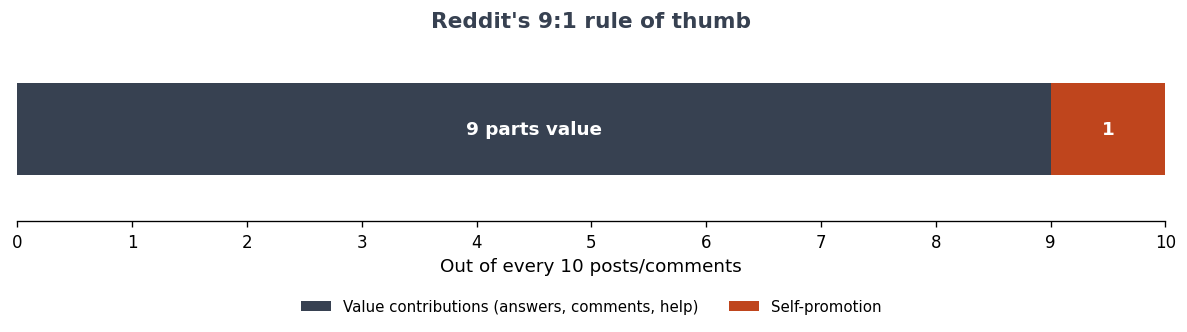
Reddit officially retired the rule as rigid policy because mods found it too mechanical, but the principle survives everywhere because it captures the actual expectation: be a participant, not a promoter. Some communities are looser; some enforce something closer to 99:1, where any whiff of self-promotion in your account history gets your comment pulled. The ratio is a posture, not a quota you game.
Here's what actually triggers removals and bans, ranked roughly by how fast they bite:
| What you do | What happens | | --- | --- | | Post the same promo across many subreddits | Spam filter flags the pattern; mods talk to each other and coordinate removals | | Account that only ever posts your own links | Site-wide spam flag, then shadowban — your posts go invisible to everyone but you | | Ignore a subreddit's stated self-promo rules | Post removed; repeat offenses earn a permanent community ban | | Use link shorteners or hide your destination | Auto-removal; treated as a sneaky-spam signal | | Ask for upvotes or run a "launch" with vote-begging | Admin-level action; reddiquette explicitly forbids it |
That last column isn't speculation. Reddit's reddiquette warns that flooding the new queue with submissions in a short span means "your future submissions may be automatically blocked by the spam filter. Shadow banning … can, and will, take place in more severe cases." The shadowban is the cruelest one because nothing tells you it happened — you keep posting into a void while your account quietly accrues zero engagement.
The defense is simple and boring: build a real account. Comment, vote, answer questions, and accumulate a history that looks like a person who belongs there. An account with months of genuine participation can mention a product and survive; a week-old account whose first three posts are launch links is spam by definition, and the filter treats it accordingly.
Which subreddits are worth a founder's time
Not all communities tolerate self-promotion equally, and matching your post to the right subreddit is half the battle. Read the sidebar rules before you post anything — reddiquette's first instruction is literally "Read the rules of a community before making a submission." Here's how the founder-relevant communities generally break down.
| Subreddit | Best for | Self-promo tolerance | | --- | --- | --- | | r/SideProject | Showing what you built, early feedback | High — maker culture, "I built this" is welcome | | r/SaaS | Honest operator talk, lessons, milestones | Medium — value-first, closely moderated | | r/indiehackers | Build-in-public updates, revenue stories | Medium — numbers and candor reward you | | r/Entrepreneur | Broad business discussion, problem threads | Low — heavy mod presence, promo gets pulled | | r/startups | Startup strategy, "feedback Friday" style threads | Low — strict, designated promo threads only |
r/SideProject is the most forgiving home for a straight "here's the thing I made" post, because the community exists to celebrate making things. r/SaaS rewards founders who talk openly about what's working and what isn't — a post about how you solved a specific operational problem will land far better than an ad. The larger general communities like r/Entrepreneur and r/startups have the biggest audiences and the least patience for promotion; treat those as places to answer questions and contribute, not to launch.
The highest-converting move on Reddit isn't a post at all. It's the comment. Find threads where someone is describing the exact problem your product solves, write a genuinely useful answer, and — only if it's truly relevant — note that you built a tool for this. That comment reaches someone with active buying intent, it's defensible because it's actually helpful, and it sidesteps the "is this a promo post" scrutiny entirely. This is the same patient, channel-by-channel approach I described in getting your first 100 customers: the slow, useful contributions compound while the spray-and-pray launches flame out.
How to write a post that doesn't read like an ad
The mechanics of the post itself matter as much as where you put it. Reddit users have a finely tuned radar for marketing copy, and the moment a post smells like a press release, the downvotes start and the comments turn hostile. A few habits keep your writing on the right side of that line.
Write a plain, factual title. Reddiquette explicitly asks you to keep titles "factual and opinion free" and warns against editorializing or sensationalizing. "I spent six months building a tool to fix X and here's what I learned" reads like a person; "The ultimate solution to X is finally here" reads like an ad and dies on arrival. The title is the single biggest signal of whether you're a contributor or a marketer, and you only get one shot at it — Reddit won't let you edit a title after posting.
Lead with the story or the lesson, not the product. The posts that do well open with a real problem, a real number, or a real mistake, and only mention the product partway through as context. If someone reads your whole post and learns something useful even if they never click your link, you've written it correctly. If the only takeaway is "this product exists," you've written an ad.
Be transparent that it's yours. Reddit forgives self-promotion far more readily when you're upfront about it. A simple "full disclosure, I built this" disarms the suspicion that you're a sockpuppet pretending to be a happy customer — which is the thing the community actually hates. Hiding the connection is what gets accounts flagged; owning it is what earns goodwill.
Link to the original source, not a tracking page. Reddiquette's guidance to "look for the original source of content" and avoid link shorteners applies directly: link to a real, canonical page, never a shortened or obviously instrumented URL. The community reads link-hiding as a tell for spam, and so does the filter. The same honest, build-in-public posture that works here works across every founder channel, which is why I lean on it in my Product Hunt launch playbook too — transparency travels well.
A posting cadence you can sustain
The founders who get value from Reddit aren't grinding it daily. They're showing up consistently in a few communities and letting a real account build over time. Here's a cadence that works without tipping into spam territory.
Spend your first two to four weeks posting nothing promotional at all. Subscribe to three or four relevant subreddits, read them daily, and comment where you have something useful to add. You're learning each community's norms and building the account history that makes everything later possible. This feels slow because it is — and it's the step most founders skip, which is why most founders get banned.
Once you've earned a little standing, aim for roughly the 9:1 balance over time. For every promotional mention, you should have nine genuinely useful contributions behind it. In practice that means most of your activity is answering questions and joining discussions, with the occasional "I built this" post in a tolerant community like r/SideProject or a contextual product mention in a comment where it's the real answer.
Timing matters less than people claim, but it isn't nothing. Weekday mornings and weekend mornings in US time zones tend to catch communities as they wake up. The bigger lever is responsiveness: when you do post, stay in the thread and reply to every comment for the first hour or two. Reddit's algorithm and its humans both reward a poster who's present and engaged over one who drops a link and leaves.
Never cross-post the same content to multiple subreddits in a burst. If a piece genuinely fits two communities, space the posts out by days and tailor each to that community's norms. The spam filter is specifically watching for the post-everywhere-at-once pattern, and mods across subreddits compare notes. Reddit also runs paid promotions and ads with their own rules if you want a sanctioned way to reach audiences — but for a bootstrapped founder, organic participation is where the durable value lives. Pair it with a channel that compounds differently, like the organic X growth tactics I use alongside it, so you're not dependent on any single platform's goodwill.
Frequently asked questions
Will I get banned for posting about my SaaS on Reddit?
Not if you've earned standing in the community and your post follows its rules. You get banned for showing up only to promote, ignoring subreddit rules, or cross-posting the same link everywhere. An account with real participation history that occasionally mentions a relevant product is fine; a new account whose first posts are all promotional is treated as spam.
What is the 9:1 rule on Reddit?
It's Reddit's rule of thumb that only about 1 in 10 of your submissions should be your own content, stated in the reddiquette. The other nine should be genuine participation. Reddit retired it as strict policy for being too rigid, but the underlying expectation — be a contributor, not an advertiser — still governs how communities and mods react.
What's a shadowban and how do I know if I have one?
A shadowban makes your posts and comments invisible to everyone except you, so you keep posting while nobody sees it. Reddit uses it against accounts its spam systems flag, often for aggressive cross-posting or promotion. The tell is sudden, total silence — zero votes or replies on posts that should get some. Check by viewing your profile while logged out.
Which subreddit is best for launching a SaaS?
r/SideProject is the most welcoming to "I built this" posts because it exists to celebrate makers. r/SaaS and r/indiehackers reward honest operator and build-in-public content. Larger communities like r/Entrepreneur and r/startups have bigger audiences but much lower tolerance for promotion — contribute there rather than launch.
How long before I should post about my product?
Spend the first few weeks contributing without promoting at all, so you build account history and learn each community's norms. There's no fixed timer, but a brand-new account that immediately posts promotional links is the exact pattern Reddit's filters target. Earn a little standing first; it's the difference between a post that survives and one that's removed.
Are comments or posts better for distribution?
Comments often convert better. A helpful reply on a thread where someone is describing your exact problem reaches a person with active buying intent and faces far less promo scrutiny than a standalone post. Useful comments also accumulate quietly over time, while posts spike and fade.
The boring truth about Reddit
Reddit isn't a growth hack. It's a place where being consistently helpful, in public, eventually pays off — and where trying to shortcut that gets you removed faster than almost anywhere else online. The channel rewards the same patience that good product work does: show up, contribute, learn the room, and let your reputation do the selling.
If you go in expecting a launch-day flood of signups, you'll be disappointed and probably banned. If you go in planning to spend a few months becoming a genuinely useful member of two or three communities, Reddit will quietly send you qualified users for years.
If you're a non-tech founder shipping a SaaS with AI coding tools and want the product side handled so you can spend your energy on distribution, Coding Capybaras is the free boilerplate I built for exactly that — it ships the whole stack so the channels like this one are where you get to focus.