Twitter/X Growth for SaaS Founders: Tactics That Compound
Organic Twitter/X growth tactics for SaaS founders in 2026 — what the algorithm rewards, the link penalty, posting cadence, and a reply strategy that compounds.
· Justin Boggs

Photo by Vitaly Gariev on Unsplash
Organic Twitter/X growth for SaaS founders in 2026 comes down to one thing the algorithm makes unavoidable: conversation beats broadcasting. X's own published ranking weights value a reply you draw out of someone — especially one you reply back to — at roughly 150 times a like. That single fact reorganizes everything. The founders who grow aren't the ones posting the most polished announcements; they're the ones starting and sustaining the most conversations, in public, every day. This post breaks down what the algorithm actually rewards, why links quietly kill your reach, and the posting and reply cadence that compounds over months instead of spiking and dying.
TL;DR
- X rewards conversation over broadcasting. A reply the author engages with is weighted far above likes or reposts in the published ranking code.
- Links in the body of a post are penalized hard — put your link in a reply, not the original post.
- Consistency beats volume: a sustainable cadence of high-signal posts plus daily replies compounds; sporadic posting doesn't.
- Build in public. Sharing real decisions, numbers, and mistakes is the highest-trust content a non-tech founder can post, and it's the cheapest to make.
What the X algorithm actually rewards in 2026
You don't have to guess at this. X open-sourced its recommendation code and published its core ranking signals in September 2025, with relative weights for each kind of engagement. The hierarchy is blunt, and once you see it, your whole strategy should bend toward it.
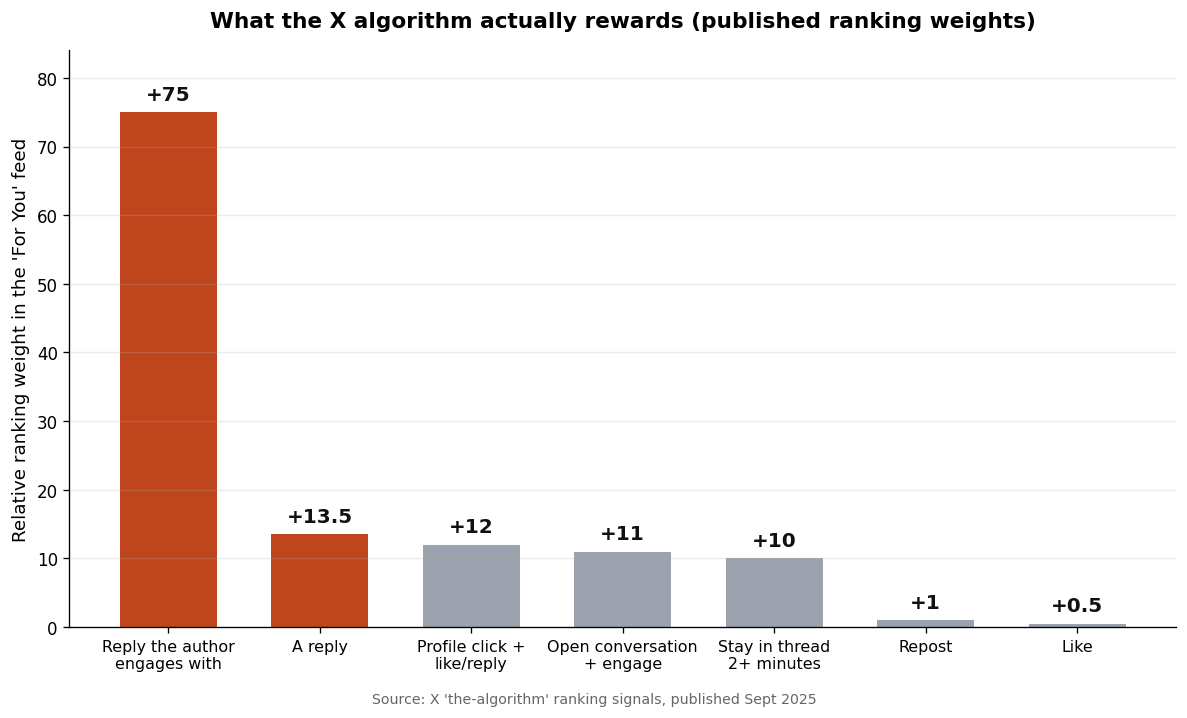
Read the chart top to bottom. The single most valuable thing you can cause is a reply that you then engage with — weighted at +75. A plain reply is +13.5. Someone clicking into your profile and engaging, or opening your conversation and staying a couple of minutes, lands in the +10 to +12 range. A repost is +1.0. A like is +0.5.
A like is worth almost nothing. Sit with that. The currency everyone instinctively chases — the heart, the like count — is the weakest signal in the system. The algorithm is built to surface posts that pull people into a conversation, and to reward authors who show up in those conversations. You can read the ranking code yourself if you want the unsimplified version.
For a SaaS founder, this is liberating. You are not trying to write the post that gets the most likes. You are trying to write the post that makes the right person reply — and then you reply back. A question that a fellow founder can't help but answer outperforms a beautifully worded announcement that everyone silently likes and scrolls past. The post that says "here's the pricing model I'm torn between, which would you pick?" beats "excited to announce our new pricing" every single time, because one invites a reply and the other invites a like.
The practical move: end posts with something repliable. Not a forced "what do you think?" on every post — that gets stale — but a genuine open question, a tradeoff you're weighing, a number that begs for a reaction. Conversation is the product the algorithm is optimizing for. Give it conversation.
The link penalty: why your reach dies when you add a URL
Here's the rule that trips up almost every founder trying to drive traffic: X penalizes posts that contain links. The same published ranking documentation lists links among the factors that reduce reach, and the reasoning is no secret — Elon Musk has been explicit that X doesn't want to send users off-platform to other sites. The platform's incentive is to keep you scrolling X, not to deliver clicks to your landing page.
So the post where you proudly drop your yourapp.com link is the post the algorithm buries. You've optimized for the exact behavior the system is built to suppress.
The workaround that the build-in-public crowd settled on is simple: put your link in a reply to your own post, not in the post itself. Write the hook, the story, or the question in the main post with no link. Let it earn reach. Then add the link as the first reply, where it doesn't drag the parent post's distribution down. People who care will go to the reply for it.
This reframes what your posts are for. The post itself isn't a billboard pointing at your site — it's a conversation starter that builds awareness and trust over time. The traffic comes later and indirectly: someone follows you because your posts were useful, watches you build for a few weeks, and clicks through when they're actually ready. That's slower than a direct-response click, and it's also far more durable. If your growth model depends on link clicks today, pair X with channels that tolerate links better, which I cover in from 0 to 100 paying customers.
A posting cadence that compounds
The mistake I see most often is treating X like a launch megaphone — going quiet for weeks, then posting ten times in two days around a launch, then going quiet again. The algorithm rewards the opposite: steady presence. Consistency is a ranking-adjacent signal because accounts that post and engage regularly accumulate the conversation history the system uses to decide who sees you.
You don't need to post constantly. You need to post reliably. A workable rhythm for a founder who also has to, you know, build the product: a few high-signal posts a week, plus daily replies. The posts plant seeds; the replies are where most of the growth actually happens (more on that next).
For a non-technical founder, the content that performs and is also genuinely sustainable is build-in-public material. You already have it — you're living it. The formats that work:
| Format | Example | Why it works | | --- | --- | --- | | The decision-in-progress | "Torn between $97 one-time and $20/mo. Here's my thinking..." | Invites replies; shows real stakes | | The number with context | "First 50 signups. Here's where they came from." | Concrete and credible; people share metrics | | The mistake + lesson | "Shipped a bug that emailed users at 3am. What I changed." | Vulnerability builds trust faster than wins | | The behind-the-scenes | "What my actual Tuesday looks like as a solo founder." | Relatable; humanizes the brand | | The genuine question | "Non-tech founders: how do you handle refunds?" | Pure conversation bait, the good kind |
The thing that makes build-in-public work for non-technical founders specifically is that you're not pretending to be an authority. You're documenting a journey people want to follow. The honesty is the content. I've written about the awkwardness of doing this when you don't feel like an expert in non-tech founder syndrome — the short version is that the imposter feeling never fully goes away, and sharing anyway is what builds the audience.
Whatever you do, don't outsource your voice to a scheduling tool that posts generic marketing copy. The algorithm's tilt toward conversation means canned broadcast content underperforms, and your audience can smell it.
Reply strategy: where the real growth actually is
If you only change one habit after reading this, make it this one: spend more time replying than posting. The ranking weights point straight at it — replies and the conversations around them dominate the scoring — but the deeper reason is about reach. Your own posts are seen mostly by people who already follow you. Your replies to bigger accounts are seen by their audience, which is the audience you don't have yet.
A thoughtful reply to a founder with 50,000 followers, on a post that's taking off, can put you in front of more of the right people than a week of your own posts. Not a "great post!" reply — those are invisible. A reply that adds something: a counterexample, a specific number from your own experience, a question that extends the conversation. The kind of reply that makes someone click your profile to see who said that. And a profile click that leads to a follow or a like is itself one of the higher-weighted signals in the system.
The mechanics that matter:
Reply early. The first 30 to 60 minutes after a post goes up is when engagement does the most to determine its reach, so being early in the replies of a post that's about to take off gets you maximum visibility. Watch the founders in your space; reply while their posts are fresh.
Reply with substance. Your reply should be able to stand on its own as a small, useful post. If someone read it without the parent, would it still say something?
Reply consistently to the same handful of people. Conversation history compounds. The accounts you engage with regularly start seeing more of you, and their audiences become familiar with your name. Pick ten to twenty founders and operators in your niche and actually become part of their conversations.
This is unglamorous and it works. It's also the part you can do in fifteen minutes between coding sessions, which makes it realistic for a solo founder. The launch playbook gets the spike; the reply habit builds the base. If a launch is on your horizon, pair this with the Product Hunt launch playbook — an engaged X following is the single best launch-day asset a non-tech founder can build in advance.
The first line is the whole game
Most posts fail in the first line. X shows the opening of your post in a crowded feed, and the reader decides in under a second whether to stop. Dwell time — how long someone lingers on your post — is one of the signals the system watches, and you can't earn dwell time on a post nobody stops to read. The first line isn't a warm-up. It's the entire pitch for the next ten seconds of attention.
Front-load the interesting part. "I just lost a customer because of a bug I should have caught" stops the scroll. "Some thoughts on customer retention" does not. Lead with the number, the mistake, the surprising claim, or the question — not with context the reader hasn't earned yet. You can add the context in the next line, once they've decided to stay.
Threads work when the topic genuinely needs more room than one post, not as a default. A thread that earns its length — a real teardown, a step-by-step, a launch retrospective — keeps people scrolling through it, which is exactly the dwell time the algorithm rewards. A thread padded to look substantial does the opposite: people bail after post two, and the drop-off hurts you. Use a thread when you have five posts' worth of something genuinely useful, and write the first post so good that nobody needs the rest to find you credible.
One discipline that pays off: write the post, then delete the first line and check whether the second line is a stronger opening. It usually is. We bury the hook under a sentence of throat-clearing almost every time.
Who to follow and how to find your corner
X growth feels impossible when you imagine broadcasting to strangers. It gets tractable when you reframe it as joining an existing conversation. There's an active indie-maker and SaaS-founder corner of X — people building in public, sharing revenue, posting launches — and your job is to become a recognized regular in it, not to go viral.
Start by following the founders building the kind of product you are, at the stage just ahead of you. Follow the people they reply to. Within a week your feed becomes a map of your corner: who posts what, which conversations recur, where you can add something. Mute the noise that isn't relevant; your feed is a tool, not an obligation.
Then contribute on the same topics consistently. If you're a non-technical founder using AI coding tools, that's your lane — talk about that specifically. Specificity is what makes you findable and memorable. "Founder" is not a niche. "Non-technical founder shipping a SaaS with AI coding tools, sharing the real numbers" is a niche, and it's one a defined group of people will want to follow.
The compounding effect is the whole point. Month one feels like shouting into a void. Month three, the same people keep showing up in your replies. Month six, you post a question and twenty relevant people answer because they know who you are. None of it comes from a single viral post. It comes from showing up in the same conversations, usefully, for long enough that the algorithm and the humans both start recognizing you.
Frequently asked questions
How often should a SaaS founder post on X?
Reliably matters more than frequently. A sustainable rhythm of a few high-signal posts a week plus daily replies beats bursts of ten posts around a launch followed by silence. The algorithm rewards consistent presence and engagement history, so a cadence you can actually maintain for months outperforms an intense one you abandon in three weeks.
Why do my posts with links get no reach?
Because X penalizes posts containing links to reduce off-platform traffic — it's in the published ranking factors. Put your link in a reply to your own post instead of in the post itself. The main post earns reach as a conversation starter, and the link sits in the reply where it doesn't suppress distribution.
Is build in public still worth it in 2026?
For non-technical founders, it's the highest-leverage content you can make, because it's both trust-building and nearly free to produce — you're documenting work you're already doing. Sharing real decisions, numbers, and mistakes invites the replies the algorithm rewards and builds an audience that follows your journey rather than just liking a post.
Should I pay for X Premium as a founder?
Premium gives verified accounts a reach advantage and prioritizes their replies in threads, so if X is a real channel for you, the subscription can pay for itself in visibility. That said, it amplifies a good strategy rather than replacing one — Premium on top of broadcast-only posting still underperforms a free account that's genuinely in the conversation.
How long until X growth shows results?
Plan in months, not days. The reply-driven approach compounds: the first month feels like a void, but by month three the same people recognize you, and by month six a question can pull in twenty relevant replies. It's slow at the start and accelerates, which is the opposite of a viral spike that fades.
Start with the reply box
Twitter/X growth for SaaS founders isn't a posting problem — it's a conversation habit. The algorithm has told you, in published numbers, that it rewards replies and the discussions around them far above the likes everyone instinctively chases. So stop optimizing for the broadcast and start optimizing for the back-and-forth: ask repliable questions, keep your links in the replies, build in public honestly, and spend more time in other founders' threads than on your own timeline. None of that requires a big following to begin. It requires showing up in the same corner of X, usefully, for longer than most people are willing to.
If you're a non-technical founder building a SaaS with AI coding tools and looking for the rest of the playbook — launch, pricing, the stack — Coding Capybaras is the free boilerplate and the blog where I work through all of it in public.