The Waitlist That Converts: What to Collect and Send | Coding Capybaras
A SaaS waitlist that converts isn't a big list — it's a warm one. What to collect at signup, the email cadence that keeps it warm, and how to turn signups into first users.
· Justin Boggs

Photo by Seongil Park on Unsplash
A SaaS waitlist that converts isn't the one with the most signups — it's the one where you can name who joined, why they joined, and what they'll do when you invite them. A big anonymous list rots: the longer someone waits without hearing from you, the less they remember signing up, and the less likely they are to pay. The waitlists that turn into paying customers do two things a signup form alone can't. They collect enough at the door to segment people, and they stay in touch often enough that "you're in" lands as a payoff instead of a surprise from a stranger.
TL;DR
- A waitlist is a lead-qualification engine, not a hype counter. Optimize for knowing your list, not growing it.
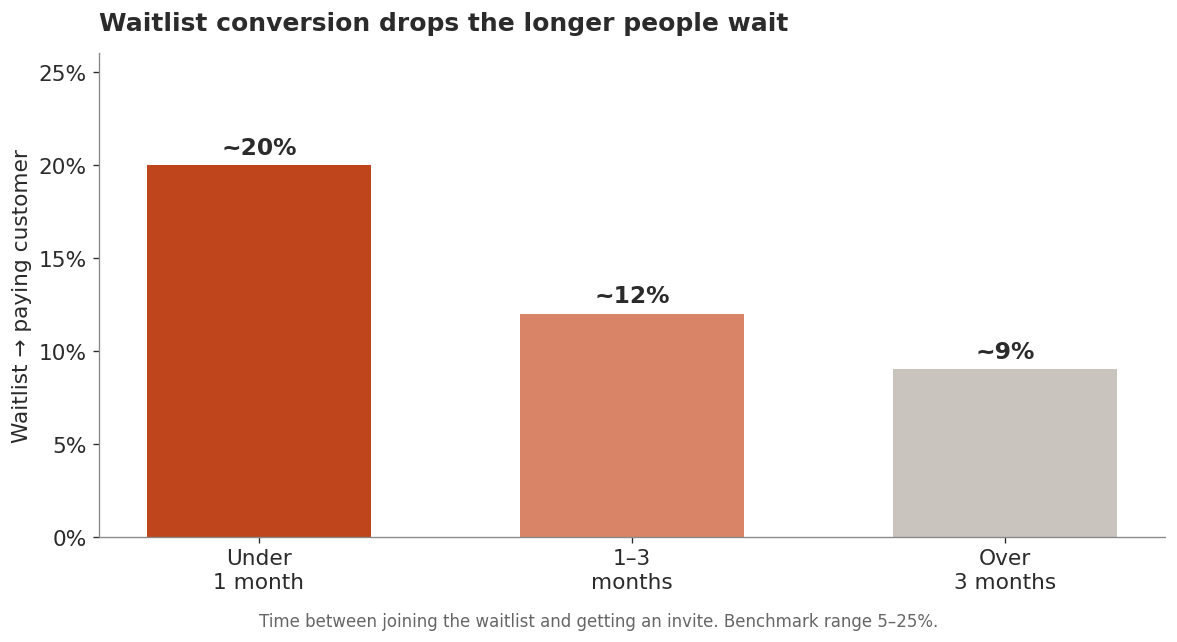
- Waitlists decay: benchmark conversion is ~20% if you invite people within a month, and under 10% if you wait past three.
- Collect one segmenting question at signup, not a form of ten fields. Ask what problem they expect you to solve.
- Email at least weekly, and make each email teach something — not "we're still building."
- Invite in engagement-based waves, not one blast. Your most involved members convert highest and churn least.
Why most waitlists rot before launch
Here's the failure mode I see most: a founder puts up a "Join the waitlist" form, collects a few hundred emails over three months, feels validated, and then goes quiet to focus on building. On launch day they email the whole list once — and a rounding error shows up to buy.
The problem isn't the product. It's decay. When someone drops their email in your form, they're making a tiny commitment based on a headline and a mood. Both fade. The team at Waitlist call this the attention decay problem: people who joined more than six months earlier show dramatically lower engagement, and a real share of them, when surveyed, can't accurately describe what your product does. They didn't lose interest in your product. They lost the memory of ever wanting it.
The numbers back this up. In benchmark data collected by Lenny Rachitsky and cited by a16z's speedrun team, waitlist-to-paid conversion runs a wide 5–25%, averaging around 20% when you get people off the list in under a month — and dropping below 10% once you wait past three months. A list you don't activate quickly has an expiration date. As they put it bluntly: waitlists rot.
So the first reframe is this: a waitlist isn't the finish line of your pre-launch, and it isn't a hype scoreboard. It's a machine for separating people who think your thing is neat from people who will actually pay for it. Everything below serves that separation. If you're still deciding whether to launch before you feel ready at all, I wrote about that tension separately in shipping your MVP before it feels ready — the waitlist is what makes that early launch land softly instead of into silence.
What to collect at signup (and what to skip)
The instinct is to grab as much as possible while you have someone's attention. Resist it. Every extra field costs you signups, and most of the data you'd collect is stuff you'll never act on. A waitlist form has one job beyond the email: give you a way to segment.
Collect the email, and then ask exactly one question that sorts people. My favorite, borrowed from the expectation-calibration idea: "What's the biggest problem you're hoping this solves?" Free-text or a few radio buttons. That single answer tells you more than role, company size, and industry combined, because it surfaces the thing most founders discover too late — that they're not building one product for one market, they're building different products for several segments who each want a different core outcome.
What you skip at signup, you can earn later. This is the intent ladder: instead of asking for everything at once, you ask for progressively bigger commitments over time, and each rung tells you who's serious.
| Rung | What you ask for | What it tells you | Friction | | --- | --- | --- | --- | | 1 | Email only | Curiosity | Almost none | | 2 | Email + one segmenting question | Which problem they have | Low | | 3 | A specific piece of feedback (mockup, pricing reaction) | Genuine engagement | Medium | | 4 | Apply for beta / book a call | Real intent | High | | 5 | Small deposit to reserve a spot | Commitment (cash) | Highest |
You don't need all five rungs. But you should know which rung each person has climbed to, because that's your conversion order at launch. The a16z team describe this same ladder — email, then email plus demographics, then a booked call, then paying to reserve a spot — and note that early-stage founders should try to add revenue as early in the journey as they honestly can. There's no better feedback than someone handing you money for the thing you haven't finished yet.
A caution on that last rung: taking deposits is powerful but raises the stakes. If you collect money, you owe a clear timeline and a real product. For most software waitlists, rungs 2 and 3 are the sweet spot. Deposits make more sense for higher-priced or hardware products — the necklace startup Taya took real money down and, on launch day, reported one preorder every four minutes.
The email cadence that keeps a list warm
If decay is the disease, email is the treatment — but only the right kind. A monthly "we're still building, thanks for your patience" note does nothing. It reminds people they're waiting without giving them a reason to keep caring.
The cadence I'd run for an indie SaaS waitlist:
The welcome, sent instantly. Not "thanks for joining." Restate what you're building, who it's for, and what happens next. This is the email that fights the memory decay before it starts. If someone opens it in three months, it should still explain itself.
A weekly-ish teaching email. This is the engine. Instead of feature lists, teach your audience something about the problem they came to you with. If you're building an invoicing tool, write about why chasing late payments quietly kills freelancers. You're building mind share — the sense that you understand their problem better than they do — so that when you launch, buying from you feels obvious.
Occasional "shape the product" emails. Share a mockup and ask which version is better. Float two pricing models and watch the reactions. This does something a broadcast can't: it converts passive subscribers into participants. People who help shape the product become psychologically invested in it, and they're the ones who buy first and stay longest.
Weekly sounds like a lot when you're heads-down building. It isn't, if each email teaches instead of updates. The mechanics of setting these sequences up without hand-writing webhook code is its own topic — I covered the tooling in setting up custom email sequences in Resend, and the broader lifecycle design in lifecycle email for indie SaaS. The marketplace has the copy-paste prompt for wiring the automation into a Next.js app.
Turning the list into your first users
Launch day is where most founders undo months of good work with a single mistake: they email the entire list at once, treating everyone identically. Don't. Roll out in waves, ordered by how far up the intent ladder each person climbed.
Give first access to your most engaged members — the people who gave feedback, joined a beta, or booked a call. They convert highest, and they become your first case studies and testimonials. (Getting those first testimonials is hard enough that I wrote a whole playbook on it; a warm, segmented waitlist is the single best source.) Then open to the people who answered your segmenting question and match your launch focus. Then the broader list.
Waves buy you three things. You catch onboarding problems with a small group before thousands hit them. Early customers turn into proof that convinces later cohorts. And you can give real, human onboarding when you're converting dozens at a time instead of drowning in thousands. That personal touch early is exactly the kind of unscalable work that pays off — the same principle behind most indie SaaS growth in the first hundred customers.
Two more levers worth pulling. Early-bird pricing, structured as a genuine reward for waiting rather than a permanent discount, reliably lifts conversion — the sweet spot lands around 10–20% off, framed as a thank-you for being early. Put the number where people already are: on your pricing page and in the invite email itself. And a real deadline on that early-bird window. A waitlist invite with no expiry is a waitlist invite that gets archived "for later" and never opened again.
The payoff for doing this right compounds past launch. Waitlist members who waited longest and engaged most tend to have noticeably higher retention — they understand not just what the product does but why it works the way it does, because they were in the room when you decided. Your waitlist, run well, is a customer-success program wearing a marketing costume.
The one spike beats a slow trickle
A quick note on filling the list in the first place, because it changes everything downstream. A waitlist you fill through one coherent moment converts better than one you trickle-fill over months, because everyone arrives with fresh, shared context.
The AI CRM startup Day.ai earned 4,000+ signups in their first 72 hours — not by announcing early, but by waiting until they had a story worth telling, then pointing press, owned content, and social at a single conversion surface on the same day. Paid.ai ran a similar play and turned 15.8K visitors into over 650 signups and 140 booked meetings.
The lesson for a solo founder without a funding announcement: manufacture your own spike. A launch, a strong demo, a customer story, a specific feature reveal — pick one moment, point everything at it, and send everyone to the same form. A list that arrives together, warm and contextualized, is one you can actually convert. A list that dribbles in over a quarter is a list that's already half-forgotten you by the time you're ready.
The three numbers worth watching
Most waitlist dashboards show you one number — total signups — and it's the one that matters least. If you track three others instead, you'll make better calls all the way to launch.
Signup source, not signup count. Where people came from predicts whether they'll convert. Signups from a targeted post in a community that has your exact problem convert far better than signups from a viral tweet that reached everyone and no one. Tag every signup with its source, even crudely, so at launch you can invite your highest-intent sources first. A hundred people from the right subreddit beat a thousand from a giveaway.
Engagement, measured as email opens and replies. This is your real conversion predictor. A subscriber who opens every email and occasionally replies is worth ten who never open. Watch open rates over time: if they're climbing or holding steady, your list is warm; if they're sliding, decay is winning and you need to either improve the emails or accelerate your timeline. Replies matter even more than opens — someone who answered your "what problem are you hoping this solves?" question has told you they're paying attention.
The next-step rate. Pick one action beyond joining — answering the segmenting question, giving feedback on a mockup, booking a call — and track what share of your list takes it. This single number tells you how much of your list is real. If 400 people joined but only 20 will click a link or answer a question, you don't have a 400-person waitlist. You have a 20-person waitlist and 380 bystanders, and knowing that before launch day changes everything about how you plan it.
None of this needs fancy tooling. A spreadsheet with source, join date, and a column for "took the next step" gets you most of the value. The point isn't the dashboard — it's refusing to let the vanity number fool you into thinking a cold list is a warm one. The founders who convert waitlists treat the waiting period as customer development, not a countdown.
Frequently asked questions
What's a good waitlist conversion rate?
For waitlist-to-paying-customer, benchmarks land between 5% and 25%, and roughly 2–8% is typical for lists that aren't nurtured. The single biggest lever is speed: convert within a month and ~20% is realistic; wait past three months and you'll likely fall under 10%. A smaller, warmer list usually beats a big cold one.
How many fields should my waitlist form have?
Two: an email and one segmenting question. Every additional field lowers your signup rate, and most extra data goes unused. You can collect role, company, and deeper intent later through follow-up emails and the intent ladder, when people have already shown they're engaged.
How often should I email my waitlist?
At least weekly, but only if each email teaches or involves rather than just updating. A weekly email about the problem you solve keeps a list warm; a monthly "still building" note lets it decay. Prepare several emails before you open the list so you're not scrambling.
Should I charge for a spot on the waitlist?
Sometimes. A deposit is the strongest possible signal of intent and it filters curious from committed, but it obligates you to a clear timeline and a real product. For most software, feedback and beta commitments are enough; paid reservations fit higher-priced or hardware products better.
Should I launch to my whole waitlist at once?
No. Roll out in waves ordered by engagement. Your most involved members convert highest and make the best first case studies, and small early waves let you fix onboarding before it hits everyone. A single blast to a cold, undifferentiated list is where most waitlist conversion goes to die.
Building the list is the easy part
The uncomfortable truth about waitlists is that the signup count you're proud of is the least important number in the whole exercise. What matters is whether you used the waiting period to turn strangers into people who are invested in you shipping. Collect one good question at the door. Email like you're teaching, not announcing. Invite in waves and reward the people who waited. Do that, and launch day feels like a natural next step instead of a cold ask.
If you're building your SaaS with AI coding tools and want the boilerplate I built for exactly this kind of founder, Coding Capybaras ships free — including the lifecycle-email plumbing that turns a warm waitlist into onboarded, paying users.