How AI Coding Changed My Relationship With Shipping
A non-tech founder on how AI coding tools rewired the way I ship software — from fear and delay to a faster, stranger, more honest relationship with done.
· Justin Boggs

Photo by Andy Li on Unsplash
AI coding tools changed my relationship with shipping software from one of avoidance to one of momentum. Before them, "ship it" meant handing my idea to someone else and waiting, or spending a weekend lost in configuration and giving up. Now shipping is something I do most days, in small pieces, without ceremony. That sounds like an unambiguous win, and mostly it is. But the honest version is more complicated: AI didn't just make me faster, it changed what shipping feels like — and some of what it changed, I'm still not sure I like.
TL;DR
- Before AI tools, shipping meant either hiring out or burning weekends on plumbing — so I mostly didn't ship.
- AI coding collapsed the distance between "I have an idea" and "it's live," which rewired shipping from a rare event into a daily habit.
- The new relationship isn't pure upside: I trust the code less, verify more, and had to build new habits to ship responsibly.
- The real change wasn't speed. It was that shipping stopped being something I was afraid of.
What shipping used to feel like
For most of my working life, "shipping software" was something other people did. I ran businesses. I built commerce sites and internal tools by wiring together whatever no-code and low-code pieces I could. But the moment a real idea needed real code, I hit a wall.
The wall had two sides. On one side: hire a developer, write a spec, wait weeks, discover the thing I described wasn't the thing I meant, iterate slowly through someone else's calendar. On the other side: try to build it myself, open a tutorial, get four steps in, hit an environment error the tutorial didn't anticipate, and lose the entire weekend to a problem that had nothing to do with my idea.
Either way, shipping felt like a wall. So I did what most non-technical founders do with a wall — I avoided it. Ideas piled up in notes apps. I told myself I'd get to them when I had budget, or time, or a technical co-founder. The relationship I had with shipping was avoidance dressed up as prioritization.
I don't think I'm unusual in this. Most people with product ideas never ship, and it's rarely because the idea is bad. It's because the distance between the idea and a running version is wide enough to be scary, and fear is a very effective way to never start. I wrote about where that fear came from in my origin story.
The moment the distance collapsed
The change didn't arrive as a lightning bolt. It arrived as a series of small moments where I asked an AI to do something I assumed would take a developer a day, and it came back in ten minutes with something that worked.
The first few times, I didn't trust it. I'd stare at the code, not fully understanding it, waiting for the catch. Sometimes there was a catch — I'll get to that. But often enough, the thing just ran. A working page. A form that saved to a database. A payment that actually charged a test card.
What collapsed wasn't my skill level. I still can't write that code from a blank file. What collapsed was the distance between having an idea and seeing a running version of it. That distance had been the wall. And when the wall came down, my whole relationship with shipping inverted. Shipping stopped being a rare, expensive, scary event I scheduled around, and became something I could do on a Tuesday night because I was curious.
This is the shift the industry is quietly going through, and the data backs up that it's mainstream now. According to the 2025 Stack Overflow Developer Survey, 84% of developers are using or planning to use AI tools, up from 76% the year before. I'm not a developer, but the tools that pulled professionals in are the same ones that pulled me across the wall. The difference is that for me, they didn't make an existing skill faster — they granted access to a thing I couldn't do at all.
The part nobody tells you: I trust the output less, not more
Here's where the honest version diverges from the marketing version. Faster shipping did not mean more confident shipping. If anything, I ship less confidently than a real developer would, because I know I can't fully verify what I'm sending out.
And it turns out even professionals feel this. The survey's AI results found that only 29% of developers trust AI output to be accurate, that 66% say AI answers are "almost right but not quite," and that 45% report losing real time debugging AI-generated code.
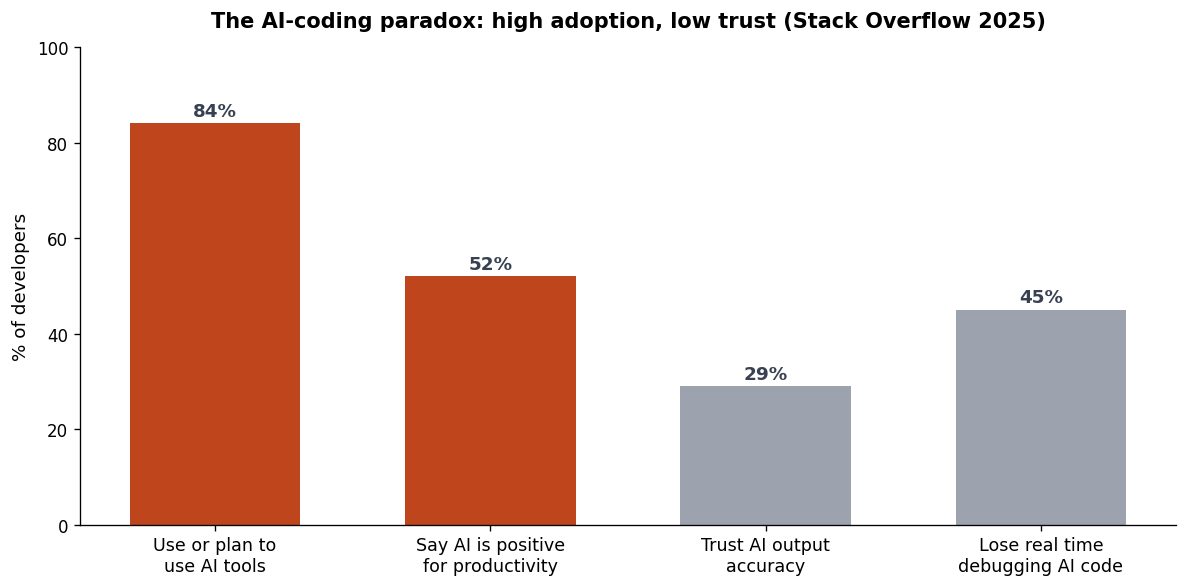
That gap — high adoption, low trust — describes my relationship with shipping precisely. I ship constantly and I distrust the output constantly. Those two things coexist. The tool that gave me the ability to ship also handed me a permanent, low-grade suspicion of everything it produces.
I've made peace with it by treating that suspicion as a feature, not a bug. Every piece of AI-generated code is guilty until I've seen it behave. I test the happy path, then I try to break it. I read the parts I can understand and ask the AI to explain the parts I can't, in plain English, until the explanation makes sense. When something touches money or user data, I slow down to a crawl. I built a whole mental checklist for this, which I laid out in when to trust your AI assistant.
The relationship with shipping that AI gave me isn't "move fast and don't worry." It's "move fast and worry precisely." I ship more, and I verify more, and the two grew together. Anyone who tells a non-technical founder that AI means they can skip the verifying is selling something.
Shipping in small pieces instead of big reveals
The other thing that changed is the size of what I ship. When shipping was expensive and scary, I batched. I'd hoard changes for a big release, because releasing felt like a production, and you don't put on a production for one small fix.
AI coding made shipping cheap enough that batching stopped making sense. Now I ship the small fix the moment it's ready. A typo in the pricing page, a better error message, one new marketplace guide — each goes out on its own. The vibe coding workflow I settled into is built around this: small, verifiable, reversible changes instead of big risky drops.
This turned out to matter more than the raw speed. Small ships are less scary, which means I resist them less, which means I ship even more. It's a compounding loop, and it runs in the opposite direction from the old avoidance loop. Fear used to compound into paralysis. Now momentum compounds into more momentum.
It also changed how I relate to mistakes. When you ship a big batch and something breaks, you're hunting through dozens of changes to find the culprit. When you ship one small thing and it breaks, you know exactly what did it, and you can undo it in seconds. Leaning on version control — commits as save points, the ability to roll back — was the safety net that made shipping small feel safe rather than reckless, and it's the backbone of my debugging playbook with Claude Code.
What I gained, and what I gave up
I want to be even-handed, because the change wasn't free.
What I gained is obvious and enormous: I can turn ideas into running software. That capability didn't exist for me two years ago at any price I could pay. It's the difference between being a person who has ideas and a person who ships them. I don't take that lightly, and on my worst days it's the thing that keeps me going.
What I gave up is harder to name. There's a version of learning to build software the slow way — reading the docs, understanding every line, earning the knowledge — that I skipped. I sometimes feel the absence of that foundation. When something breaks in a way the AI can't fix, I'm more stuck than a real developer would be, because I don't have the deep model underneath. I've written about that gap honestly in reading your AI's output when you don't speak code.
I also gave up a certain kind of pride. A developer who ships code understands what they shipped. I often ship things I understand only partially. I've decided that's an acceptable trade for actually shipping — a partial understanding that ships beats a complete understanding that never starts — but I won't pretend it's the same thing as competence. It's a different relationship with the work, and I try to be honest with myself about which one I have.
The net, though, isn't close. I'd rather be a founder who ships imperfectly than one who waits perfectly. AI coding tools made that choice available to me, and taking it changed everything downstream.
Frequently asked questions
Can a non-technical founder really ship software with AI tools?
Yes, with an important caveat: you can ship, but you can't skip the verifying. AI tools let you produce working software without writing code by hand, but you still have to test what they produce, especially anything touching payments or user data. The skill you develop isn't coding — it's directing and verifying.
Does AI coding make you a worse builder in the long run?
It's a real risk if you never learn anything about what you're shipping. I try to counter it by asking the AI to explain its code in plain English and by learning the concepts I keep running into. You don't need to become an engineer, but staying completely ignorant of your own product is dangerous.
Why do developers adopt AI tools but distrust them?
Because both things are true at once. AI tools are fast and genuinely helpful, but they're frequently "almost right but not quite," per the 2025 Stack Overflow survey. Experienced developers adopt them for the speed while keeping their guard up about accuracy — which is exactly the right posture for a non-technical founder to copy.
How do you ship confidently when you can't fully read the code?
You shift your confidence from the code to the behavior. I can't always verify that the code is correct by reading it, but I can verify that the feature does what it should by testing it hard — happy path, edge cases, deliberate attempts to break it. Confidence comes from watching it behave, not from understanding every line.
Did AI coding make shipping less meaningful?
For me, the opposite. When shipping was rare and expensive, each release carried a lot of weight and a lot of fear. Now that it's frequent and cheap, shipping feels lighter — but I do far more of it, and the cumulative output means more than any single big reveal ever did.
The takeaway
The headline change AI coding tools brought wasn't speed, though they are fast. It's that shipping stopped being something I was afraid of. The wall between my ideas and running software came down, and with it came a new relationship — more momentum, more small ships, and a healthy, permanent suspicion of everything the AI hands me. It's not the tidy story where the tool solves everything. It's the real one, where the tool changes what's possible and hands you a new set of responsibilities in return.
I write about this stuff every week on the Coding Capybaras blog — the boilerplate itself is free if you want to see how a non-technical founder actually ships.