Free Trial vs Freemium vs Paid-Only SaaS | Coding Capybaras
Free trial, freemium, or paid-only? Conversion benchmarks from 200 B2B SaaS products and a decision framework for indie founders picking an acquisition model.
· Justin Boggs

Photo by Jake Banasik on Unsplash
For most indie SaaS products, the honest answer to "free trial vs freemium vs paid-only" is: start with a free trial. It's the model most B2B software uses (57% of products, per ChartMogul's analysis of 200 companies), it forces a purchase decision instead of deferring it forever, and it doesn't require the enormous user volume that makes freemium work. Freemium earns its place when your product has viral mechanics or a huge market; paid-only works when your audience already trusts you. This post lays out the actual conversion benchmarks and a decision framework, plus why I broke my own rule with Coding Capybaras.
TL;DR
- Free trial is the default for indie SaaS — median free-to-paid conversion is 8%, and trials requiring a credit card convert around 30%.
- Freemium converts a smaller percentage of a bigger funnel. It needs a large market and a product where free users create value for you.
- Paid-only maximizes signal per customer but demands existing trust — an audience, a strong brand, or a category people already pay for.
- The full funnel matters more than the conversion rate: benchmark data shows ungated freemium can produce more paying customers per 1,000 visitors despite lower rates.
What each acquisition model actually is
The vocabulary gets sloppy, so let's pin it down. A free trial gives users the full product for a limited time — usually 14 days — after which they pay or lose access. Freemium gives users a limited product forever — restricted features, seats, or usage — with a paid tier that lifts the limits. Paid-only means no free anything: maybe a demo video or a refund window, but using the product costs money from minute one.
The distinction that matters most is what expires. In a trial, time expires, which creates a decision point. In freemium, nothing expires, which means the free plan has to create the decision point through limits — and badly-placed limits either strangle the free experience (nobody converts because nobody gets value) or make it too generous (nobody converts because free is enough).
Patrick Campbell, who built ProfitWell analyzing subscription data across thousands of companies, frames it in a way I keep coming back to: freemium is an acquisition model, not a revenue model. The free tier's job is to fill the top of your funnel cheaply. If you're evaluating freemium by asking "how much money will free users pay me," you're asking the wrong question — the right question is "how much cheaper does this make acquiring the users who will pay."
There's also a hybrid worth knowing: reverse trial — new users get the full paid product for 14 days, then drop to a free tier rather than losing access entirely. It's grown popular because it shows users the paid value first, then keeps them around in the funnel afterward. It's also more machinery: you're operating both a trial and a freemium plan, which for a solo founder is two pricing models to get right instead of one.
What do the conversion benchmarks actually say?
The best public dataset comes from ChartMogul's SaaS Conversion Report, built with ProductLed from the anonymized billing data of 200 B2B software products. The headline numbers:
| Metric | Benchmark | | --- | --- | | Products using free trial as primary entry | 57% | | Products using freemium as primary entry | 26% | | Most common trial length | 14 days (62% of products) | | Trials requiring a credit card | 20% of trial products | | Median free-to-paid conversion (all models) | 8% | | Free-to-paid, credit-card-required trials | ~30% |
That last row deserves a pause. Requiring a card up front converts at roughly 5x the rate of open trials. Before you sprint to add a card wall: it converts a higher percentage of far fewer people. The card requirement filters out the merely curious at the top of the funnel, so the survivors were already serious. Whether that trade helps you depends on whether you need more signups (early, when you're starving for feedback) or better-qualified ones (later, when support time is your constraint).
The funnel math is where the standard advice gets interesting. Per 1,000 website visitors, ChartMogul found:
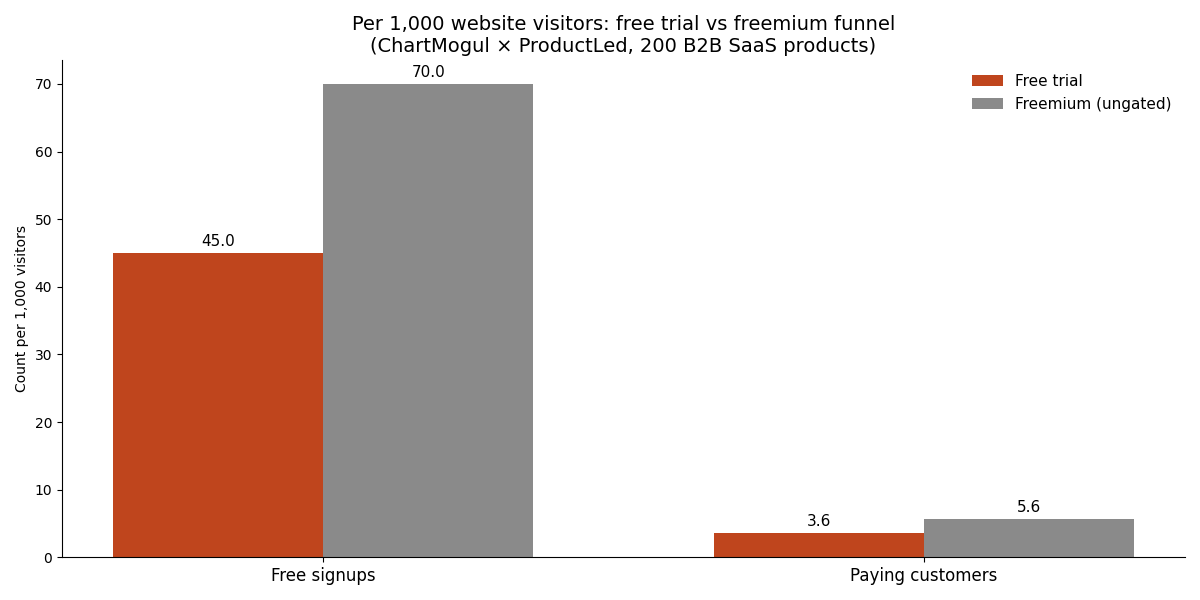
Ungated freemium produced more paying customers per visitor — 5.6 vs 3.6 — despite freemium's lower conversion percentage, because so many more people sign up when nothing expires and no card is asked for. Userpilot's benchmark roundup tells the same story from a different dataset: opt-in trials average about 8.9% conversion while good freemium sits at 3–5%, but the freemium funnel is wider at the top.
So why doesn't everyone pick freemium? Because those extra free users aren't free to you. Every one of them consumes hosting, support email, and onboarding attention. Which brings us to the real framework.
How should a non-tech founder choose?
Four questions, in order of importance.
1. How big is your market? Freemium's percentages only produce meaningful revenue against a large base. Jason Lemkin's long-running observation is that freemium works beautifully for the Zooms, Slacks, and Dropboxes — products with tens of millions of potential users — and quietly starves niche products. If your total addressable market is "operations managers at mid-size logistics companies," 3% of a small free base is a rounding error. Trial or paid-only.
2. Does a free user create value for you even if they never pay? This is the freemium unlock. Free Figma users make Figma the default their team adopts. Free Calendly users put booking links in front of new prospects with every email. If your free users recruit your paying users, freemium is an engine. If they just consume support hours — and for most B2B tools, they do — it's a cost center. Be brutally honest here; "maybe they'll tell a friend" is not viral mechanics.
3. How fast does your product show value? Trials work when a user can hit the core "this is worth money" moment inside 14 days. If your product needs weeks of data accumulation before it's impressive (analytics tools have this problem), a time-boxed trial expires before the magic happens — freemium or an extended trial fits better. This is also an onboarding design question: a trial plus a sharp first-run experience beats a longer trial with a confusing one.
4. What's your support capacity? You, alone, at 9pm, answering emails. Every acquisition model has a support cost per signup, and freemium's is the highest because it generates the most users at the lowest commitment. Paid-only has the lowest. Trials sit in between. As a solo founder, your scarcest resource isn't traffic — it's your own attention, and I say that as someone who's written about what the first-month metrics dashboard should track: support load per free user is a real line item even though no tool reports it.
Run the four questions and a pattern emerges: most indie B2B SaaS lands on a 14-day free trial, no card required at first (you need the feedback volume early), adding a card requirement later once onboarding is smooth and you'd rather have fewer, more serious trials.
Here's the whole framework as a table, since "which model when" is exactly the kind of decision that benefits from seeing all three side by side:
| Factor | Free trial | Freemium | Paid-only | | --- | --- | --- | --- | | Market size needed | Medium | Large | Small works fine | | Time-to-value required | Under 14 days | Can be slow | Buyer already convinced | | Support cost per signup | Medium | Highest | Lowest | | Signal quality per user | Good | Noisy | Excellent | | Works without an audience | Yes | Yes | Rarely | | Typical free-to-paid rate | ~8% (30% with card) | 3–5% | n/a | | Best for | Most indie B2B SaaS | Viral or network products | Trusted brands, one-time purchases |
One more variable that doesn't fit neatly in the table: your revenue timeline. A trial delays revenue by two weeks; freemium can delay it by months while the free base builds; paid-only produces revenue on day one or produces nothing. If you're bootstrapping and need cash flow to justify continuing, that timeline difference isn't academic. Freemium is the model most likely to look like traction — the signup chart goes up and to the right — while producing no money. Plenty of indie founders have ridden that chart straight into shutting down. Free users are a leading indicator only if you've verified the conversion path actually converts; until then, they're a cost with good PR. The billing math doesn't care how many free users you have.
The paid-only path (and why I took a version of it)
Paid-only gets dismissed as arrogant — "nobody will pay without trying it!" — but it has real advantages for a specific situation: when trust arrives before the signup. If buyers can evaluate your product through content, a demo, open code, or your reputation, the free layer isn't doing its usual job, and removing it means every customer is a real customer. Support conversations are all with people who paid. Feedback comes from users with skin in the game. Revenue per user is maximized from day one.
The catch is that the trust has to come from somewhere, which usually means an audience built over years, or a product category where paying up front is normal (themes, boilerplates, one-time-purchase tools), or a public artifact that is the evaluation.
Coding Capybaras is my own case study in mixing models. The boilerplate's complete codebase is free — not a crippled demo, the actual code that runs this site — and Pro is $97 one-time. Through the lens of this post, that's a freemium shape with a paid-only purchase dynamic: the free tier does the trust-building (you can read every line before paying anything), and the Pro purchase is a single considered decision rather than a subscription that renews until you remember to cancel. I chose it because question 2 above came back positive in an unusual way — a founder who ships on the free boilerplate is the marketing — and because a one-time price fit the pricing philosophy I'd already committed to: charge in a way your specific audience finds obviously fair. I'm not claiming it's optimal. I'm claiming it followed from the framework instead of from copying whatever the last successful launch did.
The general lesson: the three models aren't a menu you must order from whole. Trial-with-card, reverse trial, free-code-paid-extras — the mechanics compose. What doesn't compose is skipping the four questions and picking on vibes.
Mistakes that quietly kill each model
Trial mistakes. The most common one is a 30-day trial "to be generous." Long trials kill urgency — users park your product in a tab and forget it; 14 days with good onboarding beats 30 days without, which is why 62% of products cluster there. The second is silent expiry: the trial ends, the user is locked out, and nobody emailed them on day 10 to show what they'd lose. Your trial sequence is a lifecycle email problem, and the welcome-nurture-expiry cadence I mapped in the lifecycle email guide is most of the fix.
Freemium mistakes. Setting the free limit by copying a competitor instead of by finding your value metric. The free tier should end exactly where serious usage begins — Slack's old 10,000-message history limit was the canonical example, invisible to casual teams and unbearable for committed ones. Get it wrong in the generous direction and you've built a charity; get it wrong in the stingy direction and your free plan is a broken demo that converts nobody.
Paid-only mistakes. Charging before you've built any trust surface. Paid-only without an audience, a public artifact, or a refund guarantee just moves your conversion problem from "free-to-paid" to "stranger-to-paid," which is harder. If you go paid-only, a generous refund window does the psychological work the trial would have done.
The universal mistake: treating the choice as permanent. ChartMogul's data shows companies adding dual CTAs (freemium and a card-required premium trial side by side) and lifting premium trial starts 26%. Your acquisition model is a product feature. Version it.
Frequently asked questions
What's a good free trial conversion rate for SaaS?
The median free-to-paid rate is about 8% across B2B SaaS. For opt-in trials (no card), 8–10% is solid; for credit-card-required trials, expect around 25–30%. If your open trial converts under 3%, the problem is usually onboarding or targeting, not the pricing page.
How long should a SaaS free trial be?
14 days is the standard — 62% of trial products use it. Choose longer only if your product genuinely can't demonstrate value in two weeks, and if so, consider whether freemium fits better than a long trial.
Should my free trial require a credit card?
Early on, no — you need signup volume for feedback more than you need conversion efficiency. Card-required trials convert around 5x higher per signup but sharply cut signups. Revisit once your onboarding is smooth and support time matters more than raw user count.
When does freemium make sense for an indie SaaS?
When your market is large, your free users create value beyond their own payments (network effects, word of mouth, user-generated content), and your marginal cost per free user is near zero. If none of those are true, freemium is a support burden wearing a growth costume.
What is a reverse trial?
New users get the full paid product for a set period, then fall back to a free plan instead of losing access. It combines trial urgency with freemium retention, at the cost of operating both models at once — reasonable for a team, heavy for a solo founder's first year.
Can I change my acquisition model after launch?
Yes, and you probably should as you learn. Moving from open trial to card-required trial, adjusting free tier limits, or adding a paid pilot are all normal moves. Grandfather existing users when you tighten anything — goodwill is cheaper to keep than to rebuild.
Conclusion
The saas free trial vs freemium question has a boring, reliable default: a 14-day trial, no card required at first, with lifecycle emails doing the conversion work. Freemium is a specialist tool for big markets and viral products; paid-only is a specialist tool for founders whose trust arrives before the transaction. Answer the four questions — market size, free-user value, time-to-value, and your own support capacity — and the model mostly picks itself. And whichever you choose, instrument it from day one, because the benchmark that actually matters is your own funnel, not the median of 200 other companies. If you're building your SaaS with AI coding tools, Coding Capybaras is the free boilerplate I built for that workflow — billing, trials, and plan gating are already wired in, so changing your acquisition model is a config edit instead of a rebuild.