Show HN: A Non-Tech Founder's Launch Guide | Coding Capybaras
A Show HN launch guide for non-technical founders: how to write the title, when to post, the first comment to leave, and how to survive Hacker News critique.
· Justin Boggs

A Show HN launch is one of the few free distribution channels where a first-time, non-technical founder can stand on equal footing with a funded startup — but only if you play by the room's rules. A Show HN is a post on Hacker News, prefixed with "Show HN:", that shares something you built which people can actually try right now. The whole game is upfront honesty: a boring, specific title, a working link, no marketing language, and a founder who shows up in the comments to answer hard questions. Do that and a front-page Show HN can send thousands of genuinely curious visitors your way. Fake it — ask friends for upvotes, gate your product behind a signup wall, reply with AI-polished fluff — and Hacker News will bury you, fast.
TL;DR
- Show HN is for things people can try immediately. A landing page, waitlist, or signup wall is off-topic and gets penalized.
- Titles should be boring and specific: "Show HN: ProductName – plain-words description." No hype, no exclamation points, no numbers-as-bait.
- Post Tuesday–Thursday, roughly 8–11am US Eastern, and clear your calendar for the next two hours.
- The first hour of comments and votes decides almost everything. Reply to every comment like a human.
- Never ask for upvotes. HN's ring-detection is good enough to bury your post and ban your domain.
What a Show HN actually is (and isn't)
Hacker News is a link-sharing community run by Y Combinator. Most posts are links to articles or news. Show HN is a specific subcategory with its own tab, meant for things you made and want feedback on. When you submit, you put your product's URL in the URL field, prefix the title with "Show HN:", and — this part surprises people — usually leave the text box empty, then add your context as the first comment.
The single hard requirement is that people can try it. Per the official Show HN guidelines, the post has to be something readers can play with: a live demo, a downloadable tool, a repo they can run. A marketing page describing a product that doesn't exist yet, a "join the waitlist" form, or a signup wall that blocks the actual thing are all off-topic, and the community flags them.
This is the mental shift for non-tech founders. On Product Hunt, a slick landing page and a good tagline can carry you. Hacker News is the opposite. The audience is engineers who have seen every growth-hack trick, and they reward substance over polish. If your product is a Next.js SaaS, the working app is the pitch. If it's open source, your README is as important as your landing page — as Lucas F. Costa puts it in his Hacker News launch write-up, for a technical project "your repo is the landing page, by definition."
A Show HN is also not a one-shot lottery. The HN guidelines explicitly allow you to repost a Show HN that didn't get traction, a while later. And because the "Show" tab is less crowded than the main new-page firehose, your post can accumulate votes for longer there before it either catches or fades. That's a gentler on-ramp than most launch channels give you. It also pairs well with a broader launch plan — many founders run a Show HN alongside a Product Hunt launch so the two audiences reinforce each other on the same day.
Write a title that sounds almost boring
Your title is the entire pitch on Hacker News. There's no image thumbnail, no video, no bolded tagline — just orange link text on a white page. So the title does all the work, and the counterintuitive rule is: make it plain.
The official guidelines are blunt about this. Don't use uppercase, don't use exclamation points, don't editorialize, don't stuff in "gratuitous numbers" or superlatives. A title that reads like an ad gets fewer clicks here, not more, because the audience has trained itself to distrust marketing cadence.
The format that works is Show HN: ProductName – a plain description of what it does. Say precisely what the thing is. If you can't describe your product in one plain sentence, that's a signal worth heeding before you launch — the fuzziness in your title usually reflects fuzziness in the product itself. Costa's examples make the contrast obvious:
| Weak (marketing-speak) | Strong (specific) | | --- | --- | | Show HN: Layerform – A staging environment for each engineer | Show HN: Layerform – Open-source development environments using Terraform files | | Show HN: PromptTools – improve your model's responses in less time | Show HN: PromptTools – open-source tools for evaluating LLMs and vector DBs |
Notice what the strong versions do: they name the technology, they describe the mechanism, and they let the reader decide if it's relevant. They don't promise a benefit; they state a fact. For a non-technical founder, this is freeing — you don't have to write clever copy. You have to write an honest, one-line description of what you built and who it's for.
One more thing that trips people up: don't include your own name or the word "revolutionary" or a version number to seem impressive. "Show HN: Coding Capybaras – a SaaS boilerplate for non-technical founders using AI coding tools" tells the reader exactly what it is and who should care. That's the whole job.
Timing and the first hour
You can obsess over timing, and it matters, but not as much as what happens in the first sixty minutes after you post. Get the timing roughly right, then be present.
The consensus window across launch write-ups is Tuesday through Thursday, mid-morning US Eastern — roughly 8–11am ET. That catches East Coast developers starting their day and European engineers in their afternoon. Avoid weekends, holidays, and days dominated by a big tech keynote, when the front page fills with other news. Costa's honest caveat is worth keeping in mind, though: there's no magic best time, because more eyeballs also means more competing posts, so the ratio stays roughly constant. Pick a reasonable window and move on.
What actually decides your fate is early vote velocity. The HN ranking algorithm weighs how quickly a post gathers upvotes against a time-decay factor, so a burst of genuine interest in the first fifteen to sixty minutes is what lifts you toward the front page. If nothing happens in that first hour, the post usually sinks. This is why "post and walk away" fails.
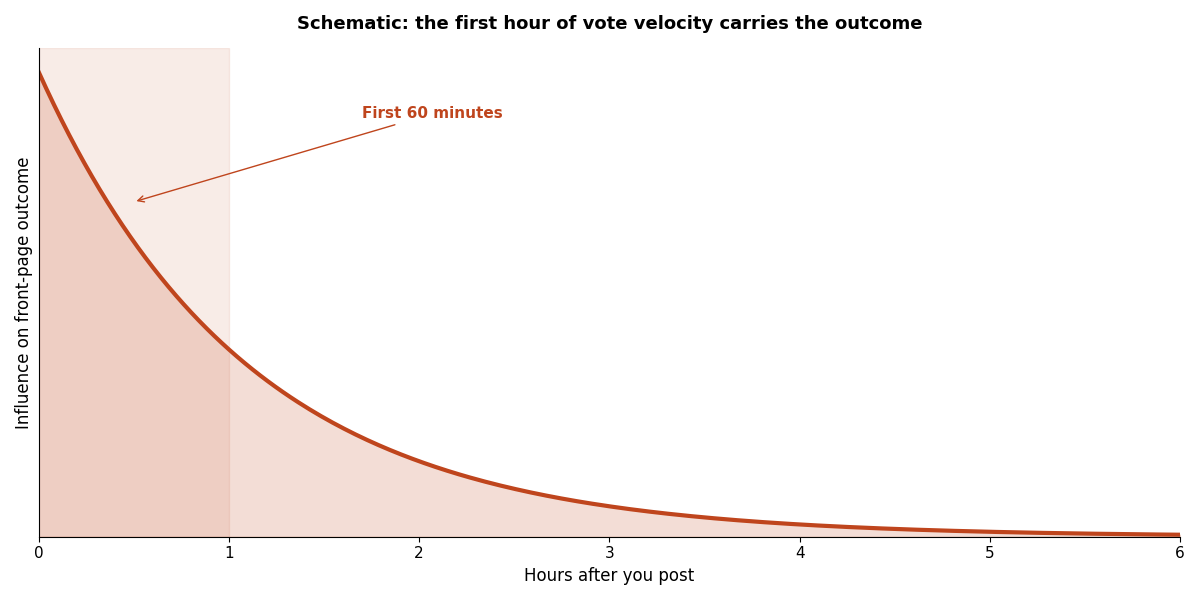
The practical takeaway: treat the two hours after you post like a live event. Don't launch right before a meeting. Don't launch and go to lunch. Sit at your desk, watch the thread, and respond to every single comment as it comes in. Engagement in the comments feeds the ranking too — threads with real back-and-forth tend to hold their position longer than threads that are just a pile of votes.
The first comment you must write
Because you left the text box empty on submission, your first comment is where you set the context. Post it within a minute or two of submitting, from your own account, as the founder.
Keep it short and human. A good first comment does three things: says you built this, explains in a sentence or two why you built it (the real reason, not a pitch), and invites specific feedback. Something like: "I'm the founder. I built this because I'm a non-technical founder and every existing SaaS boilerplate assumed I could already wire up Stripe webhooks. Happy to answer anything about the architecture or the tradeoffs I made." That's it. No feature list, no call to action, no "please check out our pricing."
Then, for the next two hours, reply to everything. Answer the skeptics directly. When someone points out a real flaw, thank them and say what you'll do about it. When someone asks why you didn't use X instead of Y, explain your actual reasoning — the honest tradeoffs, including the ones you're not sure about. This is where the value of a Show HN really lives: you're getting free, brutally honest product feedback from experienced engineers. The traffic is nice; the feedback is the real prize.
Two hard rules govern this window. First, never ask anyone to upvote — not friends, not your team, not your newsletter. HN's ring-detection catches coordinated voting from new accounts or shared networks, and the penalty is your post buried and your domain flagged. Second, don't paste AI-generated replies. The audience can smell it, and a canned tone in the comments will sink the goodwill your honest title earned. Write your replies yourself, even if they're a little rough.
Prepare the product before you post
The fastest way to waste a Show HN is to earn the click and then lose the visitor. Before you submit, walk through your own product the way a stranger will.
Make it load fast. HN readers will not wait through tracking scripts, autoplay animations, or a giant hero video. Kill the popups, the newsletter modal, the chat widget, and any signup gate that stands between the visitor and the actual thing. If your product genuinely requires an account, offer a live demo, a sandbox, or a video that shows it working — something they can evaluate without handing over an email.
This is also a moment where the boring infrastructure work pays off. A Show HN can send a spike of thousands of visitors in a short window, and a site that falls over under load turns your best day into your worst. Make sure your hosting can handle a burst, your error tracking is on so you can see what breaks, and your database isn't going to choke. If you haven't wired up monitoring yet, the Sentry setup guide walks through it in about ten minutes, and it's exactly the kind of thing you want live before, not after, a traffic spike.
It helps to have a short pre-launch checklist you run the day before, not the morning of. Confirm the product loads in under a couple of seconds on a cold visit. Open it in a private browser window with no login and make sure a stranger can see something real. Draft your first comment in a notes app so you're not writing it under pressure. Have the thread open on one screen and your product's error dashboard on another. And clear the next three hours — no meetings, no errands. The founders who look calm and responsive in the comments are usually the ones who did this boring prep the night before.
Expect harsh critique, and expect it to be useful. Hacker News comments can be blunt to the point of stinging, especially about anything that smells like hype. Read the criticism as a gift — these are exactly the objections your future customers will have, delivered for free and early. The founders who do well are the ones who stay curious and non-defensive in the thread, not the ones who argue. If the critique reveals your positioning is off, that's a cheaper lesson on HN than in six months of quiet churn. And a Show HN is only one channel — pair it with the other early-traction moves in the zero-to-100-customers playbook rather than betting your whole launch on one thread.
Frequently asked questions
Do I need karma or an established account to post a Show HN?
No. A brand-new account can post a Show HN. That said, HN's anti-abuse system watches new accounts more closely, so a fresh account that immediately posts a link and then receives votes from other fresh accounts on the same network looks exactly like a voting ring. Use your real account, participate normally, and don't try to manufacture votes.
What counts as "something people can try"?
A live web app, a downloadable tool, a runnable open-source repo, an API with a public playground — anything a reader can actually use in a few minutes. What doesn't count: a landing page for a product that isn't built, a waitlist form, or a signup wall that blocks the real thing. If the only thing behind your link is a pitch, it's off-topic for Show HN.
How much traffic does a front-page Show HN drive?
It varies widely, but a Show HN that reaches the front page commonly drives on the order of several thousand to tens of thousands of unique visitors within 24 hours, with a long tail of search-referred visits for months afterward. The exact number depends on how high you rank and how long you hold the position. Treat any specific figure as a rough expectation, not a guarantee.
Can I relaunch if my Show HN flops?
Yes. The HN guidelines allow reposting a Show HN that didn't get attention, after some time has passed. What you must not do is delete and immediately resubmit the same post, or submit the same URL repeatedly in a short span — that pattern gets flagged. Wait, improve the product or the title based on what you learned, and try again later.
Should I run my Show HN and Product Hunt launch on the same day?
You can, and many founders do, because the two audiences barely overlap and the momentum can compound. The tradeoff is attention: both channels demand you be present in the comments for the first few hours. If you can't give each one real focus, stagger them by a day. Either way, plan the cadence in advance rather than improvising on launch morning.
Is it against the rules to tell my audience I posted?
Sharing a link to the HN thread and asking people to upvote is against the rules and easily detected. Sharing that you launched and letting people find it organically is fine. The line is: don't direct traffic to the post for the purpose of voting, and never send the direct upvote link. Genuine readers who discover your product and vote because they like it are exactly what the algorithm is trying to reward.
The honest version wins here
A Show HN rewards the one thing non-technical founders can always control: honesty. You don't need a design budget, a marketing team, or clever copy. You need a working product, a plain-spoken title, and the willingness to sit in a thread for two hours answering hard questions without flinching. That's a launch strategy you can execute alone, on a Tuesday morning, for free.
If you're building a SaaS with AI coding tools and want the infrastructure solved before you launch, Coding Capybaras is the free boilerplate I built for exactly this kind of founder — so when your Show HN hits the front page, the app underneath it holds up.