LinkedIn for B2B SaaS Founders Who Hate LinkedIn
A LinkedIn B2B SaaS founder playbook: which post formats still work in 2026, a realistic cadence, DMs that aren't spam, and what returns to actually expect.
· Justin Boggs

Photo by Priscilla Du Preez 🇨🇦 on Unsplash
If you're a B2B SaaS founder who finds LinkedIn insufferable, the useful version is narrower than the one you're avoiding: post two or three times a week about work you actually did, comment on maybe ten posts from people in your market, and send a handful of DMs a month that read like a person wrote them. That's the whole thing. You don't need a personal brand, a hook formula, or a "here's what 10 years in SaaS taught me" carousel. The part of LinkedIn that makes you cringe is mostly the part that stopped working, and in March 2026 LinkedIn started actively demoting it.
TL;DR
- LinkedIn is the only major platform where the audience skew is your ICP: 53% of US adults with a bachelor's degree use it, versus 10% of those with a high school degree or less.
- LinkedIn announced in March 2026 that it's reducing engagement bait, recycled content, and the effectiveness of engagement pods. The growth-hack playbook is being actively devalued.
- The feed optimizes on dwell time, not just likes — quietly useful posts that people read all the way through beat loud posts nobody finishes.
- A realistic cadence for a founder with a product to build: 2-3 posts a week, 10 comments a week, 5-10 DMs a month.
- Expect a slow curve. Meaningful inbound from LinkedIn typically shows up in months, not weeks, and shows up as conversations rather than signups.
Why LinkedIn is worth the discomfort for B2B specifically
The case for LinkedIn isn't that it's pleasant. It's that the audience composition is unusually well-matched to B2B SaaS, and no other platform comes close on that axis.
Pew Research Center's social media fact sheet puts the education skew starkly: 53% of Americans with at least a bachelor's degree use LinkedIn, compared with 28% of those with some college and 10% of those with a high school degree or less. Usage also concentrates in the 30-49 age bracket at around 40%. If you sell software to people who make purchasing decisions at companies, that's the demographic — and it's the only large platform where that group is the core user base rather than an incidental slice of it.
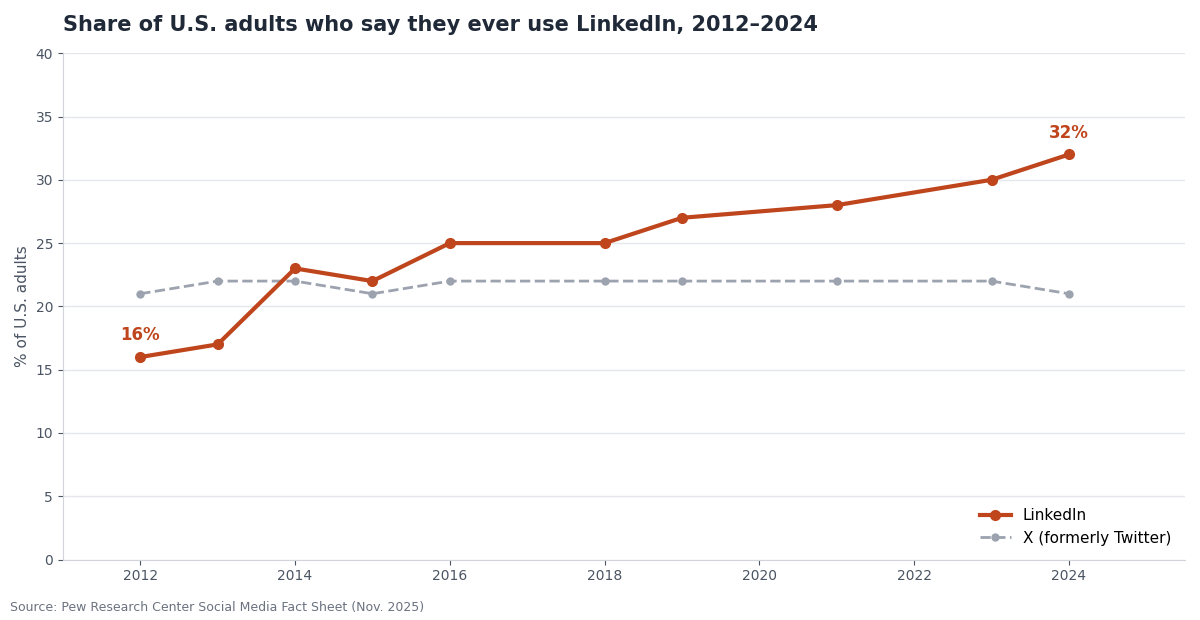
The trend line matters too. LinkedIn roughly doubled its share of US adults between 2012 and 2024, from 16% to 32%, while X stayed flat at around 21-22% across the entire period. Globally, LinkedIn reports more than 1 billion members in over 200 countries. Whatever you think of the culture, the distribution is going the right direction.
The second reason is more practical. LinkedIn profiles carry job titles, companies, and industries as structured data. When someone engages with your post, you can see whether they're a VP of Operations at a 200-person logistics company or a student. On X you get a handle and a bio. For B2B, that difference is the entire value of the channel — it turns vague "impressions" into a readable list of who's paying attention.
The third reason is that the bar is low. Most founders in most B2B niches post nothing. The ones who do post mostly post the cringe stuff. Showing up consistently with something specific and useful puts you in a very small group, and you don't have to be good at LinkedIn to be in it — you just have to be honest and consistent.
None of that makes the feed less annoying. It makes it worth twenty minutes a day anyway.
What LinkedIn changed in 2026, and why it helps you
If your objection to LinkedIn is "it rewards the worst behavior," that objection was well-founded and is now partly out of date.
In March 2026, LinkedIn published a note on how it's improving the feed that reads almost like a list of grievances founders have had for years. Four things stand out:
Engagement pods are being broken. LinkedIn says it's working to make pods ineffective and to curb comment automation and third-party tools that manufacture fake conversation. The coordinated-comment game — the reason mediocre posts used to show up with forty identical "Great insight, Sarah!" replies — is being deliberately degraded.
Engagement bait is being demoted. "Comment to agree" prompts, videos that don't match the text, and recycled low-substance posts are explicitly named as things the feed will show less of. The specific formats that made LinkedIn embarrassing are the formats now being penalized.
Ranking moved to generative recommenders and LLMs. LinkedIn describes upgrading to larger sequence models augmented with large language models that "better understand what a post is actually about." Practically, this means topical substance is legible to the ranker in a way keyword-and-engagement heuristics never made it. A post that's genuinely about Stripe webhook failures can be matched to people who care about Stripe webhook failures, whether or not they follow you.
Raw engagement is being de-emphasized in favor of who engages. A dozen comments from people in your industry now signal more than a hundred scattered likes.
Underneath all this is an older piece of engineering that explains a lot about what actually performs. LinkedIn's team published research on using dwell time to improve feed ranking — dwell time being the seconds someone spends on a post before scrolling past. They built it as an implicit signal precisely because likes and comments are too sparse and too gameable to rank a feed well on their own. The model predicts whether a post will hold attention past a context-dependent threshold, adjusting for things like where the post sits in the feed and what type of content it is.
The implication is the useful part: a post that 200 people read all the way through can outperform a post that 800 people liked reflexively and scrolled past. Depth is a ranking feature, not just a virtue. Which is good news if what you actually have to offer is a detailed account of something you built, and bad news if your plan was to post a motivational quote over a sunset.
The formats that work when you have a product to build
You have limited hours and most of them belong to the product. Here's what earns its time.
The specific thing that broke. Not "lessons learned from building a SaaS." The actual failure, the actual error message, the actual fix. When I wrote about Stripe webhook hell, the version that traveled was the one with the signature-verification error pasted in, because anyone who has hit that error recognizes it instantly. Specificity is what makes a stranger stop, and stopping is what dwell time measures.
The decision with the tradeoff shown. "We picked Supabase over Firebase and here's what we gave up" beats "5 reasons to choose Supabase." Founders in your market are making the same decisions and they want the honest cost, not the pitch. This is also the format most likely to draw comments from people who chose differently, which is exactly the kind of engagement the new ranking favors.
The number, with context. Real MRR, real churn, real conversion rate, real cost. Numbers stop the scroll. If you're not comfortable publishing revenue, publish a ratio or a cost breakdown instead. The rule is that it has to be your number — inventing a plausible-sounding statistic is the fastest way to get caught by someone who actually has the data.
The short observation. Three sentences about something you noticed this week. These take four minutes to write and often outperform the long ones, because they're complete. A post that delivers its whole idea before the "see more" fold gives people no reason to bounce.
Formats to skip: carousels (high production cost, low durability), inspirational-story posts, anything with a one-word-per-line "hook" ladder, polls used as engagement bait, and the "I'm hiring" post if you're not hiring. Also skip external links in the post body when you can — put the link in the first comment or write the post to stand alone, because outbound links pull people off-platform and the feed knows it.
| Format | Time cost | Durability | Best for | | --- | --- | --- | --- | | Specific failure + fix | 20-30 min | High | Credibility with technical buyers | | Decision with tradeoffs | 30-45 min | High | Reaching people mid-evaluation | | Real number + context | 15-20 min | Medium | Stopping the scroll | | Short observation | 5 min | Low | Staying visible between big posts | | Carousel | 2+ hours | Low | Almost nothing, for a solo founder |
One more thing that isn't a format: reply to every comment on your own posts, in a sentence or two that adds something. It's the highest-leverage twenty minutes on the platform. It extends the life of the post, it's the behavior LinkedIn says it's optimizing toward, and it's how a post turns into a conversation you can follow up on.
Cadence, comments, and DMs that aren't spam
The realistic cadence for a founder with a product to ship is two to three posts a week, ten comments a week, and five to ten DMs a month. That's roughly twenty minutes a day. Anything more and you're a LinkedIn creator who happens to have a SaaS, which is a different job.
On posting: pick two fixed days and protect them. Consistency beats volume because the compounding asset isn't any single post, it's the accumulated sense that you're a person who knows this domain. Missing a week is fine. Missing two months means restarting.
On commenting, this is the part most founders skip and it's the part that actually works. Find fifteen to twenty people who sell to your buyer — not competitors necessarily, adjacent tools, consultants, operators in the vertical — and comment on their posts with something substantive. Not "great post." A disagreement, a data point, a specific experience that complicates what they said. Their audience is your audience, and a good comment on a post with 400 engaged readers reaches more of the right people than an unnoticed post of your own.
On DMs, the rule is simple: a DM is a reply to something, or it isn't sent. Someone commented on your post, someone published something you have a real reaction to, someone's company just did a thing that's relevant to what you build. That's the opening. Reference the specific thing, say the useful thing, and don't pitch in the first message. If there's a fit, they'll ask.
What that looks like in practice, roughly:
Saw your comment about spending three weeks on billing edge cases — we hit the same wall on proration when customers downgrade mid-cycle. Ended up handling it with a Stripe scheduled subscription change rather than immediate proration. Happy to share what that looked like if it's useful.
No link. No "quick question." No calendar invite. Just the thing that was actually on your mind, sent to someone who was visibly thinking about the same problem. Most won't reply. The ones who do are worth more than a hundred connection requests. I use the same principle in cold outreach scripts for SaaS — the difference between outreach and spam is whether the message could only have been sent to this one person.
What to avoid entirely: automation tools that send DMs or comments on your behalf. Beyond being obvious to recipients, LinkedIn named unauthorized third-party tools and comment automation as things it's actively taking action against. The downside risk to your account is real and the upside was never that good.
Connection requests: send them with a note, to people you have an actual reason to connect with, and stop caring about the number. A network of 600 people in your market is worth more than 8,000 random accepts, and it makes your feed readable instead of a firehose.
Frequently asked questions
How long before LinkedIn produces anything?
Months, not weeks. The first signals are usually comments from people with relevant titles and a few DMs, not signups. Founders I know who stuck with it saw the shape change somewhere between month three and month six. If you need customers next week, LinkedIn is the wrong channel — go direct, or go where your users already gather.
Should I post from my personal profile or a company page?
Personal profile, almost without exception. Company pages get meaningfully less organic reach, and B2B buyers respond to a named human with a track record. Use the company page as a credibility artifact people can check, not as a distribution channel.
Do I need to post every day to make the algorithm happy?
No. There's no evidence that daily posting is required, and the March 2026 changes push in the opposite direction by de-emphasizing raw engagement volume and penalizing recycled content. Posting daily when you only have two good things to say a week is how you end up producing the filler the feed is now demoting.
Is LinkedIn better than X for B2B SaaS?
For reaching buyers with job titles and budgets, usually yes — the demographic skew and the structured profile data are hard to beat. For reaching other builders, X is often better and faster. They're different audiences, not competing versions of the same one. I break the X side down in Twitter/X growth for SaaS.
What do I do if I genuinely have nothing to say?
Write about what you did this week. You shipped something, debugged something, made a decision, or talked to a customer. Any of those is a post if you're specific about it. The feeling of having nothing to say is usually a feeling of having nothing impressive to say, which is a different and much less important problem.
Do hashtags still matter?
Barely. With ranking moving toward models that read what a post is actually about, hashtag stuffing is doing less work than it used to and looks worse than it used to. One or two, if they're genuinely the topic. Zero is also fine.
The version of LinkedIn worth doing
The reason LinkedIn feels unbearable is that the loudest behavior on it is performance — the hook ladder, the manufactured vulnerability, the pod comments. That's the version most founders picture when they decide to skip the platform entirely, and skipping that version is correct.
The version worth doing is smaller and quieter. You post the specific thing you learned this week. You comment on fifteen people's work with something more than applause. You send a few messages a month to people who are visibly thinking about the problem you solve. It takes twenty minutes a day, it compounds slowly, and it produces conversations rather than metrics.
And as of 2026, the platform itself is finally pushing in that direction — demoting the bait, breaking the pods, and ranking on whether people actually read what you wrote. That's about as good an argument as you'll get for showing up honestly.
If you're building the B2B SaaS you'd be posting about, Coding Capybaras is the free Next.js, Supabase, and Stripe boilerplate I built for non-technical founders — so the thing you write about shipping is the product, not the plumbing.