Cold Outreach SaaS Script That Converts | Coding Capybaras
A cold outreach SaaS script for solo founders: the exact email template, follow-up sequence, deliverability setup, and the honest data on reply rates.
· Justin Boggs

Photo by Andrew Neel on Unsplash
A cold outreach SaaS script that converts has four parts: a one-line reason why this specific person, a one-sentence description of the problem you solve in their words, a proof point that isn't about you, and a question so low-friction it feels rude to ignore. That's the whole formula — everything below is the exact template, the follow-up sequence that produces most of the replies, and the deliverability plumbing that decides whether your email ever gets seen. I'll also be honest about the numbers: reply rates in 2025 averaged well under 1% of sends, so this channel rewards precision, not volume.
TL;DR
- Average cold email reply rate across 7.5M sends in 2025 was 0.45% — but founders and owners reply at 0.57%, the most responsive group.
- The script: personalized first line → problem in their words → borrowed proof → micro-ask. Under 90 words.
- Most replies come from follow-ups. One extra follow-up boosts replies by 65.8%. Send 3, spaced 3–5 business days.
- Deliverability is now table stakes: SPF, DKIM, DMARC, one-click unsubscribe, spam rate under 0.3% — or Gmail drops you silently.
Does cold outreach still work for SaaS founders in 2026?
Yes — but the honest data will recalibrate your expectations before you send a single email. Belkins analyzed 7.5 million cold emails sent across 2025 and measured an average reply rate of 0.45%. Not 4.5%. Zero point four five. That's replies divided by total sends — a stricter denominator than the open-rate-inflated numbers most benchmark posts still quote.
Before you close the tab: the same dataset contains the best news a solo SaaS founder could ask for. Founders and owners are the most responsive audience in the entire study, replying at 0.57% — outperforming C-level executives by 35% and VPs by nearly 80%. And company size correlates almost perfectly with responsiveness: companies with 0–10 employees replied at 0.72%, more than three times the enterprise rate of 0.22%.
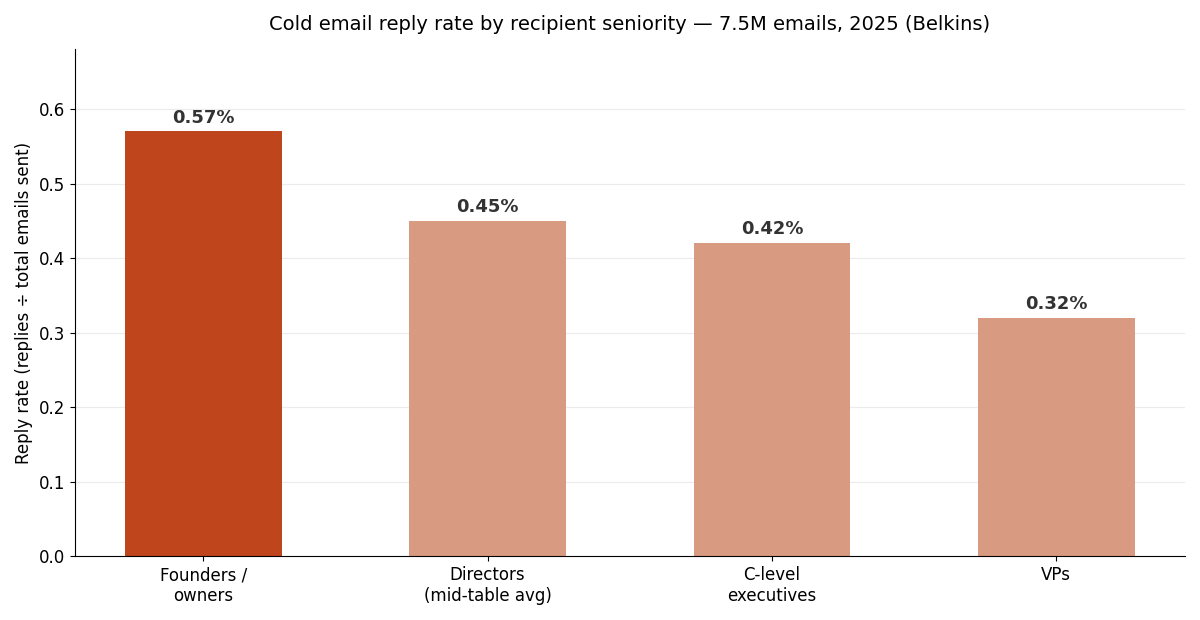
Read that chart as a targeting instruction. If you sell to indie founders, small agencies, or early-stage teams — which describes most solo SaaS products — you're fishing in the most responsive pond that exists. No executive assistant filters a founder's inbox. If your message is relevant, they read it themselves and reply themselves.
Timing matters too, and it flipped recently. Belkins' 2025 data shows morning sends (8 AM–noon, recipient's timezone) drove the highest reply rates at 0.54%, with Wednesday and Thursday the best weekdays. Late-evening sends — the old conventional wisdom — now perform worst.
One more baseline number to hold onto: Backlinko's analysis of 12 million outreach emails found only 8.5% of outreach emails get any response at all (their dataset skews toward warmer link-building outreach, hence the higher figure). Whichever dataset you trust, the conclusion is the same. Cold outreach works as a precision tool. It fails as a spray gun.
I leaned on cold outreach in the early weeks of Coding Capybaras, alongside the launch tactics I covered in how to get your first 100 customers. It was the single most uncomfortable channel — and the one where a single good reply turned into a paying customer more directly than anything else.
Build the list before you write a word
The script fails without a list that deserves it, and this is where most solo founders start backwards — writing the perfect email first, then hunting for anyone to send it to. Reverse it. The list defines what the email can say.
My working definition of a qualified prospect has three tests:
They exhibit the problem publicly. Not "they're in the industry" — they've shown the pain somewhere you can point to. A founder tweeting about churn. An agency's careers page hiring for the exact role your product replaces. A Show HN comment describing your problem in their words. Public evidence is what powers the first line of the script; no evidence, no email.
They match the size band that replies. Remember the company-size curve: 0–10 employee companies reply at 0.72%, enterprises at 0.22%. For a solo founder, the sweet spot is companies small enough that the person you email can decide alone, and just large enough to have budget. For most indie SaaS, that's the 1–50 employee range.
You can find the actual human. Generic info@ addresses convert like wet cardboard. You want the founder or the person who owns the problem, with a verified direct address. This is where an enrichment tool like Apollo earns its cost — filter by headcount, role, and tech stack, then verify before sending.
Where the good lists hide, in rough order of quality: recent Product Hunt launchers in an adjacent category (they have momentum and budget, and their pain is fresh), engaged commenters in niche subreddits and communities, people who follow or reply to your competitors on X, attendees of niche virtual events, and job boards — a company hiring for a problem is a company feeling it.
Budget your time honestly: building 25 qualified prospects takes about as long as writing 25 first lines, roughly two hours for both. That's the daily unit of cold outreach as a solo founder. It feels slow until you compare it to the alternative — 500 unqualified sends that produce zero replies and a scorched domain.
The exact cold outreach script (steal this)
Here's the template. It's under 90 words in the body, because nobody reads paragraph four of a stranger's email.
Subject: {specific thing they did} + {your product category}

Hi {first name},

Saw {specific, verifiable thing — their launch post, a tweet,
their pricing page, a job listing}. {One sentence reaction
that proves you actually looked.}

I built {product} for {person exactly like them} dealing with
{problem in their words}. {One proof point that isn't about
you: a result, a number, a named customer with permission.}

Worth a look? Happy to send a 90-second Loom of exactly how
it'd work for {their company} — no call required.

{Your name}
{One-line signature: real name, real product, real URL}
Why each line earns its place:
The subject line references them, not you. "Your Product Hunt launch + onboarding emails" beats "Quick question" every time, because it's un-fakeable. Backlinko's data found personalized subject lines boost response rates by 30.5%. Generic subject lines are the first spam signal a human applies.
The first line is the personalization budget — spend all of it there. One specific, verifiable observation. Not "I love what you're building" (fake-able in bulk, and everyone knows it). Something like "saw you're hiring a support contractor — guessing ticket volume outgrew founder-inbox mode." That sentence proves a human looked, which is the entire game in 2026, when every inbox is drowning in AI-generated "personalization."
The problem sentence uses their vocabulary. If your buyers say "webhook hell," write "webhook hell," not "event-driven integration challenges." I keep a note of exact phrases from Reddit threads and support emails for this. It's the same listening muscle I use for Reddit distribution — the channel where founders complain in their native language.
The proof point borrows credibility instead of claiming it. "Two agencies replaced their $400/mo tool with this last month" beats "we're the leading platform for…" — one is evidence, the other is noise.
The ask is deliberately tiny. "Worth a look?" plus an offer of a short async Loom. You're not asking for a 30-minute call from a stranger. You're asking for a yes/no that costs them four seconds. The meeting comes later, after they've replied.
What the script never includes: multiple links (spam signal), attachments (spam signal), five paragraphs about your feature set, or the phrase "I know you're busy, so I'll keep this short" — which is never followed by a short email.
The follow-up sequence that does the heavy lifting
Here's the part most solo founders skip, and it's the most expensive skip in outreach. Backlinko found that sending a single additional follow-up boosts replies by 65.8%, and emailing the same contact multiple times generates roughly 2x the responses of one-and-done sends.
Silence usually isn't rejection. It's a founder who saw your email on their phone during a support fire and never scrolled back. The follow-up is the scroll-back.
My sequence is four touches over about three weeks:
| Touch | Timing | Content | Length | | --- | --- | --- | --- | | Email 1 | Day 0 (Wed/Thu morning) | The full script above | ~90 words | | Email 2 | Day 3–4 | Reply to your own thread. Add ONE new thing: a relevant resource, a customer result, a Loom link | ~50 words | | Email 3 | Day 8–10 | Different angle on the same problem — a mistake you see people make, with the fix | ~60 words | | Email 4 | Day 18–21 | The polite close: "Guessing timing's off — I'll stop here. Door's open if climbs the list." | ~35 words |
Two rules that keep this from becoming spam:
Every follow-up adds value. "Just bumping this to the top of your inbox" adds nothing and burns goodwill. A new proof point, a new resource, or a new angle earns the touch.
Email 4 actually closes the loop. The breakup email consistently pulls replies from people who meant to respond weeks ago — and it signals you're a professional, not a sequence robot that fires forever. After it, stop. Move them to a "revisit in 6 months" list.
Reply handling is its own skill: answer within a few hours if you can, keep the momentum async (send the Loom the same day), and only propose a call once they've engaged twice. Every reply — even a "not now" — is a warm contact for your launch list, which is exactly how I seeded the audience for my Product Hunt launch.
Deliverability: the unglamorous plumbing that decides everything
None of the copywriting matters if the email lands in spam, and the bar moved permanently in 2024. Google and Yahoo now enforce sender requirements that apply pressure at every volume level: SPF and DKIM authentication, a DMARC policy, a one-click unsubscribe option, and a spam-complaint rate under 0.3% (Google recommends staying under 0.1%). The 5,000-emails-per-day threshold gets quoted a lot, but as MarTech's coverage notes, authentication is effectively table stakes for everyone now — Gmail escalated from delaying unauthenticated mail to outright rejecting it.
The solo founder's deliverability checklist:
- Never send cold outreach from your main domain. If codingcapybaras.com got flagged for spam, my transactional email — receipts, magic links, password resets — would burn with it. Buy a sibling domain (I'd use something like codingcapybaras.io) and send cold from there.
- Set up SPF, DKIM, and DMARC on the sending domain. Every sending tool documents this; it's 30 minutes of DNS records. Unauthenticated mail in 2026 simply doesn't arrive.
- Warm the domain up. New domains that jump to 200 sends/day get flagged. Start at 10–20/day and ramp over 3–4 weeks. Tools like Instantly automate warm-up and inbox rotation.
- Verify every address before sending. A bounce rate above 2–3% torches your sender reputation. An email finder plus verifier like Hunter handles both sides.
- Include a real opt-out. A plain "reply 'no' and I'll never email you again" line satisfies the spirit of the rules for 1:1 outreach and, more importantly, gets honored complaints instead of spam-button complaints.
This is also your volume ceiling as a solo founder: 20–40 genuinely researched emails a day, not 500 templated ones. That's not a limitation — the Belkins data shows lower-volume, better-targeted campaigns consistently outperform. Precision is the strategy, not the compromise.
When cold outreach is the wrong channel
Honest section, because cold email evangelists skip it and founders waste months finding out the hard way.
Cold outreach fails for low-priced self-serve products with broad audiences. The math is unforgiving: at a 0.5% reply rate and maybe a 20% reply-to-customer conversion, 1,000 painstakingly researched emails might produce one paying customer. If your product costs $9/month, that's a terrible hourly wage. Cold outreach earns its keep when a customer is worth hundreds of dollars or more — annual plans, lifetime deals, agencies, B2B tools with expansion revenue.
It fails when you can't articulate exactly who has the problem. "Anyone building a SaaS" is not a targetable segment. "Agencies with 5–15 people still doing client reporting in spreadsheets" is. If you can't write the first line of the script — the specific, verifiable observation — you don't know your target well enough to cold email them yet.
It fails as a substitute for distribution you haven't built. Cold email is a spark, not a fire. It works best when the recipient can Google you and find something: a landing page with real customers, an active X account, a blog. That's why I run it alongside building in public on X rather than instead of it — outreach starts conversations, and public presence closes the credibility gap that a stranger's email opens.
If your product fits the failure modes above, put these hours into SEO, communities, and launch platforms instead. The channels compound differently: outreach is linear (more emails, more replies), while content and community compound. The best growth stack I know for a solo founder uses outreach to get the first 20 customers and conversations, then graduates to channels that scale without your keyboard.
Frequently asked questions
How many cold emails should I send per day as a solo founder?
Start at 10–20 per day from a warmed-up secondary domain, and cap around 30–50 even at full speed. The Belkins data shows smaller, better-targeted campaigns outperform volume plays — and staying far below bulk-sender thresholds keeps you out of the strictest enforcement tier.
What reply rate should I expect from cold outreach?
Benchmark against 0.45% of total sends (the 2025 average across 7.5M emails), and treat anything above 1% as strong. If you're targeting founders at small companies with genuinely personalized first lines, 1–2% is achievable. Measure replies per send, not opens — open tracking is unreliable and the pixel hurts deliverability.
Should I use AI to write my cold emails?
Use AI for research compression — summarizing a prospect's site, launch history, and recent posts — and write the first line yourself. Fully AI-generated "personalization" has a tell, and founders' inboxes are now full of it. The script above works precisely because the observation in line one can't be faked at scale.
Is cold email legal for SaaS founders?
In the US, CAN-SPAM permits unsolicited B2B email if you identify yourself honestly, include a working opt-out, and honor it promptly. The EU (GDPR/ePrivacy) and Canada (CASL) are much stricter — consent or documented legitimate interest is required, so most solo founders simply exclude EU/Canadian prospects from cold sequences. This isn't legal advice; check the rules for your market before sending.
How long should my cold email be?
Under 100 words in the body. Backlinko's data shows longer subject lines outperform, but the body is a different animal: your reader decides in one phone screen whether to reply, archive, or report. Four short paragraphs, one link, one question.
What's the best day and time to send cold email?
Wednesday or Thursday morning, 8 AM to noon in the recipient's timezone — the top-performing slot in 2025 data at 0.54%. Avoid Friday afternoons and late evenings; the old "8–11 PM so you're on top of the morning inbox" trick no longer works, likely because AI inbox triage buries overnight mail before humans see it.
Conclusion
A cold outreach SaaS script converts when everything around it is built for precision: a small list of people who verifiably have the problem, a first line no robot could write, three follow-ups that each add something, and deliverability plumbing that gets you into the inbox at all. Expect fractions of a percent, aim them at founders and small teams, and treat every reply — even the no's — as a relationship deposit. Twenty researched emails a day beats five hundred templated ones, and the data now proves it.
If you're building your SaaS with AI coding tools, Coding Capybaras is the free boilerplate I built for exactly this stage — auth, billing, and email already wired, so your outreach hours go toward customers instead of infrastructure.