SOC 2 for Indie SaaS: When You Need It | Coding Capybaras
What SOC 2 costs an indie SaaS, how long it takes, the deal size that actually triggers it, and what enterprise buyers accept instead while you wait.
· Justin Boggs

Photo by Olena Kholina on Unsplash
Most indie SaaS businesses do not need SOC 2, and the ones that do usually find out from a single email. A prospect forwards a security questionnaire, or their procurement team asks for "your SOC 2 report" before legal will look at the contract. That email is the trigger — not your revenue, not your headcount, not a feeling that you should look more professional. SOC 2 for an indie SaaS is a sales unblocker with a price tag between roughly $12,000 and $100,000 and a timeline measured in months, so the honest answer to "do I need it?" is: not until a deal you want is blocked without it.
TL;DR
- SOC 2 is a sales unblocker, not a security upgrade. Pursue it when a specific deal requires it, not preemptively.
- A first Type 2 report typically takes 6–15 months end to end and costs $12,000–$100,000+, depending on scope and firm.
- Type 1 proves your controls are designed correctly today; Type 2 proves they operated correctly over a 3–12 month window. Enterprise buyers usually want Type 2.
- Before you have a report, most mid-market buyers will accept a completed security questionnaire, a public trust page, a signed DPA, and your subprocessors' SOC 2 reports.
- Do the underlying work now (access control, logging, backups, incident plan). It's cheap, it's useful anyway, and it shortens the audit later.
I have not put Coding Capybaras through a SOC 2 audit. I looked hard at whether I needed one, decided I did not, and wrote down why. This post is that research, plus the framework I'd use to make the call again. If you're selling to enterprises today and getting blocked, skip to the cost and timeline section. If you're pre-launch and wondering whether SOC 2 belongs on your roadmap, the short answer is no, and the rest of this explains what to do instead.
What is SOC 2, and what does the report actually prove?
SOC 2 is an attestation report, written by a licensed CPA firm, stating that an independent auditor examined your security controls and found them adequate. It is not a certification, not a government standard, and not something you can self-declare. It comes out of the AICPA's System and Organization Controls suite of services — the same professional body that governs financial audits.
The report is graded against the Trust Services Criteria. There are five: Security, Availability, Processing Integrity, Confidentiality, and Privacy. Security is mandatory. The other four are optional, and you pick the ones that match what you actually promise customers. A scheduling tool that promises uptime might add Availability. A tool handling health or financial records might add Confidentiality. Every criterion you add expands the audit scope, and scope is the single biggest lever on cost.
The thing that surprises founders: SOC 2 does not define specific controls. There's no checklist that says "use 14-character passwords" or "rotate keys every 90 days." The criteria are outcome-based. You decide what controls meet the objective, document them, and the auditor tests whether what you documented is what you actually do. That's why two companies with wildly different stacks can both hold a clean SOC 2 report.
Type 1 versus Type 2, in one sentence each
A Type 1 report says your controls were suitably designed on a specific date. The auditor looks at your policies, your configuration, your current access list, and signs off that the design is sound.
A Type 2 report says your controls were suitably designed and operated effectively over a period of time — an observation window that runs 3 to 12 months. The auditor samples evidence from across that window: access reviews, incident tickets, change logs, onboarding records.
That distinction is the whole game. A Type 1 proves intent. A Type 2 proves habit. Enterprise procurement teams have learned to tell the difference, which is why a Type 1 buys you goodwill and a deadline, not a signature.
One more thing worth knowing before you shop: the AICPA itself has been publicly uneasy about the "SOC 2 in two weeks" end of the market. The Journal of Accountancy ran a piece in February 2026 titled "Promises of 'fast and easy' threaten SOC credibility," and the AICPA has published notices about evaluating SOC vendors and auditors carefully. If a firm promises you a Type 2 report faster than an observation period physically allows, that report may not hold up when a real procurement team reads it.
When does an indie SaaS actually need SOC 2?
Here's the framework I use. SOC 2 is worth pursuing when a named deal, with a known contract value, is blocked on it, and that value comfortably exceeds the total cost of getting the report.
Three conditions, all three required:
A named deal. Not "enterprises might ask someday." A specific company, with a specific champion, who has told you in writing that procurement needs the report. Speculative compliance is how founders burn a quarter on paperwork nobody asked for.
A known contract value. If the deal is worth $8,000 a year and the report costs $30,000, you are not doing compliance, you are doing charity. Ask what the contract is worth annually, and what the renewal looks like. SOC 2 is an annual expense, not a one-time one — reports are treated as valid for about 12 months and require renewal.
A repeatable pattern. One blocked deal is a data point. Three blocked deals in the same segment is a market telling you where your ceiling is. The second is worth paying for; the first often isn't.
If you're selling to solo founders, small agencies, indie developers, or SMB teams that swipe a card on a pricing page, you will likely never be asked. That's most of the indie SaaS world. The buyers who ask are regulated industries — fintech, healthtech, govtech — and any company big enough to have a dedicated vendor-risk function. Regulated buyers essentially never accept a point-in-time snapshot, so if that's your market, budget for Type 2 from the start.
There's also an honest counter-case. Some founders pursue SOC 2 early on purpose: it's a credible signal in a crowded category, it forces discipline that would otherwise slip, and it can be a wedge into a segment competitors haven't served. That's a legitimate strategic bet. Just call it a bet on positioning rather than a security necessity, and price it accordingly against everything else that money could buy — which for most solo founders is distribution and first customers.
What does SOC 2 cost, and how long does it take?
This is where most published numbers get slippery, because "cost" can mean the audit fee alone or the all-in program cost. Both matter, and they're very different.
Drata's comparison of Type 1 and Type 2 reports puts audit costs at $7,500–$60,000 for a Type 1 and $12,000–$100,000+ for a Type 2, with first-time timelines of 3–6 months and 6–15 months respectively. Those are audit-fee ranges. On top of that sit the compliance automation platform, any remediation work, and your own time — which for a solo founder is the expensive part nobody puts on the invoice.
The timeline is driven almost entirely by one choice: how long your observation window runs.
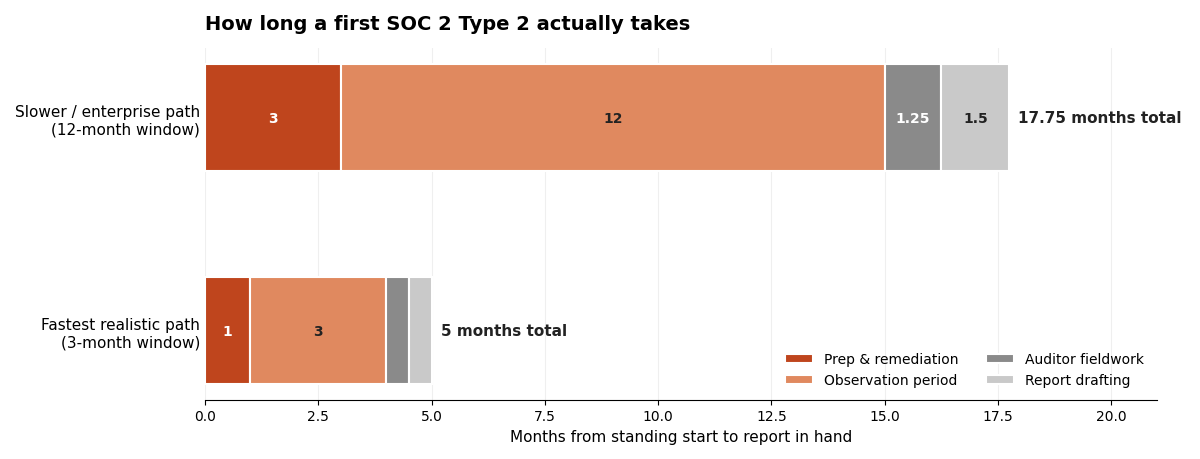
Vanta's guidance on observation periods matches what the audit firms say: most organizations pick 3 months for a first Type 2 to get a report back quickly, then move to 12-month windows for renewals. Three months is the practical floor. Twelve months is what enterprise renewals settle into.
| | SOC 2 Type 1 | SOC 2 Type 2 | | --- | --- | --- | | What it tests | Control design, on one date | Design plus operating effectiveness | | Observation period | Point in time | 3–12 months | | First-time timeline | 3–6 months | 6–15 months | | Typical audit cost | $7,500–$60,000 | $12,000–$100,000+ | | Evidence needed | Policies, screenshots, access lists | Access reviews, scan results, incident records | | Enterprise acceptance | Temporary, with a commitment | The expectation | | Renewal | Usually superseded by Type 2 | Annual |
The strategic move most growing companies make is the stepping stone: run a Type 1 to get a report in a prospect's hands, start the Type 2 observation window the same week, and hand over the Type 2 when it lands. That gets you a document to send while the clock runs. It costs more in total than going straight to Type 2, and it only makes sense when a real deal is waiting.
Two things reliably blow up the timeline, and both are avoidable. The first is scope creep — adding Availability and Confidentiality criteria mid-engagement because someone asked. Lock scope before you sign with an auditor. The second is manual evidence collection. If proving "we review access quarterly" means screenshotting things by hand across six tools, you'll lose weeks to it. This is exactly what the compliance automation platforms sell, and for a small team it's usually cheaper than the hours it replaces.
What buyers accept while you don't have a report
This is the section I wish someone had written for me, because "we don't have SOC 2" is not the end of a sales conversation. It's the start of a negotiation, and you have more to offer than you think.
A completed security questionnaire. Most enterprise buyers send a standardized questionnaire — often SIG Lite or a CAIQ, sometimes a homegrown spreadsheet. Answering it thoroughly and fast is worth real credibility. Answer honestly, including the "no" answers, with a note on what you do instead. Procurement teams read hundreds of these; the ones that get flagged are the ones where every answer is a confident yes.
A public trust page. A single page on your site listing your subprocessors, where data is stored, your encryption posture, your backup cadence, and how to report a vulnerability. It costs an afternoon and it answers half the questionnaire before anyone sends it. Pair it with a status page for uptime transparency and you've covered the two questions buyers ask most.
Your subprocessors' reports. If you run on Vercel, Supabase, and Stripe, your infrastructure sits on top of vendors who all hold their own SOC 2 reports. That doesn't transfer to you — you still own your own controls — but naming them and linking their trust pages materially changes the risk conversation. It reframes "this is one person's laptop" into "this is a thin application layer on audited infrastructure."
A signed DPA and clear legal terms. For European customers this is often the actual requirement, and it's a GDPR obligation rather than a SOC 2 one. Having a data processing agreement ready to sign, with your subprocessor list attached, removes a step that otherwise takes weeks. Your terms of service and privacy policy should already say the same things your questionnaire does.
A written incident response plan. Buyers want to know what happens at 2 a.m. when something breaks. A one-page plan naming who gets contacted, in what order, and what the customer notification timeline is, does most of that work. I wrote up the incident plan I actually use, and it's short on purpose — a plan you won't read at 2 a.m. isn't a plan.
A commitment with a date. "We're starting our Type 2 observation period in Q1 and expect a report by Q3" is a real answer. Some buyers will sign with that commitment written into the contract. Only offer it if you mean it.
The work that isn't wasted either way
Here's the part that makes this decision easier: almost everything a SOC 2 auditor will eventually ask about is something you should be doing anyway, and most of it is free.
Access control. Every service should use SSO or unique accounts with MFA, and you should be able to produce a list of who has access to what. For a solo founder that list is short, which is an advantage, not an embarrassment. Write it down. Review it when anything changes.
Secrets handling. No credentials in the repo, no keys in a Slack message, one place where secrets live. I keep mine in .env.local only, and the region rules in the Coding Capybaras codebase enforce it — the full approach is in how I handle environment variables and secrets.
Least-privilege data access. If your database enforces row-level security, you can answer "how do you prevent one customer from reading another's data" with a policy file instead of a paragraph of prose. Supabase row-level security is the version I use, and it's a much stronger answer than application-layer checks.
Backups you've actually restored. Everyone has backups. Far fewer have restored one. Do a restore once, write down how long it took, and you've answered a question most vendors fumble.
Logging and change history. Git history covers code. For infrastructure and access changes, some record that isn't your memory. This is the control that's painful to reconstruct retroactively, so starting early is worth more here than anywhere else.
A vendor list. Every SaaS tool that touches customer data, what it's for, and what it can see. Ten minutes to write, and it's the first question on nearly every questionnaire.
Do those six things and you've built the substance of a security program without spending a dollar on an audit. If a SOC 2 becomes necessary later, you walk into the readiness assessment with most of your controls already operating — which is exactly what shortens the timeline and the bill.
Frequently asked questions
Do I need SOC 2 to sell to enterprise customers?
Usually yes, eventually — but not to start a conversation. Mid-market buyers often accept a completed security questionnaire plus a written commitment to obtain a Type 2 report within a defined timeframe. Regulated industries like finance and healthcare are the exception; their procurement teams typically will not accept a point-in-time snapshot or a promise.
Can I get SOC 2 as a solo founder with no employees?
Yes. Company size doesn't disqualify you, and a small scope is genuinely easier to audit. The controls still have to be documented and operating — segregation of duties gets interpreted differently for a one-person company, and your auditor will tell you how they handle it. The cost, however, does not scale down proportionally with headcount.
How much does SOC 2 cost for a small SaaS?
Audit fees run roughly $7,500–$60,000 for Type 1 and $12,000–$100,000+ for Type 2. Add a compliance automation platform and any remediation on top. The variance comes from scope, how many Trust Services Criteria you include, and which firm you hire — so get more than one quote.
Is SOC 2 the same as ISO 27001 or GDPR compliance?
No. SOC 2 is a US-centric attestation report from a CPA firm. ISO 27001 is an international certification of an information security management system, and it's what European and Asian buyers more often ask for. GDPR is a law, not a report — you comply with it whether or not you hold either certification.
How long is a SOC 2 report valid?
Reports don't formally expire, but their usefulness does. A Type 2 report is generally treated as valid for 12 months, and buyers expect annual renewal with continuous observation periods. A report with a stale observation window will get questioned.
Should I get Type 1 first or go straight to Type 2?
Go straight to Type 2 if you can afford three months of waiting and no deal is blocked right now. Do Type 1 first only when a specific deal needs a document in hand sooner than a Type 2 can produce one — then start the observation window immediately so you're not paying twice for the same year.
The decision, stated plainly
SOC 2 for an indie SaaS is a sales expense that happens to improve your security posture, not a security expense that happens to help sales. Framed that way, the decision gets easy. If a named deal worth materially more than the report is blocked on it, buy the report. If not, spend the money on customers and spend an afternoon on the trust page, the questionnaire answers, and the six controls above.
The mistake I see most often isn't skipping SOC 2 — it's pursuing it out of insecurity, months before any buyer asked, while the actual problem was that not enough people knew the product existed. Compliance is a ceiling-raiser. It doesn't build the floor.
I'm building Coding Capybaras as a free boilerplate for non-technical founders shipping with AI coding tools, and the security defaults — row-level security, secrets isolation, webhook signature verification — are wired in from the first commit specifically so this conversation starts from a better place than a blank Next.js app.