When to Add a Free Tier to Your SaaS | Coding Capybaras
A free tier strategy either fills your funnel or quietly kills your business. Here's the framework, the 2026 conversion data, and when free is the wrong call.
· Justin Boggs

Photo by Eugene Chystiakov on Unsplash
Add a free tier when free users make paid users more likely — and skip it when they don't. That's the whole test, and almost every founder gets it wrong because they reason about the free tier as a marketing channel instead of as a cost center with a job. A free tier earns its keep in exactly three ways: it creates word-of-mouth, it produces network effects, or it teaches people something they can't learn from your landing page. If your free tier does none of those, you've built a permanent expense that converts at 3-5% and answers support tickets forever. This post is the decision framework, the actual 2026 numbers, and the arithmetic that tells you which side you're on.
TL;DR
- Free tiers cost more in 2026 than they did in 2020. AI token costs mean every free user burns real money, so "serving one more free user is free" is no longer true.
- The median free-to-paid conversion across 200 B2B products is 8%, but for freemium specifically, 3-5% is good and 8-12% is great. Plan for 4%, not 40%.
- Freemium wins the funnel (90 signups per 1,000 visitors vs. 45 for trials) but a credit-card trial wins the sale (10.5 paying customers per 1,000 vs. 5).
- The killer question isn't "free or paid" — it's what real cost do I incur per free user, and what do I get back that I couldn't buy cheaper?
- If your honest answer is "more signups," you want a trial. Free tiers are for products where free users create value for the people who pay.
What a free tier actually is (and what it isn't)
Let's separate three things people mush together. A free tier is a permanently free version of your product with feature or usage limits, that a user can stay on indefinitely. A free trial is time-limited access to the full product. A reverse trial is a hybrid — full product for 14 days, then a drop to the free tier instead of a lockout.
The difference that matters is what expires. In a trial, time expires, which manufactures a decision. In a free tier, nothing expires, so the limits have to manufacture the decision instead. That's a much harder design problem, and it's why free tiers fail in two symmetrical ways: too stingy and nobody reaches the aha moment, so nobody converts; too generous and everybody reaches the aha moment and stops there, so nobody converts.
ChartMogul's 2026 SaaS Conversion Report — built by Kyle Poyar with ProductLed from a January 2026 survey of 200 B2B software products — puts a fine point on this. In their words: "The worst middle ground is a timid free experience that neither drives adoption nor creates urgency to buy." That sentence describes the free tier most founders ship, because it's what you get when you pick the free tier limits by feel in an afternoon.
Here's the market shape from that same report. Free trials are the primary entry point for 57% of products — more than double freemium's 26%. Reverse trials are 7%, interactive demos 7%, paid trials 4%. But the split isn't uniform: 61% of pure SaaS products lead with a trial, versus 51% of AI/SaaS hybrids and just 43% of AI-native products. AI-native products skew toward free tiers because their aha moment happens in the first thirty seconds, not after a setup weekend.
That's the real signal in the data. The free-versus-trial choice isn't about taste. It tracks a property of your product: how long does it take a stranger to feel the value? If it's instant, a free tier is plausible. If it takes setup work, a trial clock is doing you a favor by forcing the setup to happen this week instead of never. I made this same argument from a different angle in the free trial vs. freemium vs. paid-only breakdown — this post is the other half: assuming free is on the table, when should you actually pull the trigger.
The three jobs a free tier can do
A free tier is worth its cost only if it does at least one of these. Not "might eventually." Does.
Job 1: Word-of-mouth. Free users tell other people about you. This works when the product is visible in use or the free user has a reason to talk. Dropbox is the canonical case — free storage plus a referral loop that paid out in the currency of the product itself. If your product is a back-office tool nobody sees and nobody brags about, free users won't generate word-of-mouth just because they exist.
Job 2: Network effects. Free users make the product better for paying users. Slack's free tier put whole teams inside a workspace; the paid upgrade was bought by the org that already lived there. Figma's free viewers made paid editors more valuable. Test it honestly: if you deleted every free user tonight, would your paying customers notice? If no, you don't have network effects — you have guests.
Job 3: Teaching. The product is hard to explain and easy to feel. This is the AI-native pattern, and it's why 38% of freemium products in the ChartMogul data now let users try the product before creating an account at all. You can't put "watch it write a working migration in nine seconds" on a landing page in a way that lands. You have to let people watch it.
Notice what's not on this list: "getting more signups." More signups is not a job. It's a metric, and it's the metric most likely to talk you into a free tier you'll regret, because a signup that never converts and never refers anyone is a liability wearing the costume of traction.
Notice also what's not on the list: lead generation. Kyle Poyar's take in the report is blunt about the email-capture instinct — "What good is capturing an email address if the person has written-off your product?" If the only thing your free tier buys is an address for a drip campaign, buy the address a cheaper way. I wrote about what those sequences can and can't do in the lifecycle email guide, and the honest answer is that no email sequence rescues a free user who never found the value.
What do the 2026 numbers actually say?
Set your expectations against real data before you set them against your hopes. From the ChartMogul/ProductLed report, here's what good and great look like by model:
| Model | GOOD | GREAT | | --- | --- | --- | | Freemium, regular signup | 3-5% | 8-12% | | Freemium, ungated (no account needed) | 7-9% | not reported | | Free trial (all trial products) | 4-6% | 10-15% | | Reverse trial* | 4-6% | 8-12% | | Free trial, credit card required | 25-35% | 50-60% |
*The report notes the reverse-trial sample was relatively small and the difference is not statistically significant.
The median across all 200 products is 8%. But as the report notes, very few products actually sit at 8% — there's a 10x spread between the top and bottom quintiles. For freemium specifically, one in four products converts under 2.5% of free users within six months. If you're modeling your free tier at 20% conversion, you are modeling a product that essentially doesn't exist.
Now the part that complicates the easy conclusion. Conversion rate is only half the equation — you can only convert people who signed up in the first place. Here's the full funnel per 1,000 website visitors:
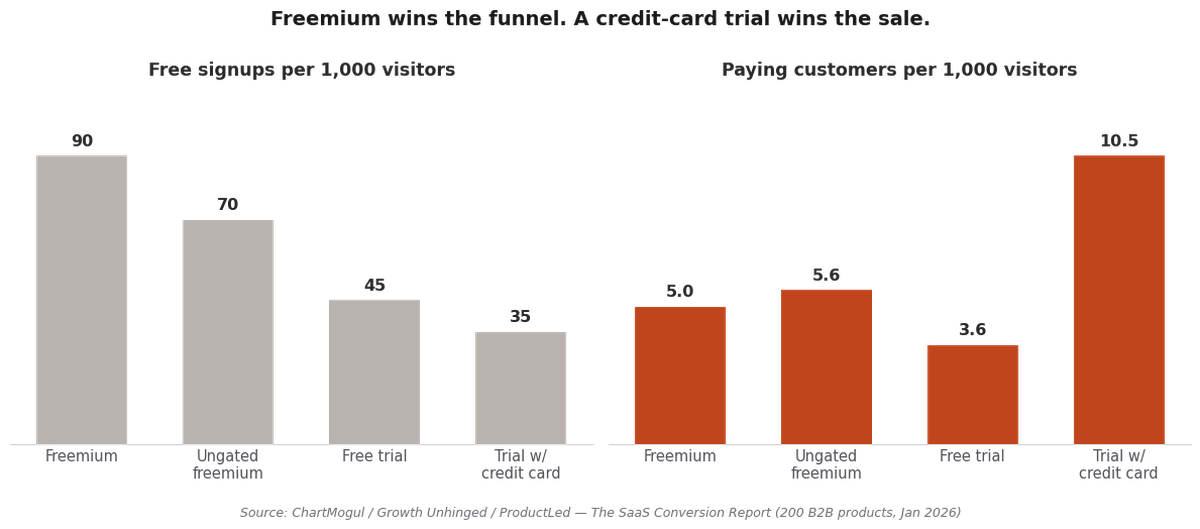
Read those two panels together and the picture inverts twice. Freemium doubles your signups over a trial (90 vs. 45) — and still beats it on paying customers (5.0 vs. 3.6), because the funnel is so much wider that the weaker conversion rate doesn't matter. So freemium beats trials outright? Not quite. A credit-card-required trial produces the fewest signups of any model (35) and twice the paying customers of freemium (10.5).
So the data doesn't say "free tiers are good" or "free tiers are bad." It says the two ends of the spectrum both work and the middle is where products go to die. Open the product all the way up and win on volume, or gate it with a card and win on intent. A polite, medium free tier — signup wall, no card, cautious limits — is the shape that loses on both axes at once.
The question that actually decides it: what does a free user cost you?
Here's what changed since the last time you read a freemium article. ChartMogul's own executive summary flags it: "Supporting free users has gotten much more expensive as AI token costs have remained high."
The entire freemium playbook was built on an assumption from a cheaper era — that serving one more free user costs approximately nothing. Storage was cheap, bandwidth was cheap, and a dormant free account cost you a database row. That assumption is dead for any product with AI in the loop. Every time a free user hits Enter, your inference bill moves.
Vikas Kansal, who leads product for Google AI subscriptions, wrote up this exact wall in Lenny's Newsletter, and his framing is the most useful thing I've read on 2026 pricing. Google's problem was that their free tier was too good: "Users rightly asked themselves, 'Why should I pay $20 a month when the free version is already smarter than I am?'" The traditional SaaS move would be to paywall the best features — the way Slack gated message history. But for an AI product, gating the magic means users never form the habit, so there's no one left to upgrade.
Their answer is worth stealing even if you're not Google. Instead of gating intelligence, gate usage intensity — how much work a user can push through the system. Kansal's conclusion: "We found that gating usage intensity was a more powerful monetization lever than gating model intelligence." Midjourney does the same trick with Fast Mode versus Relax Mode — same output quality, different priority on the GPUs. Users pay for throughput, not for a better product.
For a solo founder, that translates into one arithmetic exercise you should do before you ship a free tier at all:
- Estimate your marginal cost per active free user per month. Inference, storage, email, third-party API calls. If you don't know, instrument it before you launch the tier, not after.
- Multiply by the free users you'd need to hit your paid target at a 4% conversion rate. Not 20%. Four.
- Add support. Free users file tickets, and they file them at a rate wildly out of proportion to their revenue. ProductLed's own breakdown of the six free models in SaaS lists "cost control" among freemium's named risks and "higher support rates" among its cons — this is a known failure mode, not bad luck.
- Compare that number to what the same money buys in any other channel.
If free is the cheapest way to acquire the customers who pay, ship it. If it isn't, you just talked yourself out of a very expensive mistake. This is the same discipline you'd apply to any other infrastructure line item — I mapped out what a genuinely cheap stack looks like in the free tier SaaS stack, and the irony is that founders who obsess over a $20 hosting bill will hand out unlimited free accounts without ever putting them on the spreadsheet.
When a free tier will kill your business
Four situations where I'd tell a founder not to do it, and mean it.
Your market is small. Freemium is a volume trade — you're accepting a low conversion rate in exchange for a huge top of funnel. If your total addressable market is 20,000 businesses, 4% of the fraction you reach isn't a business. You need pricing power and a smaller number of customers who pay more. Freemium is structurally the wrong instrument.
Your marginal cost per user is real. Covered above, and it's the single biggest change in this decision since 2020. If every free user costs you $2/month in compute and converts at 4%, each paying customer carries roughly $48/month of dead weight before you've paid yourself.
The free tier is a better product than your paid tier for most people. This is the cannibalization trap, and it's sneakier than it sounds because it doesn't feel like a mistake while you're building — being generous feels like being good. But if the free tier solves the whole problem for 80% of your users, you didn't build a funnel. You built a free product with a donation button. ProductLed names this outright in their risk list for the freemium model: "no incentive to upgrade."
You're using free to avoid the conversation. The one that actually kills indie SaaS. Free tiers are a great way to postpone learning whether anyone will pay you, and postponing that is the most expensive thing a first-time founder can do. Ten thousand free users and zero revenue is not traction — it's an unfalsified hypothesis with a hosting bill. If you're unsure whether your price is right, run a pricing experiment instead of hiding behind free.
There's also a one-way-door problem. Taking a free tier away is one of the worst days a founder can have. Adding one later is easy; removing one costs you goodwill, forum threads, and a week of your life. Given that asymmetry, the default should be to start narrower than feels comfortable and loosen later.
How I actually made this call for Coding Capybaras
I'll be honest that Coding Capybaras looks like it breaks my own rule, and I want to explain why rather than pretend it doesn't.
The free tier here isn't a limited version. It's the complete boilerplate — the entire codebase that runs this site. Pro is $97 one-time. By the framework above, that's a maximalist free tier that should cannibalize everything, and I shipped it anyway. Three reasons.
First, my marginal cost per free user is genuinely near zero. It's a code download, not an inference call. The 2020 assumption still holds for me specifically, and that's the exception that makes this work — not a rule you can borrow if you're running a product with GPUs behind it.
Second, the free tier does Job 3, and it's the only thing that could. The claim I'm making is "a non-technical founder can ship a real SaaS with this." Nobody believes that from a landing page. They have to download it, point Claude Code at it, and watch the thing work. A crippled demo would prove nothing, because the exact fear I'm addressing — it'll break the moment I touch it — can only be answered by the real code.
Third, I priced against a decision, not a paywall. Free is the code. Pro is the stuff that saves you time once you've decided to build: the deeper integration guides, the support. That's a bet that people who get value will pay for the next thing, and it lives or dies on whether the free thing is actually good.
If my costs were per-user instead of near-zero, I'd have made a different call, and it wouldn't have been close. The framework isn't "be generous." It's "know exactly what you're paying, and know exactly what it buys." You can see how that shook out on the pricing page — one free tier, one $97 door, no middle.
Frequently asked questions
What is a good free-to-paid conversion rate for a free tier?
For a freemium product with a normal signup, 3-5% is good and 8-12% is great, per ChartMogul's 2026 survey of 200 B2B products. If users can try the product without creating an account, good rises to 7-9%. Anyone quoting you 20%+ is describing a credit-card trial, not a free tier.
Should I launch with a free tier or add one later?
Later, in almost every case. Adding a free tier is easy; removing one is a public relations event. Launch with a trial, learn what your aha moment costs to reach, then decide whether free users would make your paying users more likely.
Does a free tier still make sense for AI products?
Yes, but not the 2020 version. Because inference costs money on every request, gate usage intensity — how much a user can run — rather than gating your best features. Google's AI subscriptions and Midjourney both landed on this, and the reasoning applies at any scale.
How do I stop my free tier from cannibalizing my paid plan?
Gate on something that grows with the user's success rather than on core functionality. Volume, seats, automation, and history all scale with how much someone relies on you. If your free tier fully solves the problem for the median user, the limits are in the wrong place.
Isn't a free tier the best way to get early feedback?
It's a cheap way to get a lot of low-signal feedback. Free users report bugs; they don't tell you what they'd pay for. Ten conversations with people who gave you money will teach you more than a thousand free signups.
What about a reverse trial — full product first, then drop to free?
It appears to land between the two (4-6% good, 8-12% great), though ChartMogul flags that the reverse-trial sample was small and the difference isn't statistically significant. It also means operating a trial and a free tier — two pricing models to get right instead of one. For a solo founder, that's usually a worse use of your attention than doing one model well.
The call
The free tier question looks like a pricing decision and isn't. It's a cost question wearing a growth costume. Answer the three questions the ChartMogul report ends on — do you want more people to use the product or more people to buy it, when does the aha moment actually land, and what does each free user really cost you — and the free tier strategy stops being a matter of opinion. It becomes arithmetic you can do in an afternoon.
The trap isn't picking wrong. It's picking by vibes, shipping a cautious middle-ground free tier, and spending eighteen months wondering why 12,000 signups produced $400 in MRR. Pick an end of the spectrum on purpose. Open it all the way up because free users genuinely make paid users more likely, or gate it because they don't. Both work. The polite middle doesn't.
If you're building the thing you'll eventually have to price, Coding Capybaras is the free boilerplate I built for founders shipping with AI coding tools — Stripe, Supabase, and the billing plumbing already wired, so the pricing decision is the hard part instead of the checkout page.