Free SaaS Tech Stack: Launch on $0/Month Infrastructure
A free SaaS tech stack that launches your business on $0/month — the actual free tiers for database, hosting, email, and storage, plus where each one breaks.
· Justin Boggs

Photo by Alex Knight on Unsplash
You can run a real, revenue-generating SaaS on a free SaaS tech stack for $0 per month — but only if you pick the free tiers carefully, because the most popular one has a rule that quietly forbids commercial use. The honest version of the $0 stack in 2026 is Supabase for the database and auth, Cloudflare Pages for hosting, Resend for transactional email, and Cloudflare R2 for file storage. Each ships a permanent free tier generous enough to carry a launching product through its first hundred users. The catch isn't usually price — it's the line in the fine print where "free" turns into "free for hobby projects only." This post walks the whole stack, piece by piece, and shows exactly where each free tier ends.
TL;DR
- A genuine $0/month SaaS stack exists in 2026: Supabase (Postgres + auth, 50k MAU free), Cloudflare Pages (hosting, unlimited bandwidth, commercial use allowed), Resend (3,000 emails/mo free), and Cloudflare R2 (10 GB storage, zero egress fees).
- The big trap: Vercel's free Hobby plan forbids commercial use. Any project that takes payment must be on a paid Vercel plan. For a truly free path, Cloudflare Pages or Netlify's free tier allow commercial sites.
- Supabase free pauses a project after one week of inactivity and caps you at 500 MB of database storage — fine for launch, a problem before you scale.
- Plan to spend roughly $0 at launch, ~$45/mo at early traction, ~$175/mo at ~10k users. The jump comes from one or two services at a time, not all at once.
- The free tier is for validating, not scaling. Ship on it, get your first paying customers, then upgrade the one service that's actually straining.
What does "free" actually mean for a SaaS stack?
A free SaaS tech stack is a set of cloud services whose permanent free tiers, combined, can host and run a small production SaaS without a monthly bill. The keyword is permanent. A 14-day trial is not a free tier. What you want are services that say, in writing, "this tier never expires as long as you stay under these limits."
In 2026, enough of those exist that you can wire together a complete stack — database, authentication, hosting, email, file storage — and pay nothing until you have real usage. That's a genuine shift from a few years ago, when "free" meant a trial credit that evaporated in a month.
But "free" has three different flavors, and confusing them is how founders get a surprise bill or, worse, an account suspension.
Free with hard caps. You get a fixed allowance, and when you hit it, the service stops until next month. Vercel's Hobby plan works this way: 100 GB of bandwidth, then the project pauses. No overage charge, but no service either.
Free with usage-based overage. You get an allowance, and past it you pay per unit. This is the most dangerous flavor for a beginner, because a traffic spike can produce a bill you didn't expect. Most database and storage services work this way once you're on a paid plan.
Free with a fair-use ceiling. You get generous, often "unlimited," usage, but the provider reserves the right to ask you to upgrade if you're clearly running a business at scale. Cloudflare Pages is the headline example — unlimited bandwidth even on the free plan, qualified by a fair-use policy.
The single most important distinction, though, isn't about limits at all. It's whether the free tier permits commercial use. Some do, some explicitly don't, and that one line decides whether your stack is actually free for a business or just free for a side project. I'll come back to it, because it's the trap that catches the most people.
The $0 stack, piece by piece
Here's the stack I'd actually reach for if I were launching today with no budget. It mirrors the Next.js + Supabase + Stripe + Resend combination I build on, with the hosting choice adjusted for the free-tier reality.
Database and auth: Supabase. Supabase's free tier gives you a 500 MB Postgres database, 50,000 monthly active users for authentication, 1 GB of file storage, 5 GB of database egress, and 500,000 edge function invocations, across two active projects. Per Supabase's pricing page, that's a permanent free tier, not a trial. For a launching SaaS, 50,000 auth users is enormous headroom — you'll hit the 500 MB database ceiling or the inactivity pause long before you run out of user slots. If you're weighing the alternative, I broke down Supabase versus Firebase in detail.
Hosting: Cloudflare Pages. This is where the free stack gets opinionated. Cloudflare Pages offers unlimited bandwidth on its free tier, no credit card required, and — critically — commercial use is allowed. For a static or server-rendered frontend, that's hard to beat at $0.
Email: Resend. Resend's free tier is 3,000 emails per month with a cap of 100 per day, per Resend's pricing. For transactional email — password resets, magic links, receipts, the welcome message — that carries a launch comfortably. The 100/day cap is the part that bites first; one busy onboarding day can brush against it. I compared Resend against Postmark and Mailgun if you want the deliverability angle.
File storage: Cloudflare R2. R2 gives you 10 GB of storage free with zero egress fees, always — meaning serving those files to users costs nothing. For user avatars, uploads, and assets, that's the most founder-friendly storage economics in the market, because egress is the line item that usually surprises people on other providers.
Domain. This is the one piece that genuinely isn't free. A .com runs roughly $10–15 a year. Budget for it; it's the cheapest credibility you'll ever buy.
How far does the free tier actually take you?
Here's how the four core services line up, free tier against the limit that matters most.
| Service | Role | Free tier | First limit you'll hit | Commercial use? | | --- | --- | --- | --- | --- | | Supabase | Database + auth | 500 MB DB, 50k MAU, 1 GB files | 500 MB database, or 1-week inactivity pause | Yes | | Cloudflare Pages | Hosting | Unlimited bandwidth, fair-use | Worker invocation limits on dynamic routes | Yes | | Resend | Transactional email | 3,000/mo, 100/day | 100 emails/day | Yes | | Cloudflare R2 | File storage | 10 GB, zero egress | 10 GB stored | Yes |
The pattern in that table is the whole point: each service breaks on a different axis. Supabase breaks on database size and inactivity. Resend breaks on daily volume. R2 breaks on total storage. They don't all run out at once, which is exactly why a free stack works for a launch — you grow into the paid tiers one service at a time, not in a single cliff.
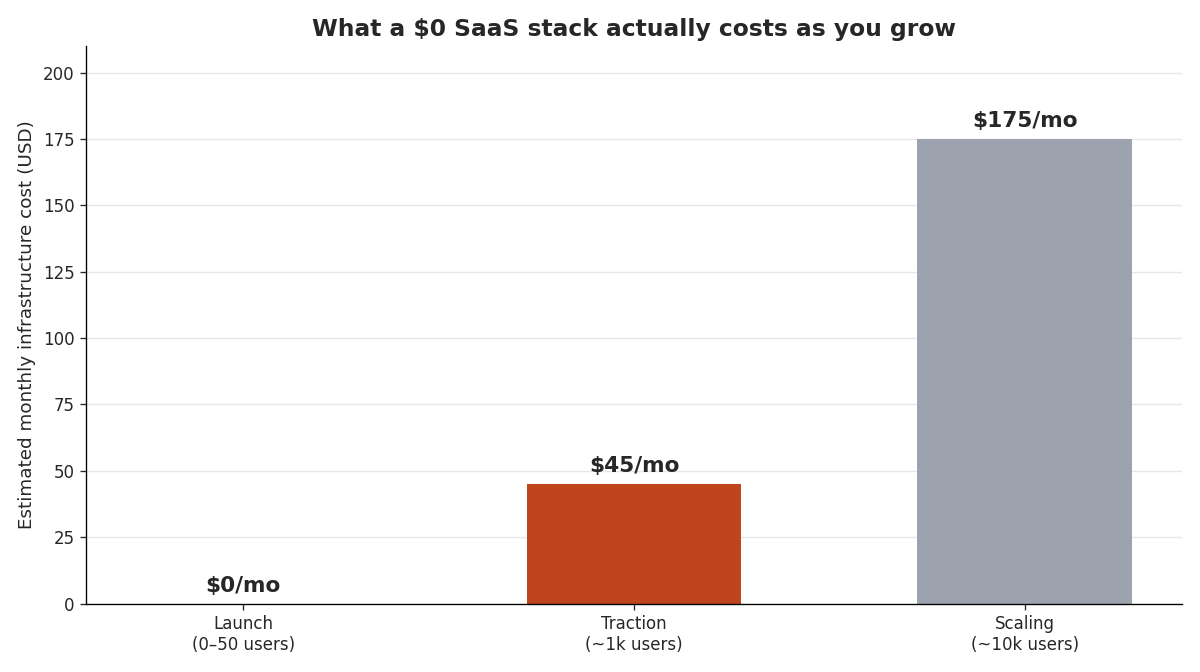
The chart above is a directional estimate, not a quote — your real numbers depend on what your app does. But the shape is reliable. You launch at zero. Somewhere around real traction, one service — usually Supabase's database or Resend's daily cap — pushes you onto a paid plan, and you're at roughly $45 a month. By the time you're serving thousands of active users, you're paying for two or three services and landing near $175. The free tier didn't fail you; it did its job, which was getting you to revenue before you spent a dollar.
That progression is healthy. The unhealthy version is paying $175/month for infrastructure before you have a single customer, which is what happens when founders over-provision out of fear. Match the spend to the usage.
The commercial-use trap (and the honest free path)
Now the part that trips people up. The most popular hosting choice for a Next.js SaaS is Vercel — and Vercel's free Hobby plan does not allow commercial use.
This isn't a gray area. Per Vercel's fair-use guidelines, commercial usage is "any Deployment that is used for the purpose of financial gain," which explicitly includes any method of requesting or processing payment from visitors, and even running ads. The moment your SaaS takes a dollar, the Hobby plan no longer covers you — you need Vercel Pro at $20/month. Donations are the only carve-out. Violating it can get the account suspended.
So if your plan was "deploy my paid SaaS on Vercel's free tier and pay nothing," that plan doesn't exist. It's not that Vercel is being stingy — $20/month is reasonable, and Vercel hosts Next.js better than anyone, which is why I covered the Vercel versus Netlify versus Railway tradeoffs separately. It's that "free for commercial use" and "free Vercel" are two different things, and conflating them is how founders end up surprised.
This is why the honest $0 stack uses Cloudflare Pages for hosting instead. Its free tier permits commercial use outright, with no per-seat tax and unlimited bandwidth under fair use. Netlify's free tier is the other commercial-friendly option. Both will host a real paying SaaS at $0 in a way Vercel's Hobby plan, by its own terms, will not.
The tradeoff is real and worth naming. Vercel's first-party Next.js support is smoother than anything else — if your time is worth more than $20/month (it is), paying for Vercel Pro on day one is a perfectly defensible choice. The point isn't that you must use Cloudflare. It's that if your hard requirement is genuinely $0, you need to route around the commercial-use rule, and Cloudflare Pages is the cleanest way to do it. Pick your constraint honestly: lowest cost, or lowest friction. You usually can't max both.
When should you start paying?
The free tier is a validation tool, not a destination. The signal to upgrade a service is simple: when the free limit starts shaping your product decisions instead of just sitting in the background.
Concretely, upgrade Supabase off the free tier the moment your database approaches 500 MB or you can't tolerate the one-week inactivity pause — which, for a live product with real users, you can't. Supabase Pro is $25/month and removes the pause, so it's usually the first paid line item on the bill. Upgrade Resend when your daily sends regularly bump the 100/day ceiling; that's a sign you have enough active users to justify the spend anyway.
Don't upgrade out of anxiety. I've watched founders — and done this myself early on — pre-pay for capacity they won't touch for a year because a bigger plan "feels safer." It isn't safer; it's just more expensive. The free tier exists precisely so you can defer that spend until usage forces the decision. Let usage force it.
There's a deeper point here that connects to how you price your own product: your infrastructure cost per user should be a tiny fraction of what you charge per user. If a $97 customer costs you fifty cents a month to serve, your free-tier-now-paid-later progression is working. If your infra cost per user is climbing toward your price, that's a margin problem to solve before it's a scale problem.
The free stack's real gift isn't the saved money — it's the removed excuse. There's no "I'll launch once I can afford the infrastructure," because the infrastructure is free until you have customers. The only thing standing between you and a live SaaS is the building and the shipping, which is how it should be.
Frequently asked questions
Can I really run a commercial SaaS for free?
Yes, if you choose commercial-use-friendly free tiers. Supabase, Cloudflare Pages, Resend, and Cloudflare R2 all permit commercial use on their free plans. The notable exception is Vercel's Hobby plan, which forbids commercial use — so a paid SaaS on Vercel needs the $20/month Pro plan.
Why not just use Vercel's free tier for my SaaS?
Because Vercel's Hobby plan is explicitly non-commercial. Per Vercel's fair-use guidelines, any deployment that processes payment or runs ads counts as commercial and requires a paid plan. It's a great host — just not a free one for a business. Cloudflare Pages or Netlify's free tier are the $0 commercial alternatives.
What's the first thing I'll have to pay for?
Usually Supabase. The free tier pauses a project after a week of inactivity and caps the database at 500 MB, so a live product with steady users typically moves to Supabase Pro ($25/month) first. A domain name (~$12/year) is the only thing that's never free.
How many users can the free stack handle?
Comfortably into the low thousands of active users for most apps, with Supabase's 50,000 MAU auth limit being far from the binding constraint. You'll hit database size, daily email volume, or storage limits well before you run out of user capacity. The stack is built to carry a launch to its first hundred-plus paying customers.
Is a free stack worth it if I'll just upgrade later?
Yes. The free tier removes upfront cost as a barrier to launching and validating, which is its entire value. You upgrade individual services only when real usage demands it, so you never pay for capacity ahead of revenue. Starting free and scaling spend with usage is the financially sane path for a bootstrapped founder.
Do I need Cloudflare for both hosting and storage?
No, but it pairs well. Cloudflare Pages (hosting) and R2 (storage) are independent services that happen to share an account and a fair-use philosophy. You could host on Netlify and store files on Supabase Storage instead. The Cloudflare pairing is attractive mainly because of R2's zero egress fees and Pages' commercial-friendly unlimited bandwidth.
The bottom line
A free SaaS tech stack in 2026 is real, not a marketing fiction — Supabase, Cloudflare Pages, Resend, and Cloudflare R2 will carry a paying SaaS from zero to its first hundred customers at $0 a month. The only judgment call that matters is reading the commercial-use fine print, because the most popular host on the list quietly excludes the exact use case you're building for. Pick the free tiers that permit business use, ship on them, and upgrade one service at a time as real usage appears.
If you're building a SaaS with AI coding tools, Coding Capybaras is the free boilerplate I built for exactly this workflow — it ships on the Supabase + Stripe + Resend stack above, and the marketplace has copy-paste prompts for wiring in each service so you can stand up the whole free stack in an afternoon.