Product Hunt Launch Checklist: 47 Things to Do First
A 47-item Product Hunt launch checklist for non-tech founders — exactly what to prepare across the four weeks before launch day, organized so nothing slips.
· Justin Boggs

A good Product Hunt launch checklist isn't a list of growth hacks — it's a sequence of unglamorous preparation tasks spread across the four weeks before launch day, so that nothing is left to scramble on the morning itself. The 47 items below are organized by when to do them: foundation work a month out, asset creation two weeks out, final prep in launch week, and a tight execution loop on the day. Most of them take minutes. The reason launches fail isn't that founders skip the clever parts — it's that they leave the boring parts until the night before, then publish something half-prepared at the worst possible time. This checklist exists so that doesn't happen to you.
TL;DR
- Product Hunt's homepage runs a 24-hour cycle on Pacific time; schedule your launch for 12:01 a.m. PST to get a full day on the leaderboard. You can schedule up to a month ahead.
- The data that matters: 70% of top products (Product of the Day/Week/Month) had a maker's first comment, and 53% of Product-of-the-Day winners since 2021 used a video. Prepare both.
- Don't pay a hunter. Self-launching is fully effective now — hunt your own product.
- Spread the 47 tasks across four phases so launch day is execution, not creation. The morning is for engaging, not building assets.
- The first comment, the gallery, and your warm audience are the three things worth real time. Everything else is hygiene.
Why a checklist beats a launch "strategy"
Most launch advice is strategy: build community, find your angle, ride momentum. All true, all useless at 11 p.m. the night before when you realize you never made a thumbnail. A checklist is different. It converts the vague goal "have a good launch" into forty-seven specific, checkable actions, each small enough to finish in one sitting.
I learned this the slightly hard way with my own Product Hunt launch — the things that went well were the things I'd prepared days ahead, and the stressful moments were all last-minute scrambles I could have front-loaded. The fix wasn't more talent. It was sequencing.
The official Product Hunt launch guide is full of specific, checkable facts — exact image dimensions, character limits, and percentages from real launches. I've pulled the load-bearing ones into the checklist below and cited them where they appear, so you're not guessing at requirements.
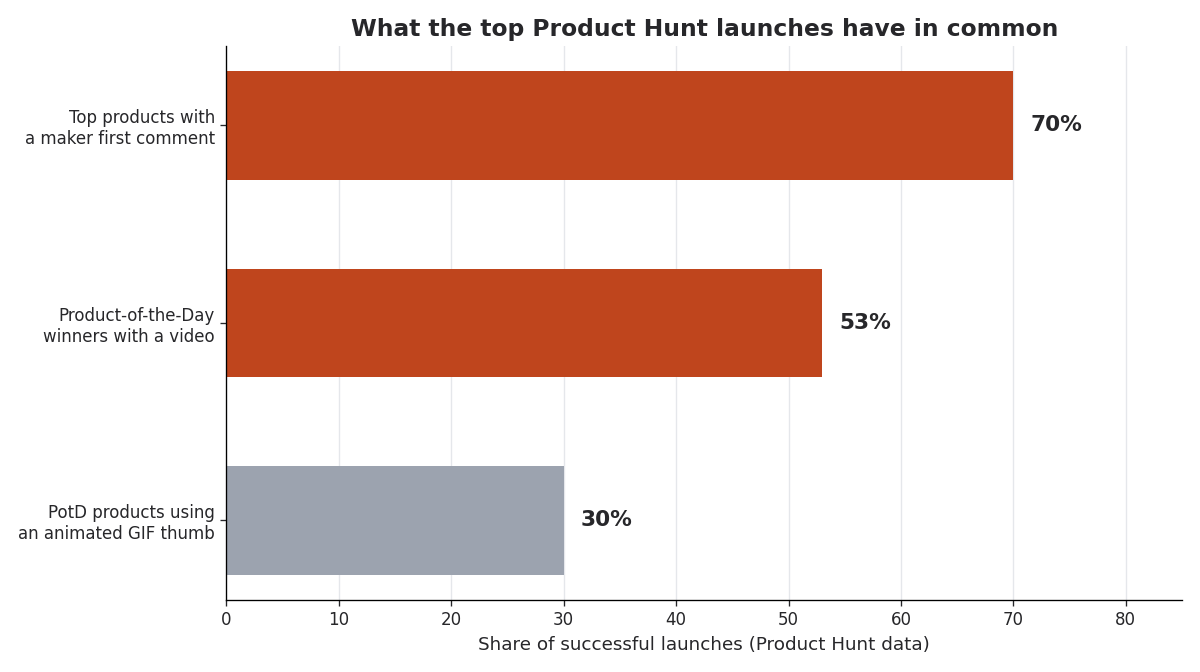
The chart makes the priorities obvious. A first comment and a video are present in a majority of winning launches; an animated GIF thumbnail, despite being widely recommended, shows up in under a third. Spend your prep time where the data points, not where the folklore does.
One more framing note before the list. A checklist is also how a non-technical founder competes with a funded team on launch day. You can't out-spend them on a video or out-staff them on comment replies, but you can out-prepare them — and preparation is free. Every item below that you finish a week early is one fewer thing you're improvising while a better-resourced competitor launches calmly beside you. The checklist is the great leveler between you and a bigger team.
Phase 1 — Four weeks out: foundation (items 1–14)
This phase is about audience and positioning. None of it happens on launch day, and all of it is the difference between launching to a crowd and launching to crickets. Per Product Hunt, the single biggest controllable variable is the audience you bring with you.
- Pick a tentative launch date — a Tuesday, Wednesday, or Thursday is the common default for reach; weekends get 15% more "Visit" clicks with less competition. Decide which matters more to you.
- Create your Product Hunt account and complete the profile — real photo, bio, links. New accounts with no history look like vote farms.
- Start engaging on Product Hunt daily — upvote, comment genuinely, support other makers. The community rewards people it recognizes.
- Build a warm list — email subscribers, X followers, a waitlist, a small Slack or Discord. This is the audience you'll notify on the day.
- Set a single, honest goal for the launch (e.g., "300 signups" or "feedback from 50 real users"), so you can tell afterward whether it worked.
- Write your one-line positioning — what the product is, for whom, in plain language. Everything else derives from this.
- Draft your tagline (max 60 characters, no hype) — it's the main thing that makes someone click from the homepage.
- Audit your landing page — the launch sends traffic here, so make sure it loads fast and explains the product in five seconds. My notes on SEO for SaaS landing pages cover the basics.
- Make sure signup actually works end to end — test it on mobile, in an incognito window, with a fresh email.
- Set up basic analytics so you can measure launch traffic and conversion, not just upvotes.
- Identify 3 "shoutout" tools you'll credit — Product Hunt gives you exactly three, so pick the ones that genuinely shaped the product.
- Line up your co-makers and have them create Product Hunt accounts now, so they're credited and can comment on the day.
- Start a launch-day contact list — the specific people you'll personally message (not spam) when you go live.
- Begin teasing the launch softly on your channels — "building something, launching soon" — to warm the audience without burning it out.
That's the unsexy groundwork. If you do nothing else from this post, do items 4 and 13: a warm audience and a list of real people to tell. A launch with no audience is just a press release no one reads.
Phase 2 — Two weeks out: assets (items 15–30)
Now you build the actual launch materials. This is the phase founders most often compress into launch eve, and it's the worst possible thing to rush, because these assets are what the community sees first.
- Create your thumbnail — square, recommended 240×240, under 3 MB. A clean logo beats a busy graphic.
- Decide on a static image vs. GIF thumbnail — GIFs animate on hover and don't autoplay, so the first frame has to stand alone. Under a third of winners use GIFs, so don't force it.
- Produce at least two gallery images (recommended 1270×760) — two is the minimum to make the gallery visible at all.
- Make the gallery tell a story — first image states the value proposition, the rest show the product doing its most impressive thing.
- Record a demo video — about 53% of Product-of-the-Day winners include one. A 45–60 second Loom showing the product in action is plenty; it doesn't need a budget.
- Lead the video with the payoff — show the most impressive thing in the first five seconds, before anyone clicks away.
- Upload the video to YouTube (the only supported source) and confirm it's public, not unlisted or private.
- Write your product description (max 500 characters) — concise value proposition plus key features, no fluff.
- Draft your first comment — this is the highest-leverage asset you'll write. 70% of top products had one.
- Structure the first comment around your story, who it's for, key features, and a direct ask for feedback (never "please upvote").
- Build an interactive demo if it fits — tools like Arcade and Storylane are free for Product Hunt launches and let people try before they leave.
- Pick your three launch tags so the product surfaces on the right topic pages.
- Prepare a promo code for the Product Hunt community if you offer one — the offer, code, and expiry are all required fields.
- Write your notification copy in advance — the email, the X post, the DMs — so launch morning is copy-paste, not composing.
- Prepare social assets — a launch-day graphic and a short video clip for X, sized for the feed.
- Have a few honest testimonials ready to drop into the conversation or the landing page; here's how to get your first paying customers to vouch.
The first comment (items 23–24) deserves a second pass. Write it like a person, not a brand. Introduce yourself, say who the product is for, and ask a specific question you actually want answered. The marketing-speak version reliably underperforms the humble, helpful version.
Phase 3 — Launch week: final prep (items 31–40)
The week of, you stop creating and start staging. The goal is that by the night before, every asset is uploaded as a draft and the only thing left is to hit publish.
- Submit your product as a scheduled draft — everything auto-saves, so build the page over several days, not in one panic.
- Schedule the launch for 12:01 a.m. PST (or the time that fits your audience's timezone and any press embargo).
- Hunt your own product — don't pay a hunter; self-launching is just as effective now.
- Proofread every field — tagline, description, links — on desktop and mobile.
- Test every link in the listing and the first comment, including UTM-free URLs (shortened and tracked links are rejected).
- Confirm co-makers are added and know their role for the day.
- Finalize your launch-day timeline — who you message when, so the day runs on a plan instead of adrenaline.
- Warn your audience of the exact date — not "soon," the date — so they can show up.
- Clear your launch-day calendar — you'll spend the day replying to comments, not in meetings.
- Prepare canned-but-personal replies to predictable questions (pricing, how it compares, who it's for) so you respond fast without sounding robotic.
The most underrated item here is 39. The launch isn't the publish — it's the twelve hours of conversation after it. The first two hours especially set your initial ranking, and Product Hunt weights genuine engagement over raw upvote count. You cannot do that from a meeting.
Phase 4 — Launch day: execution (items 41–47)
Today you create nothing. Everything is built. Your only job is presence and conversation.
- Post your first comment the moment the launch goes live — it sits right under the gallery and frames everything.
- Notify your warm list with the prepared copy — personal messages to real people, not a blast.
- Reply to every single comment quickly and personally; quality of engagement outranks volume.
- Ask for feedback, never upvotes — soliciting votes violates the rules and the community can smell it.
- Post your launch on X and other channels and engage with everyone who shares it; here's the organic X playbook I use.
- Stay present all day, especially the first two hours — momentum compounds when the maker is visibly there.
- Thank everyone who showed up, and capture the feedback — it's the most valuable thing the launch produces, more than the ranking.
Here's the day-of shape at a glance:
| Time (PST) | Focus | Why it matters | | --- | --- | --- | | 12:01 a.m. | Go live, post first comment | Full 24-hour window; first comment frames the launch | | First 2 hours | Notify warm list, reply fast | Early engagement sets initial ranking | | Midday | X push, reply to every comment | Keep momentum visible; engagement is weighted | | Afternoon | Steady presence, answer questions | Algorithm rewards the maker being there | | Evening | Thank supporters, log feedback | The feedback outlasts the ranking |
Notice that not one launch-day item is "make" anything. That's the entire point of the four-phase split: if you've done phases 1 through 3, launch day is calm. If you haven't, no amount of launch-day hustle saves it.
Frequently asked questions
What's the best day and time to launch on Product Hunt?
Product Hunt's homepage runs a 24-hour cycle on Pacific time, so launching at 12:01 a.m. PST gives your product a full day on the leaderboard. Tuesday through Thursday are the common high-traffic defaults, while weekends have less competition and get about 15% more "Visit" clicks. The honest answer from Product Hunt itself: launch when you're genuinely ready.
Do I need to pay a hunter to launch?
No. Product Hunt explicitly advises against paying a hunter, and since 2023 self-launching has been just as effective as being hunted. Hunt your own product — you keep control of the listing, the first comment, and the timing.
How important is the first comment?
Very. 70% of products that achieved Product of the Day, Week, or Month included a maker's first comment. It appears directly below your gallery, introduces you and the product, and should ask for feedback rather than upvotes. Write it ahead of time and post it the instant you go live.
Do I need a video to launch?
It helps but isn't mandatory. About 53% of Product-of-the-Day winners since 2021 included a video, so it correlates with success. A simple 45–60 second screen recording that shows the product's best feature in the first five seconds is enough — you don't need production budget.
How big should my audience be before launching?
Big enough that the first two hours have real engagement, since that window shapes your initial ranking. There's no magic number, but the more important shift is building a warm list — email subscribers, followers, a waitlist — weeks ahead so you have specific people to notify on the day rather than launching into silence.
Can I launch the same product more than once?
Yes, after a waiting period and ideally after a meaningful update. Many successful makers launch a product multiple times as it evolves. If a first launch underperforms, treat it as a rehearsal, fold in the feedback, and relaunch with a stronger asset set and a warmer audience.
The bottom line
A Product Hunt launch checklist works because it moves the hard work earlier. The forty-seven items above aren't growth hacks — they're a schedule that puts audience-building a month out, asset creation two weeks out, staging in launch week, and pure engagement on the day. Do them in order and launch morning becomes the easy part: you show up, post your first comment, talk to people, and let the preparation carry the result.
I write about this kind of unglamorous founder work every week on the Coding Capybaras blog — the free SaaS boilerplate I built is there too if you want to see the product I took through this exact checklist.