Annual vs Monthly Billing: The Math Behind the Discount
How to decide between annual and monthly billing for your SaaS — the discount math, what churn rate justifies it, and when annual billing slows your growth.
· Justin Boggs

Photo by Eric Rothermel on Unsplash
Offer both, default to monthly, and price your annual discount against your actual monthly churn rate rather than against what other companies do. That's the short version. Annual billing buys you cash today and a customer who only makes one cancel decision a year instead of twelve — and you pay for both with a discount and with slower top-line growth. Whether that trade is worth it depends almost entirely on a number you can look up in ten minutes: how many of your monthly customers are still paying you a year from now. This post walks the math, the benchmark data, and the operational costs nobody mentions.
TL;DR
- The right annual discount is the one where the months of revenue you give up are fewer than the months a monthly customer would have churned out of anyway.
- At 5% monthly churn, a monthly cohort pays you about 9.2 months in year one — so a "two months free" annual plan (10 months of revenue, collected upfront) is a straight win.
- At 2-3% monthly churn, that same discount costs you money in year one. You're buying cash and certainty, not revenue.
- ChartMogul's analysis of 2,500+ SaaS companies found early-stage companies leaning on monthly billing grow fastest — the top quartile under $1M ARR hit 131% YoY growth with over 75% of revenue from monthly plans.
- Monthly-to-annual upgrades peak in month two, so the offer belongs in your onboarding sequence, not on a renewal notice.
What annual billing actually buys, and what it costs
Annual billing is a trade: you give up a slice of revenue and some growth velocity in exchange for cash today, fewer cancellation decisions, and revenue you can plan around. Every argument about annual versus monthly is really an argument about how much you value each side of that trade right now.
Start with what you gain, in order of how much it usually matters to a solo founder.
Cash today. A customer on $20/month who pays $200 upfront hands you ten months of revenue you'd otherwise wait ten months to collect. If you're spending money to acquire customers, that upfront payment funds the next acquisition immediately instead of dribbling in. This is the single largest benefit and the one most founders underweight because it doesn't show up in MRR.
Fewer chances to leave. A monthly customer makes twelve renewal decisions a year. Each one is an opportunity to look at the charge, decide they haven't used it lately, and cancel. An annual customer makes one. That's not a psychological trick — it's just fewer decision points and, mechanically, fewer card declines. Failed payments are a real churn source, and an annual plan gives the card eleven fewer chances to expire mid-relationship.
Revenue you can forecast. Knowing that $18,000 of your revenue is already collected and can't churn until next March is genuinely useful when you're deciding whether to pay for a tool, a contractor, or an ad test.
Now the costs, which are less obvious.
The discount is permanent, not promotional. It applies at every renewal. A 20% annual discount on a customer who stays four years isn't a 20% acquisition cost — it's 20% of four years of revenue.
Slower growth signal. Annual billing raises the price of the first purchase decision. Asking a stranger for $200 instead of $20 converts worse, and for an early-stage product where you're still proving credibility, that friction is expensive.
Refund exposure. A month-two refund request on an annual plan is a $200 conversation, not a $20 one. Your refund policy for indie SaaS needs to say what happens to the unused portion before someone asks.
You've pre-spent money you haven't earned. Cash in the bank from an annual plan is partly a liability. Spend all of it in Q1 and you've borrowed from a customer who might ask for some of it back in Q2.
The discount math: what each structure actually costs
Here's where most founders stop thinking and start copying. "Everyone does 20% off, so 20% off." That's not a decision, it's a default. The number should come from your churn rate.
First, translate the common discount structures into a single comparable unit: how many months of revenue you actually collect.
| Discount structure | Months of revenue collected | Effective discount | Annual price on a $20/mo plan | | --- | --- | --- | --- | | One month free | 11.0 | 8.3% | $220 | | 10% off | 10.8 | 10.0% | $216 | | Two months free | 10.0 | 16.7% | $200 | | 20% off | 9.6 | 20.0% | $192 | | 25% off | 9.0 | 25.0% | $180 |
The "months free" framing consistently reads as more generous than the equivalent percentage while costing less. "Two months free" sounds bigger than "16.7% off" and is the same offer. "One month free" sounds bigger than "8.3% off" and is dramatically cheaper than the 20% most people reach for by reflex. How you present the two cycles side by side matters as much as the number itself — I tore down five real examples in pricing pages that convert.
Now the other half. How many months would a monthly customer have actually paid you? Take a cohort of monthly subscribers and apply your monthly churn rate:
| Monthly churn rate | Months collected in year one | Implied average lifetime | | --- | --- | --- | | 2% | 10.8 | 50 months | | 3% | 10.2 | 33 months | | 5% | 9.2 | 20 months | | 7% | 8.3 | 14 months | | 10% | 7.2 | 10 months |
Both tables are modeled from the arithmetic, not survey data. The second assumes a cohort acquired at the same time with a constant monthly churn rate.
Put the two tables side by side and the decision makes itself. At 5% monthly churn you collect about 9.2 months from a monthly cohort in year one. A "two months free" annual plan collects 10 months — upfront. That's more revenue and better cash flow. You'd be leaving money on the table by not offering it.
At 3% monthly churn you collect 10.2 months. That same annual plan collects 10. Now the discount costs you revenue in year one, and you're explicitly buying cash flow and churn insurance with it. That might still be the right call — but you should know you're making that purchase.
At 10% churn, a monthly cohort yields 7.2 months. You could offer 25% off and still come out ahead. High-churn products have the most to gain from annual billing, which is exactly backwards from how most founders behave — they add annual plans once things are going well.
There's a limit to this reasoning worth naming. Annual customers aren't a random sample of your monthly customers. The ones who choose annual are disproportionately the ones who would have stayed anyway. So some of the churn reduction you see when you launch annual plans is selection, not causation. The math above is a floor for the discount you can afford, not a promise of what it'll do to your blended retention.
What the benchmark data says about when annual helps
The best public dataset on this is ChartMogul's SaaS Billing Report, built from the billing patterns of over 2,500 SaaS companies. Three findings matter for anyone under $1M ARR.
Early on, monthly billing correlates with faster growth. The top quartile of companies under $1M ARR that generated over 75% of their recurring revenue from monthly plans grew 131% year-over-year. Growth stayed above 100% for that quartile even when monthly plans dropped to half of revenue. Meanwhile, the median company under $1M ARR that leaned on annual plans for 50-75% of revenue grew just 15%.
That's a strong signal against making annual your default when you're pre-traction. Low friction on the first purchase is worth more than cash certainty when your main problem is that nobody has heard of you.
Annual plans retain far better, and the gap is widest at low prices. For companies under $25 ARPA, ChartMogul found median customer retention of 62% on annual plans versus 41% on monthly — a 21 percentage point gap. Above $100 ARPA the gap narrows to around 10 points. The cheaper your product, the more annual billing does for you, because low-priced products attract the most casual, most easily-distracted buyers.
Net revenue retention follows the same pattern. In the $250-500 ARPA band, the median company hit 88% NRR on annual plans versus 76% on monthly. ChartMogul found that NRR gap across every ARPA range they measured.
Here's what that looks like as cash in your bank account. This chart models the same 100 customers under both billing cycles:
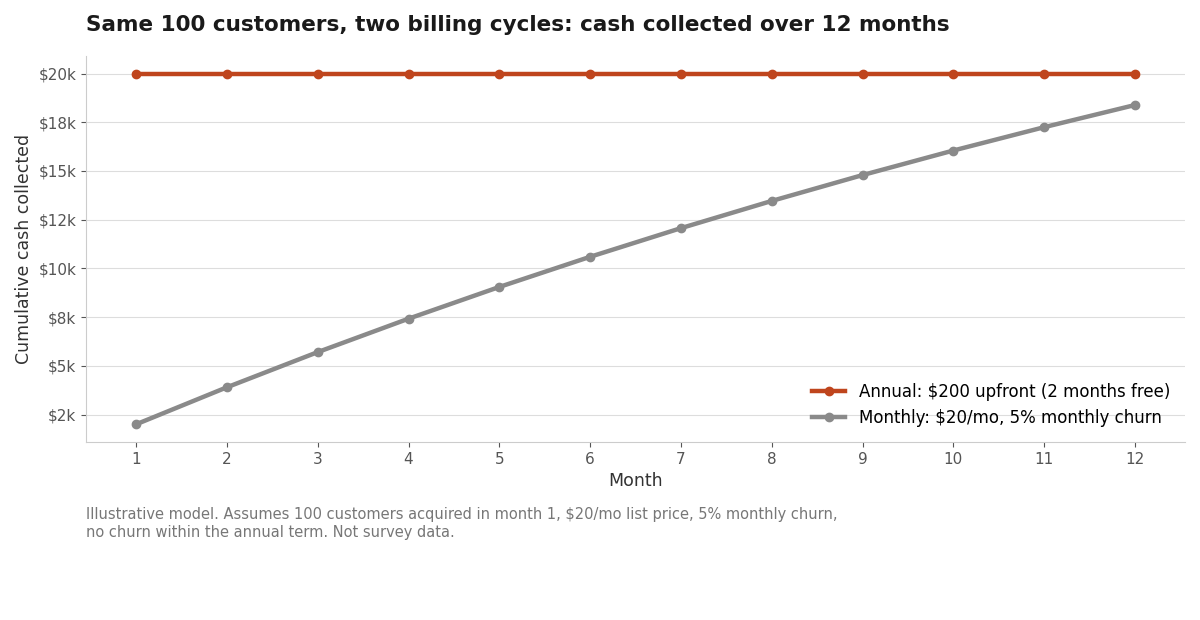
The annual line is flat at $20,000 from day one. The monthly line climbs to about $18,400 by month twelve and never catches up — because 5% of customers leave each month, so you never collect twelve full months from the full cohort. The 16.7% discount isn't costing you revenue in this scenario. It's paying for itself out of churn you were going to eat anyway.
Change the assumption to 2% monthly churn and the picture inverts: monthly collects roughly $21,500 over the year and the annual plan looks expensive. Which is the whole point. Run the numbers on your churn, not on a blog post's. If you don't know your churn rate yet, churn analysis for non-tech founders covers how to calculate it, and subscription billing math walks through the surrounding metrics.
When to make the offer: month two, not month twelve
The timing finding in ChartMogul's data is the most immediately actionable thing in this post, and almost nobody acts on it.
Upgrades from monthly to annual peak in month two. Their analysis of customers who signed up in January 2024 found those customers were over three times more likely to upgrade in their second month than in their ninth. Elevated conversion continues through months four and five, then falls off.
The intuition is straightforward once you see it. Many customers treat their first month as an extended trial. By month two they've either integrated the product into their week or they haven't. The ones who have are ready to commit — and they're at peak enthusiasm, before the tool becomes invisible infrastructure they occasionally reconsider.
That means the annual offer belongs in your onboarding sequence, sitting somewhere around day 35-45, not on a renewal reminder eleven months later. If you're already running a lifecycle email sequence, the slot after "you've hit your first real milestone" is the one.
Two more things from the same report worth planning around. Only 9% of companies under $300K ARR see any monthly-to-annual upgrades at all, compared to 78% of companies at $15-30M ARR. That's not because small companies have worse customers — it's because they haven't built the offer, the trigger, or the one-click path. And low-ARPA companies that do build it convert at high rates: ChartMogul found sub-$25 ARPA companies were twelve times more likely to see annual upgrades than the highest-ARPA segment.
Translation: the upgrade path is a feature, and most small SaaS products simply haven't shipped it.
The operational costs nobody warns you about
Annual billing is not just a second price on your pricing page. It creates work. Here's what actually landed on my plate.
Proration gets complicated fast. When someone on an annual plan upgrades to a higher tier mid-term, you owe them credit for the unused portion and a charge for the remainder. Stripe handles the arithmetic — its proration docs explain that it calculates prorations down to the second by default — but the policy is yours. Does a mid-year downgrade produce a refund, an account credit, or nothing until renewal? Decide before someone asks, because the first time it comes up you'll be improvising in a support reply.
Renewals are a surprise if you don't warn people. An annual charge that appears with no notice generates chargebacks. Send a renewal reminder two to four weeks out. It feels like handing customers a cancellation opportunity, and it is — it's also dramatically cheaper than disputing a $200 charge with a customer who genuinely forgot. Card networks care about this, and so does your dispute rate.
Your MRR reporting needs a decision. Do you count a $200 annual payment as $200 in the month it arrived, or as $16.67 of MRR for twelve months? The second is correct and standard. The first makes your dashboard lie to you in both directions — a fake spike this month, a fake hole next month. Pick the normalized version and stick with it.
Billing cycle alignment is a real setting. If you're running annual and monthly plans side by side, Stripe's billing cycle documentation covers how to control when the renewal date lands. Getting this wrong produces the classic "why did I get charged twice in March" ticket.
The customer portal has to handle it. Whatever you build for customer self-service billing needs to show the renewal date clearly, let people switch cycles, and make cancellation findable. Hiding the annual renewal date is a dark pattern that converts into disputes.
None of this is hard. All of it is work you don't have on a monthly-only product, and it's worth pricing into your decision — especially if you're a solo founder whose support queue is also your inbox.
Frequently asked questions
What annual discount should I offer for a SaaS?
Start by calculating how many months of revenue a monthly cohort actually pays you at your churn rate, then pick a discount that collects at least that many months upfront. At 5% monthly churn that's roughly "two months free." If you have no churn data yet, "one month free" is the cheapest structure that still reads as a real offer, at an effective 8.3%.
Should a brand-new SaaS offer annual billing at all?
Offer it, but don't default to it. ChartMogul's data shows early-stage companies that lean on monthly plans grow substantially faster, because low first-purchase friction matters more than cash certainty before you have credibility. Put annual on the pricing page as the secondary option and push the upgrade at month two instead.
Does annual billing actually reduce churn or just hide it?
Both, and the split matters. It genuinely reduces churn by removing eleven cancellation decisions and eleven chances for a card to fail. It also defers churn — an unhappy annual customer simply doesn't renew, so your churn arrives in an annual lump instead of monthly drips. Track annual renewal rate separately or you'll mistake deferral for improvement.
How do I handle refunds on an annual plan?
Write the policy before you need it and put it on the pricing page. The common approaches are a full refund inside a short window (7-30 days), a prorated refund for the unused months, or account credit only. Prorated refunds are the friendliest and the most operationally annoying; a short no-questions window is the simplest to run alone.
Can I switch existing monthly customers to annual?
Yes, and it's usually the highest-ROI billing work available to a small SaaS — you're offering existing happy customers a discount they'll perceive as a favor. Email your monthly subscribers with a one-click upgrade and a clear price. Just don't switch anyone automatically; an unexpected annual charge is a chargeback waiting to happen.
How should annual revenue show up in my metrics?
Normalize it. A $200 annual plan is $16.67 of MRR, not a $200 spike. Keep collected cash as a separate line from recognized revenue so you can see both your runway and your real growth rate. Conflating the two is how founders convince themselves a good December was a good year.
Pick the number, then pick the plan
The annual versus monthly question feels strategic and is mostly arithmetic. Find your monthly churn rate. Convert it into months of revenue you actually collect in year one. Offer an annual plan that collects at least that many months upfront. If the discount that requires feels too expensive, your real problem is churn, and no billing cycle will fix it.
Then default to monthly, put the annual offer in front of people around day forty, and make sure the renewal doesn't surprise anyone. That combination gets you the growth velocity of low-friction pricing and most of the cash and retention benefits of annual, which is as close to having it both ways as this trade allows.
If you're building the billing side of a SaaS right now, the Coding Capybaras marketplace has copy-paste prompts for wiring Stripe subscriptions, the customer portal, and renewal emails into a Next.js app — including the parts of this that are annoying to get right the first time.