AppSumo vs Product Hunt vs BetaList: Launch Channels Compared
AppSumo vs Product Hunt vs BetaList: an honest look at paid and free launch channels for indie SaaS — what each one actually drives, and when to use it.
· Justin Boggs

Photo by Markus Winkler on Unsplash
AppSumo, Product Hunt, and BetaList are three different launch channels that pay you in three different currencies, so "which is best" is the wrong question — the right one is "what do I need on launch day." AppSumo is the only one of the three that hands you money on day one; it's a lifetime-deal marketplace full of buyers with a credit card already out. Product Hunt hands you a spike of attention, credibility, and traffic — but not direct revenue. BetaList hands you a cheap trickle of early-adopter email signups before you've built any audience at all. Pick the channel whose currency matches your stage.
TL;DR
- AppSumo = revenue. A lifetime-deal marketplace with 1M+ deal-hunting buyers. Real money on launch day, but a meaningful revenue share and a support-heavy customer base.
- Product Hunt = attention + credibility. The biggest single-day launch stage. Drives traffic and social proof, not direct sales. Free, and you can self-launch.
- BetaList = early signups. Cheap way to collect beta emails before you have an audience. Modest numbers, and less potent than it was a decade ago.
- Sequence, don't choose. Most founders use these at different stages, not on the same day. BetaList pre-launch, Product Hunt at launch, AppSumo later to monetize a finished product.
The one difference that decides everything
Before comparing features, get one distinction straight, because it settles most of the decision: each channel pays you in a different currency.
AppSumo pays in revenue. It's a marketplace where you list your product as a discounted lifetime deal, and a large audience of people who buy software deals for a living shows up ready to purchase. If your goal is "I need dollars in the account this month," AppSumo is the only one of the three that reliably produces them.
Product Hunt pays in attention and credibility. A strong launch puts you in front of the tech-and-maker crowd for a day, sends a spike of traffic to your site, and — if you do well — gives you a badge and a story you can point to for years. What it does not do is charge anyone's card. Every dollar from a Product Hunt launch comes later, downstream, from people who found you that day and converted on your own site.
BetaList pays in early signups. It's aimed at pre-launch products still collecting a waitlist. You get a modest number of email addresses from people who like discovering new startups. Not revenue, not a traffic firehose — just early adopters willing to try something unfinished.
When founders feel disappointed by a launch, it's almost always a currency mismatch: they wanted revenue and picked an attention channel, or they wanted mass reach and picked a beta-signup directory. Match the currency to the stage and the disappointment mostly disappears. The rest of this post is the detail underneath each of those three currencies, and a sequence for using them together.
Product Hunt: attention, credibility, and a spiky traffic day
Product Hunt is still the default launch stage for software, and for good reason — it has the largest single-day audience aimed specifically at new products. But be clear about what a good day there actually buys you: reach and reputation, not a sales spike.
The mechanics reward preparation over spend. According to Product Hunt's own launch guide, the platform runs a 24-hour leaderboard on Pacific time, and the variables that correlate with winning launches are things anyone can prepare for free: the guide notes that around 70% of top products had a maker's first comment, and about 53% of Product-of-the-Day winners used a video. None of that costs money. It costs a warm audience and a week of asset prep.
That's the honest appeal of Product Hunt for a non-technical founder: it's a channel where preparation beats budget. You can't out-spend a funded competitor, but you can out-prepare them. I walked through my own launch-day cadence in the Product Hunt launch playbook, and the boring truth was that the things that worked were the assets I'd built days ahead, not anything clever I improvised on the morning.
The catch is that Product Hunt's audience skews toward makers, other founders, and tech-curious early adopters — not necessarily your paying customer. If you sell to marketers, lawyers, or plumbers, the crowd that shows up may not be your buyer. You'll still get traffic and backlinks and a credibility badge, but you have to convert that attention on your own landing page, with your own pricing, over the following weeks. Treat the launch as the top of a funnel, not the bottom.
One more myth worth killing: you don't need to pay a "hunter" to post for you. Self-launching works fine now. Save the money and hunt your own product. If you want the full pre-launch task list, I put 47 of them in order in the launch checklist — the point of both posts is that a Product Hunt result is mostly decided in the two weeks before you press publish.
AppSumo: the only channel that hands you revenue on day one
AppSumo is the odd one out, and the one most misunderstood by first-time founders. It's not a launch-day leaderboard — it's a lifetime-deal marketplace. You list your product at a steep one-time price (a "lifetime deal," or LTD), AppSumo puts it in front of its large audience of deal-hunting buyers, and every sale is real money that day.
The model is genuinely different from a subscription. Instead of $20/month forever, an LTD buyer pays once — say $49 or $99 — and keeps access. That's a strange trade if your product has real ongoing server costs, so think hard before you offer one. The upside is a cash injection and a wave of users; the downside is you've sold future revenue at a discount, and lifetime-deal customers are famously demanding.
On the commercials, ignore the internet folklore about AppSumo "taking 70%." AppSumo's own explainer on how revenue share works describes a negotiated split with no upfront fees — they only earn when you sell — and they directly address the 70% figure as a common misconception. The real share depends on your category, whether it's a new or repeat campaign, and expected performance. There's also an affiliate angle worth knowing: partners can earn 100% commission up to $100 for every new AppSumo buyer they personally bring in, on top of the revenue share. Campaigns typically run around 60 days with marketing support, and you can structure the deal in multiple tiers so bigger spenders unlock more.
The requirements are the real filter. AppSumo wants a working product, not a beta, and a business stable enough to support a flood of lifetime customers for years. That's the tradeoff nobody mentions: the sale is one-time, but the support obligation is forever. If you're a solo founder, model the support load before the revenue. A thousand lifetime customers is a thousand inboxes you owe answers to, at a price you can never charge again.
So AppSumo earns its slot for one job: converting a finished product into a pile of cash and users quickly. It's the wrong tool for validating an idea, and a risky tool if your margins are thin. It's the right tool when you have something real, want runway, and can absorb demanding customers. It's also worth thinking through your core pricing strategy first, because an LTD only makes sense as a deliberate exception to it — not as your actual price.
BetaList: cheap early signups before you have an audience
BetaList sits at the opposite end from AppSumo. There's no revenue and no big leaderboard — it's a directory of pre-launch startups for people who like discovering new things early. What you get is email signups, and the appeal is that it works before you have any audience at all.
The honest numbers are modest, and I'd rather show you one real launch than a vague range. A widely-shared founder writeup from Learnetto documented their BetaList feature: roughly 175 new email subscribers over ten days, with 74 of those arriving on the first day and the rest trickling in afterward.
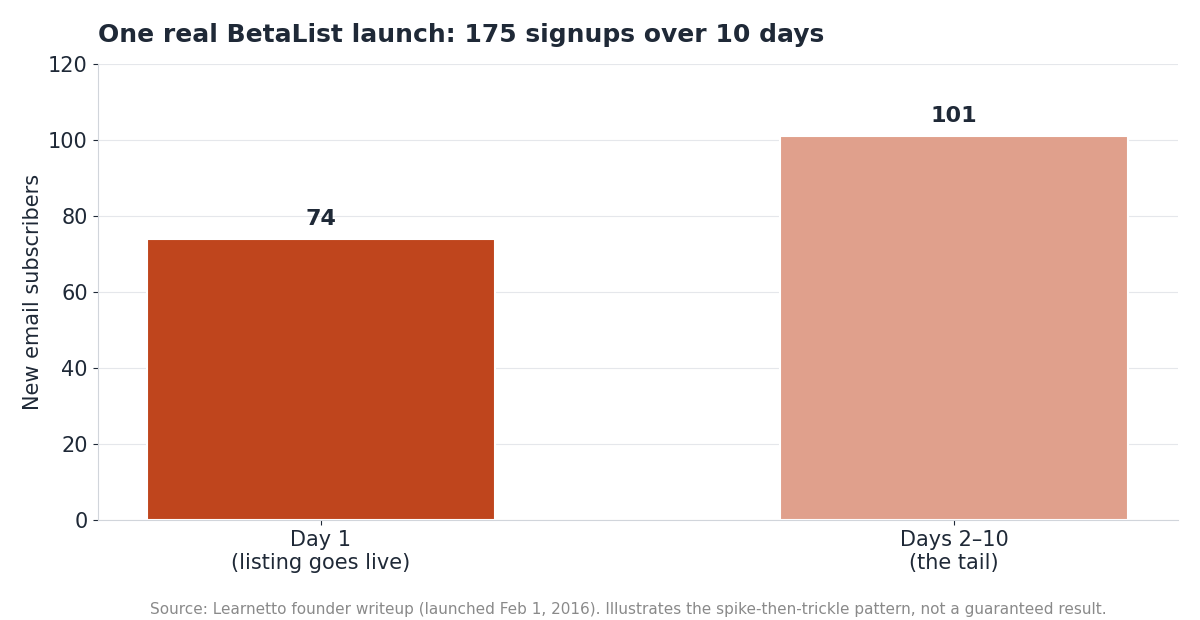
Two things stand out in that chart. First, the day-one spike is real but not enormous — 74 signups, not 7,000. Second, and more useful, the tail matters: more than half the signups came after day one, plus a raised baseline of daily traffic that persisted. BetaList's own guidance and the founder's takeaway line up — treat it as a slow, steady kickstart, not a firehose.
A few caveats. That case study is from 2016, and BetaList's potency has faded since its early-2010s peak; the audience today leans more toward makers than end customers, same drift Product Hunt has. Listing is free but slow — submissions can wait months — so most serious founders pay for expedited placement. In the Learnetto case, that came to roughly 50 cents per subscriber, which is cheap if those emails eventually convert, and pointless if they don't. BetaList's other real value is psychological: it forces you to ship a landing page and see the first signups arrive, which does more for a wavering founder than the raw numbers suggest. If you're still deciding what "ready" even means, that nudge pairs well with the argument in the minimum viable launch.
Side-by-side: what each channel actually gives you
Here's the comparison in one view. Read the "primary currency" row first — it's the one that should drive your decision.
| Attribute | AppSumo | Product Hunt | BetaList | | --- | --- | --- | --- | | Primary currency | Direct revenue | Attention + credibility | Early email signups | | Cost to launch | Revenue share on each sale (negotiated, no upfront fee) | Free (self-launch) | Free listing, or paid expedited placement | | Best stage | Finished, stable product | Launch moment of a real product | Pre-launch / waitlist | | Audience | Deal-hunting buyers | Makers, founders, tech early adopters | Startup-curious early adopters | | Typical output | A cash wave + many lifetime users | A traffic spike + backlinks + a badge | A modest, steady drip of signups | | Main risk | Selling future revenue cheap; demanding customers | Wrong audience for your niche; no direct sales | Small numbers; faded potency | | Effort that moves it | A compelling deal + support capacity | Pre-launch prep (first comment, video, warm list) | A strong landing page |
The table also explains why comparing them head-to-head feels slippery: they don't compete for the same job. AppSumo and BetaList barely overlap at all — one monetizes a finished product, the other collects emails for an unfinished one. Product Hunt sits in the middle as the moment you announce a real product to the world. That's why the smartest move usually isn't picking one.
How to sequence them (instead of picking one)
The founders getting the most out of these platforms in 2026 don't choose between them — they use each one at the stage it fits. Here's the sequence I'd run, and the reasoning behind it.
Pre-launch: BetaList (plus a landing page). While you're still building, list on BetaList to start collecting emails and to force yourself to ship a real landing page. The numbers are modest, but a few hundred early adopters is exactly the warm list you'll need later. Pair it with the organic channels in going from 0 to 100 customers so BetaList isn't your only pre-launch signal.
Launch moment: Product Hunt. When the product is genuinely usable, launch on Product Hunt and notify the warm list you built. This is your attention-and-credibility moment — the day you get the badge, the traffic, and the backlinks. It won't produce much direct revenue, so measure it in signups and reputation, not sales.
Post-launch monetization: AppSumo (maybe). Once the product is finished, stable, and you understand your support load, an AppSumo lifetime deal can convert momentum into a cash injection. This is deliberately last, because AppSumo punishes anyone who lists too early — refunds and support complaints pile up on a product that isn't ready. Only run it when you can absorb demanding lifetime customers for the long haul.
Not every product needs all three, and some need none of them — plenty of SaaS businesses grow entirely through organic search and word of mouth without a single launch-day spike. But if you're going to use launch channels, using them in sequence beats betting everything on one loud day. A launch is a moment; a business is the months around it.
The meta-point: a "launch" isn't one event you either win or lose. It's a series of smaller moments — collecting your first emails, announcing to the world, monetizing what you built — and these three channels each own a different one. Stop asking which is best and start asking which moment you're in.
Frequently asked questions
Is AppSumo better than Product Hunt for making money?
For direct, immediate revenue, yes — AppSumo is the only one of the two that charges customers on launch day, because it's a lifetime-deal marketplace. Product Hunt drives attention and traffic that you convert into revenue later, on your own site. If you need cash now and have a finished product, AppSumo; if you want reach and credibility, Product Hunt.
Do I have to pay to launch on Product Hunt or BetaList?
Product Hunt is free, and self-launching (posting your own product) works fine now — you don't need to pay a hunter. BetaList is free to list, but the free queue can take months, so many founders pay for expedited placement to launch on a specific date.
Will a Product Hunt launch actually get me customers?
It gets you traffic, backlinks, and credibility, but rarely a wave of direct sales. Whether it produces customers depends on your landing page and pricing converting that spike over the following weeks. Treat the launch as the top of your funnel, not the checkout.
Is BetaList still worth it in 2026?
For a pre-launch product with no audience, it can be a cheap way to collect early email signups and force you to ship a landing page. But its potency has faded since the early 2010s, the numbers are modest, and the audience leans toward makers. Use it as a small kickstart, not a growth engine.
What's the risk of an AppSumo lifetime deal?
You're selling future revenue at a one-time discount, and lifetime-deal buyers tend to be demanding, so your support load stays high long after the cash arrives. It's a strong move for a finished, stable product with capacity to support customers for years, and a dangerous one for an unfinished product or a thin-margin business.
Can I use all three channels for the same product?
Yes, and sequencing them usually beats picking one: BetaList while pre-launch to collect emails, Product Hunt at the launch moment for attention, and AppSumo later to monetize a finished product. They pay in different currencies at different stages, so they complement rather than compete.
The bottom line
AppSumo, Product Hunt, and BetaList aren't really competitors — they're three tools for three different moments in a launch. AppSumo gives you revenue from a finished product, Product Hunt gives you attention and credibility at the launch moment, and BetaList gives you cheap early signups before you have an audience. Choose based on the currency you actually need this month, and if you're going to use more than one, run them in sequence rather than all at once.
If you're a non-technical founder shipping a SaaS with AI coding tools, Coding Capybaras is the free boilerplate I built for exactly this path — the complete codebase ships free, so you can get to the point where a launch channel is even worth thinking about.