Vercel vs Netlify vs Railway: Hosting for Non-Tech Founders
Vercel vs Netlify vs Railway compared for non-technical SaaS founders in 2026 — real pricing, the serverless vs container split, and which host fits you.
· Justin Boggs

Photo by Kevin Ache on Unsplash
For most non-technical SaaS founders in 2026, the Vercel vs Netlify vs Railway decision comes down to one question: are you deploying a frontend, or a whole backend? Vercel and Netlify are frontend-first platforms — they shine at static sites, server-rendered pages, and serverless functions, and they bill per team member. Railway is container-first — it runs your app, your database, your cron jobs, and your background workers in one place, and it bills for the resources you actually consume. If you're shipping a Next.js app with AI coding tools, Vercel is the path of least resistance because Vercel builds Next.js. But it's not automatically the cheapest, and for some apps it's not even the right shape. Here's how I'd think it through.
TL;DR
- Vercel is built by the makers of Next.js, so a Next.js app deploys with zero friction. Pro is $20/user/month with 1 TB of bandwidth included, then $0.15/GB. Best default for frontend-heavy Next.js apps.
- Netlify is the other frontend-first platform. Free tier is generous, and its OpenNext integration made Next.js support far better than it used to be. It moved to credit-based pricing in late 2025, refined again in April 2026.
- Railway is container-based: it runs your app and a managed database, cron jobs, and workers. Usage-based pricing (Hobby $5/mo, Pro $20/seat) often costs less at scale than per-seat platforms.
- Neither Vercel nor Netlify gives you a managed database. If you need persistent backend services in one place, Railway is the clear pick of the three.
- Many teams run both: Vercel for the frontend, Railway for the backend and database. That's a legitimate answer, not a cop-out.
What's the actual difference between these three?
The split that matters isn't price — it's architecture. Vercel and Netlify are frontend-first platforms; Railway is a container platform. Get that distinction right and the rest of the decision falls out of it.
Vercel and Netlify are built around the idea that your app is mostly a frontend with some serverless functions bolted on. You push code, they build it, and they serve your pages from a global edge network. Your backend logic runs as short-lived serverless functions that spin up on request and disappear. There's no server you manage, no container that stays warm, and — importantly — no database that lives on the platform. You bring your own database (usually Supabase or a hosted Postgres) and connect to it.
Railway takes the opposite stance. You give it a container — your app, a Postgres instance, a Redis cache, a background worker — and it runs that container continuously. It feels closer to a traditional server, but without the part where you SSH in and patch the OS yourself. Because the container stays running, Railway can host things Vercel and Netlify structurally can't: a long-running websocket server, a queue worker that processes jobs around the clock, a cron job that fires every minute.
This is the same kind of decision I described when choosing the rest of the stack — it's less about which tool is "better" and more about which shape matches what you're building. A marketing site with a contact form wants a frontend platform. A SaaS with a job queue and a database might want a container platform, or a combination.
How do the prices actually compare?
Here are the published 2026 rates. The headline numbers are easy; the part that bites you is the billing model underneath.
| Platform | Model | Free tier | Paid entry | Overage / usage | | --- | --- | --- | --- | --- | | Vercel | Serverless, per-seat | Hobby: 100 GB bandwidth, hard caps | Pro $20/user/mo, 1 TB bandwidth | $0.15/GB bandwidth beyond included | | Netlify | Serverless, credit-based | Free: 100 GB bandwidth, 300 build min | Pro $20/mo (unlimited seats) | Credit-based; 3,000 credits on Pro | | Railway | Containers, usage-based | Trial: one-time $5 credit | Hobby $5/mo, Pro $20/seat | ~$0.10/GB egress, ~$0.028/vCPU-hr, ~$0.014/GB-hr RAM |
Per Vercel's pricing page, the Hobby plan is free but ships hard caps — 100 GB bandwidth, 1M function invocations — and when you hit one, the project stops serving until the next month or you upgrade. Pro is $20 per user per month and includes 1 TB of bandwidth, with overage at $0.15/GB. The catch for teams: Vercel bills per seat, so a three-person team starts at $60/month before any usage.
Netlify's pricing changed twice recently. It moved all new accounts to a credit-based model in September 2025, then refined it again in April 2026 — the headline change being that the Pro plan is now a flat $20/month with unlimited team members. For a small team that detail alone can make Netlify cheaper than Vercel, since you're not paying per seat.
Railway's pricing is the odd one out: there's no per-seat tax on the Hobby plan, and you pay for actual CPU, RAM, storage, and egress consumed. The base fee ($5 Hobby, $20 Pro) includes that much usage credit; you pay the delta above it. For an app that sits idle most of the day, this can be dramatically cheaper than a fixed plan.
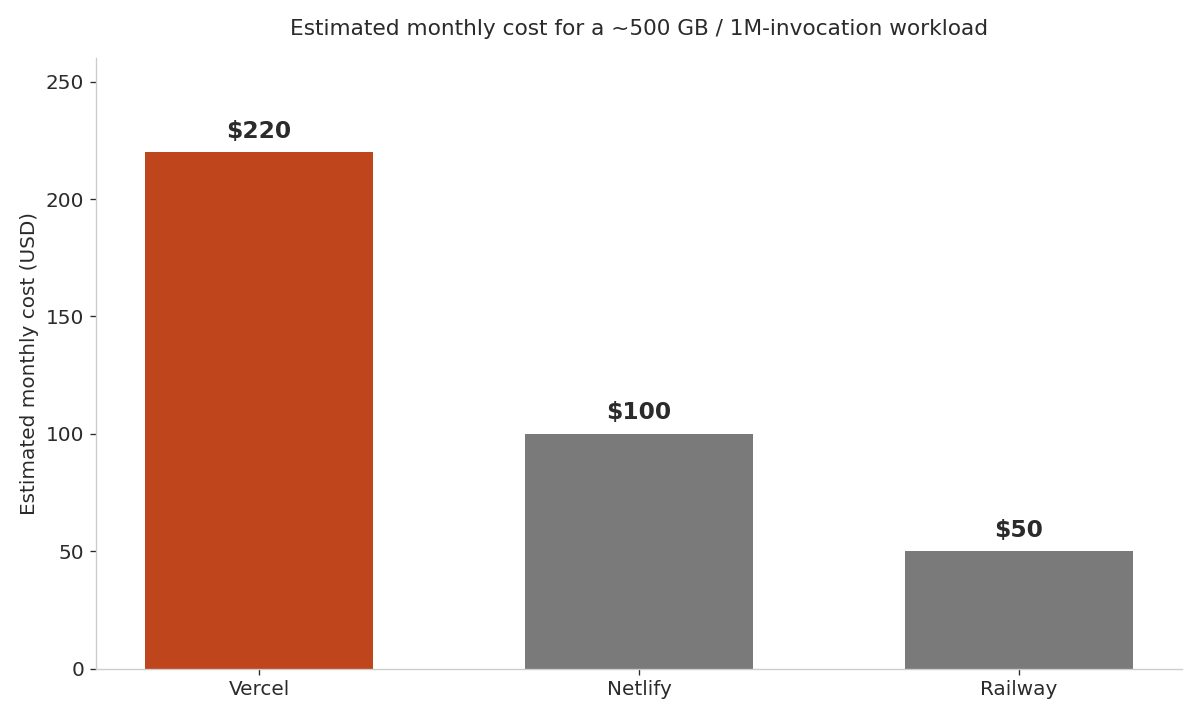
The chart above is an illustrative estimate built from each platform's published 2026 rates for one scenario: a mid-size full-stack app pushing roughly 500 GB of bandwidth and a million function invocations a month, with a small team. Your real bill depends heavily on traffic shape, seat count, and how much compute sits idle — so treat it as a directional comparison, not a quote. The honest pattern: per-seat platforms (Vercel, Netlify) get expensive as the team grows; usage-based platforms (Railway) get expensive as traffic grows. Which one bites you depends on which axis you scale first.
How well does each one host a Next.js app?
If you're building with AI coding tools, the odds are you're building a Next.js app — it's the default the boilerplate ships on, and the one Claude Code and Cursor know best. So Next.js support isn't a side detail; it's most of the decision.
Vercel hosts Next.js better than anyone, because Vercel makes Next.js. Every new framework feature lands on Vercel first and works without configuration. Image optimization, incremental static regeneration, server actions, the App Router — they all just work because the framework and the host are built by the same team. For a non-technical founder, that means fewer mysterious deploy failures and fewer "works on my machine but not in production" nights. That alignment is worth real money in saved debugging time.
Netlify used to be rough for Next.js and now isn't. The turnaround came from OpenNext, an open-source adapter that translates Next.js's server features into a form Netlify (and other platforms) can run. With OpenNext, Netlify handles SSR, the App Router, and serverless functions far better than it did a couple of years ago. It's not as seamless as Vercel's first-party support, but it's close enough that Netlify is a real option — especially given the unlimited-seat pricing.
Railway runs Next.js, but it isn't Railway's strength. You can absolutely deploy a Next.js app in a container on Railway, and it works. But you lose the edge-network niceties — global CDN, automatic image optimization, ISR — that the serverless platforms give you for free. Where Railway earns its place isn't serving your Next.js frontend; it's running the backend pieces that Next.js can't host: the database, the queue, the worker. Which leads to the combination most growing teams land on.
The "use both" answer (and why it's not a cop-out)
For a lot of SaaS apps, the right answer is Vercel (or Netlify) for the frontend, Railway for the backend and database. This feels like dodging the question, but it's the architecture a large share of production indie SaaS apps actually run.
Here's why. Neither Vercel nor Netlify offers a managed database — that's not their model. So even if you host your Next.js app on Vercel, your data lives somewhere else: Supabase, a Railway Postgres, a Neon instance. Once you accept that your database is a separate service, the question becomes where the rest of your backend lives. If all you have is serverless functions, keep them on Vercel. But the moment you need a long-running process — a worker draining a job queue, a websocket server, a scheduled task that runs every minute — you need something that stays warm. That's Railway.
flowchart LR
    U[User] --> V[Vercel / Netlify<br/>Next.js frontend + SSR]
    V --> R[Railway<br/>backend services]
    R --> DB[(Postgres)]
    R --> Q[Job queue / worker]
    R --> C[Cron jobs]
    V -.connects directly.-> DB
The diagram above is the common shape: the user hits your Next.js app on Vercel, which renders pages and runs short-lived functions; anything that needs to run continuously or hold state lives on Railway, alongside your database. It's more moving parts, yes — but each part is doing the job it's actually good at.
The tradeoff is operational overhead. Two platforms means two dashboards, two billing relationships, and two sets of environment variables to keep in sync. For a brand-new project with no background jobs, that's overkill — start on one platform and split only when a real need appears. I'd rather ship on Vercel alone today and add Railway the week I actually need a worker than architect a two-platform setup for an app with twelve users. Premature infrastructure is its own kind of debt. This is the same instinct behind keeping your error tracking and analytics lightweight early — add the operational machinery when the pain is real, not before.
Which one should a non-technical founder actually pick?
Forget the feature matrices for a second. Here's how I'd decide based on what you're building.
Pick Vercel if you're shipping a Next.js app and you want the fewest possible surprises. It's the default for a reason: the framework and the host are the same team, deploys are boring (the good kind), and AI coding tools assume Vercel when they scaffold a project. The cost is per-seat pricing that adds up for teams and bandwidth overage at $0.15/GB if you get a traffic spike. For a solo founder launching a Next.js SaaS, this is the safe, fast choice — and it's the one I reach for first.
Pick Netlify if you want a frontend platform but the per-seat math on Vercel bothers you, or you're already comfortable in Netlify's ecosystem. The April 2026 unlimited-seat Pro plan makes it genuinely attractive for small teams, and OpenNext closed most of the Next.js gap. The credit-based billing takes a minute to wrap your head around, so model your usage before committing.
Pick Railway if your app is more than a frontend — if you need a database, background workers, cron jobs, or a long-running server in one place, with predictable usage-based costs. It's also the most natural fit if you're not on Next.js, or if you're running a Python/Node backend that doesn't map cleanly to serverless functions. The usage model rewards apps that idle and punishes apps that run hot 24/7, so know your traffic shape.
Pick a combination if you've outgrown a single platform — Next.js frontend on Vercel, backend and Postgres on Railway. Don't start here, but don't be afraid to grow into it. When I weighed the whole boilerplate landscape, how cleanly a starter let you split frontend and backend later was one of the things I cared about, because painting yourself into a single-platform corner is a real risk.
One thing AI coding tools genuinely change: the deploy configuration that used to favor "whichever platform has the simplest setup" matters much less now. Pasting your platform's docs into Claude Code or Cursor gets you a working vercel.json, netlify.toml, or Railway config in minutes. The decision is back to being about architecture and economics — exactly where it belongs.
Frequently asked questions
Is Vercel or Netlify better for a Next.js app?
Vercel has the edge because it's built by the Next.js team, so every framework feature works without configuration. Netlify is now a strong second thanks to its OpenNext integration, and its unlimited-seat Pro pricing can make it cheaper for small teams. For pure ease, pick Vercel; for team cost, weigh Netlify.
Can Railway host a Next.js frontend?
Yes, Railway runs Next.js in a container, but you lose the edge-network features (global CDN, automatic image optimization, ISR) that Vercel and Netlify provide for free. Railway's strength is hosting the backend — database, workers, cron jobs — not serving a frontend. Many teams pair Railway's backend with a Vercel frontend.
Which is cheapest for a small SaaS?
It depends on what scales first. Per-seat platforms (Vercel at $20/user, Netlify at a flat $20 for unlimited seats on Pro) cost more as your team grows; Railway's usage-based model costs more as traffic grows. For a solo founder with modest traffic, all three are inexpensive — Netlify's free tier and Railway's $5 Hobby plan are the lowest entry points.
Do any of these include a database?
Only Railway. Vercel and Netlify are frontend-first and expect you to bring your own database (commonly Supabase or a hosted Postgres). Railway offers managed Postgres, Redis, and other services in the same place you run your app, which is its biggest structural advantage for full-stack apps.
Should I use Vercel and Railway together?
It's a common and legitimate setup: Next.js frontend on Vercel, backend services and database on Railway. Start on a single platform to keep things simple, and add the second only when you have a real need — a background worker, a queue, a long-running process — that serverless functions can't handle.
What happens if I exceed the free tier?
On Vercel's Hobby plan you hit hard caps and the project stops serving until the next month or you upgrade. Netlify's free tier pauses sites that exceed limits. Railway's trial credit simply runs out. None of them silently bill you huge overages on the free tiers, but the paid plans do meter usage, so watch your dashboards as you grow.
The bottom line
The Vercel vs Netlify vs Railway question is really a question about shape. If you're shipping a Next.js frontend and want zero deploy drama, Vercel is the obvious first move. If per-seat pricing grates and you want a frontend platform anyway, Netlify's 2026 plan is worth a serious look. If your app is a real backend — database, workers, cron — Railway is the only one of the three built for that, and pairing it with a Vercel frontend is a setup you'll see in production again and again.
Whichever you choose, the deploy is the easy part now — describe your stack to an AI assistant and the config writes itself. If you're building a SaaS with AI coding tools, Coding Capybaras is the free boilerplate I built for exactly this workflow; it ships ready to deploy on Vercel, and the marketplace has copy-paste prompts for the services that run alongside it.