Pricing Experiments: How Indie SaaS Founders Find the Price
A practical guide to running pricing experiments for indie SaaS: the tests that work, the ones that waste time, and how to change price without wrecking trust.
· Justin Boggs

Photo by Kvalifik on Unsplash
Indie SaaS founders find the right price by running small, structured experiments on real buyers rather than guessing once and freezing the number forever. The pattern that works: pick a defensible starting price using a lightweight research method, test variations only on new customers, watch conversion and churn for 60 to 90 days, and keep the change if the numbers hold. Pricing is the highest-leverage lever a bootstrapped founder controls, and it is also the one most of us touch the least. You don't need a pricing consultant or a data team. You need a habit of treating your price as a hypothesis instead of a fact.
TL;DR
- Solo founders systematically underprice; the fix is a testing habit, not a magic formula.
- Set a defensible starting price with a fast method like the Van Westendorp meter, then validate it against real purchase behavior.
- Test new prices on new customers only, and read the result across conversion, churn, and ARPU together — never one in isolation.
- Your entry model (freemium vs. trial) moves conversion far more than the dollar amount does.
- Change price with empathy: grandfather existing customers, give notice, explain the value.
Why founders underprice (and why it's the default mistake)
The single most common pricing mistake in indie SaaS isn't a bad formula. It's picking a number that feels safe, shipping it, and never touching it again. I did exactly this with the first version of Coding Capybaras Pro. I looked at what felt "fair," landed on $97 one-time, and told myself I'd revisit it later. Later is the trap.
Founders underprice for a reason that has nothing to do with the market. It's fear. When you built the thing yourself, every bug is vivid to you, so you discount for flaws the customer never notices. You anchor on consumer-app prices — the $5 and $10 you pay for phone apps — when your actual buyer is a business getting real work done. And you conflate "low price" with "low friction," assuming a cheaper number always converts better. It often doesn't.
The 2025 State of Micro-SaaS report from Freemius found that pricing experimentation shows up as the top growth lever for bootstrapped SaaS founders. Not a new channel, not a new feature — pricing. That's because a price change costs nothing to ship and applies to every future customer at once. A 20% increase that holds conversion is pure margin.
The cautionary tale here is RB2B's launch, documented by founder Adam Robinson. They launched with a simple flat price and let usage run. Nearly 5,000 users signed up in the first 45 days — and only 13 paid. The pricing was "broken at both ends": too expensive for small teams, too generous for the free tier, and not structured for larger accounts. After they tightened free usage, added a lower entry plan, and built clear upgrade moments, paid conversions followed and ARR crossed $1M shortly after. The product didn't change. The pricing structure did.
That's the mental shift. If you've already sweated the number once and moved on, the highest-return work you can do this quarter is to reopen it. My longer take on the psychology of this lives in SaaS pricing for non-tech founders.
How to set a defensible starting price fast
You can't experiment without a starting point, and "what feels right" isn't one. The good news is that you don't need a research budget to get a defensible baseline. You need one afternoon.
The fastest credible method for a solo founder is the Van Westendorp Price Sensitivity Meter, a technique developed in the 1970s that's still a workhorse for SaaS pricing research. You ask a handful of potential buyers four questions about your product:
- At what price would this be so expensive you wouldn't consider it?
- At what price would it be expensive but worth considering?
- At what price would it be a bargain?
- At what price would it be so cheap you'd question the quality?
Plot the answers and you get an "acceptable price range" plus an optimal price point. As Monetizely's guide explains, the method is popular precisely because the questions are easy to answer, which means higher completion rates and more usable data than heavier techniques like conjoint analysis. You can run it in a Google Form sent to 20 people in your target market.
The critical caveat: Van Westendorp tells you what people say, not what they do. Stated willingness to pay is optimistic. According to the same research, combining stated-preference data with real behavioral data can improve pricing accuracy by up to 30%. So treat the survey result as a starting hypothesis, set your launch price inside the acceptable range, and let actual purchase behavior be the tiebreaker.
If surveying feels like overkill for a v1, there's an even simpler baseline: price against the alternative your customer is already paying for, whether that's a competitor, a freelancer, or the cost of doing the job manually. Anchor to the value you replace, not to your hosting bill.
Running the experiment without breaking things
Here's where founders get nervous, and reasonably so. Changing your price sounds like something that could blow up your revenue. It won't, if you follow one rule: test new prices on new customers only.
Never retroactively change what existing customers pay in the middle of an experiment. Grandfather them. This does two things — it protects your relationship with the people who already trusted you, and it keeps your experiment clean by isolating the new price to a fresh cohort.
The mechanics of a split test are simpler than they sound. You show half of new visitors the current price and half the new price, then compare cohorts after enough volume. One example cited in the 2025 micro-SaaS data: a SaaS tested new tiers via a 50/50 in-app split and cut churn from 5.8% to 4.5% over 90 days. That's the shape of a good result — not a dramatic overnight spike, but a measurable move in a metric that compounds.
A few guardrails I'd insist on:
- Give it 60 to 90 days. Pricing effects show up in churn and renewals, which lag. A one-week read is noise.
- Change one thing at a time. If you move the price and restructure the tiers and add a feature, you'll never know which lever mattered.
- Have enough volume. If you're getting five signups a week, a 50/50 split takes months to reach significance. At low volume, sequential testing (old price this month, new price next month) is more honest than a underpowered split — just watch for seasonality.
The most important discipline is deciding your success metric before you start. Write it down: "I'll keep the new price if conversion drops by less than X while ARPU rises by Y." Otherwise you'll rationalize whatever happened.
Reading the results: the three numbers that matter together
The classic pricing mistake, after underpricing, is reading a single metric. Conversion dropped, so you panic and revert. But conversion in isolation is meaningless. A higher price that converts fewer, better-fit customers at higher revenue per user is often the better outcome — you're doing less support for more money.
Read three numbers as a set:
| Metric | What it tells you | The trap | | --- | --- | --- | | Conversion rate | How many visitors become payers | Reverting the second it dips | | ARPU (avg revenue per user) | Whether higher prices offset lower conversion | Ignoring it entirely | | Churn rate | Whether the new price attracts the right buyers | Reading it too early (it lags) |
Here's the math that founders miss. If you raise your price 30% and conversion drops 15%, you're still up on revenue and you're supporting fewer accounts. Higher-priced customers also frequently churn less, because a price that's too low can attract tire-kickers who were never a fit. A 2025 study referenced in the micro-SaaS data found that of SaaS companies that changed pricing, just 4% saw a slowdown afterward while the remaining 96% grew faster — when the change was tied to clear value and communicated with empathy.
The other big lever most indie founders leave on the table is billing cadence. The same report cites analysis showing annual upfront plans cut churn by roughly 30% and lift lifetime value by 27% versus monthly. Offering an annual option at a modest discount is one of the safest "pricing experiments" you can run, because it improves cash flow and retention at once. I break the tradeoffs down in annual vs. monthly billing, and the underlying metrics in subscription billing math.
Your entry model matters more than your price
If you're agonizing over $39 vs. $49, you may be optimizing the wrong variable. For most indie SaaS, the entry model — how someone gets in the door — moves conversion far more than the dollar amount.
The data here is stark. First Page Sage's analysis of 80+ SaaS clients found these typical free-to-paid conversion rates by entry model:
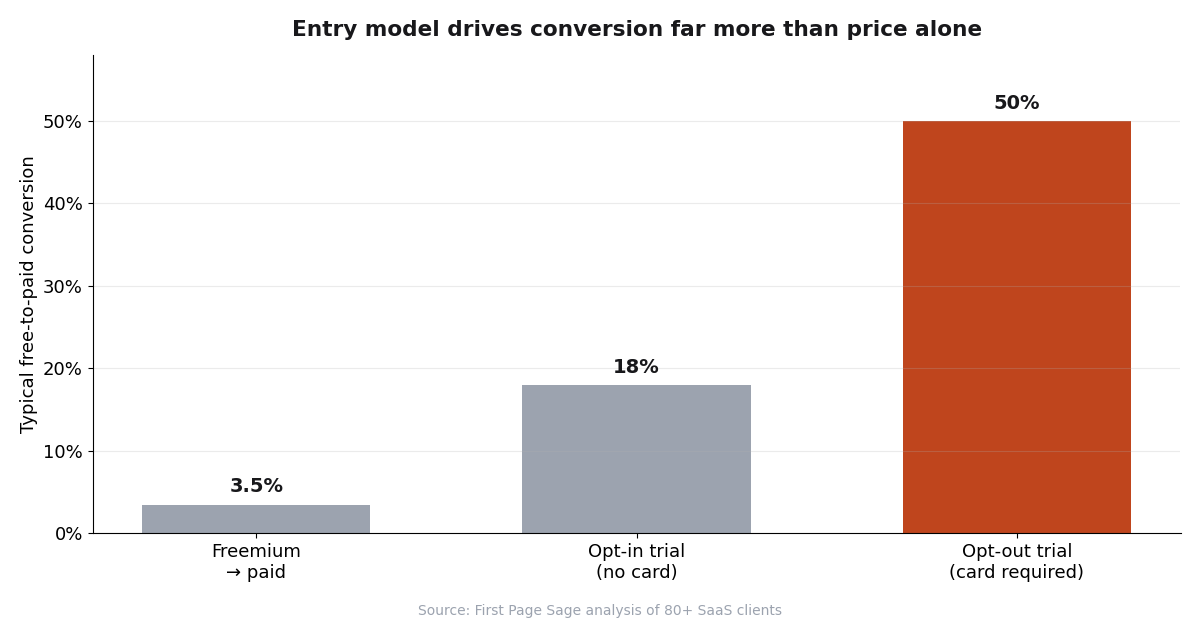
A freemium tier converts around 3–4%. An opt-in trial with no card required converts around 18%. An opt-out trial that requires a card up front converts around 50%. That's not a rounding difference — it's more than a 10x swing driven entirely by how you gate access, not by the price behind the gate.
This is why "should I do freemium?" is a bigger pricing question than "what should the paid plan cost?" Freemium can work when the free tier drives referral and word of mouth, but it saddles a solo founder with supporting a large base of people who will never pay. The 2025 data shows the indie world moving decisively toward trials: only about 17% of SaaS still maintain a freemium tier, while roughly two-thirds offer a free trial, and around 70% of those now ask for a card up front.
I'm not saying card-required trials are right for everyone — they qualify buyers harshly, which is great for revenue and bad for top-of-funnel volume. But the point stands: run the entry-model experiment before you obsess over the price. I go deeper on this decision in free trial vs. freemium vs. paid, and on how your pricing page itself converts, which is its own experiment surface.
Pricing experiments that waste your time
Not every pricing experiment is worth running. Some feel productive and teach you nothing, or worse, teach you the wrong lesson. Here are the ones I'd steer a first-time founder away from.
Discount-driven tests. Running a "20% off this week" promo and calling it a pricing experiment measures urgency, not willingness to pay. All you learn is that people like discounts, which you already knew. Worse, discounts train your audience to wait for the next sale and quietly anchor your product's value lower. If you want to know what people will pay, test the actual price, not a temporary markdown.
Testing on existing customers. I said it above and it's worth repeating as its own trap: changing what current customers pay in the middle of an experiment contaminates both the data and the relationship. You can't tell whether a churn spike came from the price or from the betrayal of a mid-stream change. Grandfather everyone and test only on new cohorts.
Reading a vanity metric. Watching signups go up after you lowered the price and declaring victory ignores whether those signups pay, stay, or cost you support. A cheaper price that triples your free signups and doubles your support load while lowering revenue is a loss dressed as a win. Always tie the experiment back to revenue and retention, not top-of-funnel counts.
Over-tiering too early. The temptation to launch with four tiers, add-ons, and usage overages is strong because it looks sophisticated. For a v1 it's a mistake. Every tier is a decision you're forcing on a confused buyer and a branch of logic you have to build and support. Start with one or two clean plans. You can't run a clean experiment on a pricing page nobody understands. Complexity is something you earn once you know where customers actually get value — not something you launch with.
The through-line: a good pricing experiment isolates one real variable, runs on fresh customers, and gets judged on money and retention. Anything that violates those three is usually motion without progress.
Frequently asked questions
How many customers do I need before I can test pricing?
You can start setting a defensible price on day one with a Van Westendorp survey of 15–20 target buyers. For live split tests, you want enough signup volume that a 50/50 split reaches a readable result in 60–90 days — realistically a few dozen conversions per arm. Below that, test sequentially (change the price for a month, compare to the prior month) instead of splitting, and lean more on qualitative buyer conversations.
Won't raising prices make me lose customers?
If you grandfather existing customers and apply the new price only to new signups, you lose nobody you already have. For new buyers, a higher price filters out poor-fit users who tend to churn and generate disproportionate support. The evidence is that most pricing increases, when tied to real value, correlate with faster growth rather than slower — not because price hikes are magic, but because underpricing was quietly capping the business.
Should I use usage-based or flat pricing?
Usage-based and hybrid pricing (a base subscription plus usage expansion) have become the norm in the broader SaaS market and tend to show stronger revenue performance than flat plans, because revenue scales with the value customers get. For a first SaaS, though, flat tiers are far simpler to build, explain, and support. Start flat, and add usage components once you understand where customers actually get value. Complexity you can't operate isn't worth the theoretical uplift.
How often should I revisit my pricing?
Treat it as a standing quarterly review rather than a one-time decision. You don't have to change the price every quarter — you have to look. Check whether conversion, churn, and ARPU are drifting, whether you've added value since the last review, and whether your best customers would clearly pay more. Most indie founders under-revisit; a light quarterly check corrects that.
What's the safest pricing experiment to run first?
Adding an annual billing option at a modest discount. It rarely hurts conversion, it improves cash flow immediately, and it measurably reduces churn and lifts lifetime value. It's the closest thing to a free lunch in pricing, and it teaches you the mechanics of changing your billing setup on a low-risk change before you touch the headline number.
The takeaway
Finding the right price isn't a moment of insight — it's a habit of running small experiments and reading the results honestly. Set a defensible baseline, test on new customers only, watch conversion, ARPU, and churn together, and remember that your entry model probably matters more than the number itself. The founders who win at pricing aren't the ones who guessed right the first time. They're the ones who kept looking.
If you're building a SaaS with AI coding tools and want a foundation where changing your pricing is a config edit rather than a code change, Coding Capybaras ships pricing, billing, and the admin controls to run these experiments as a free boilerplate — the same one this site runs on.