Programmatic SEO for SaaS Without Getting Deindexed
A practical programmatic SEO guide for indie SaaS founders: how to scale template pages that rank, the thin-content line, and Google's scaled content abuse rule.
· Justin Boggs

Photo by Luke Chesser on Unsplash
Programmatic SEO is the practice of generating many search-targeted pages from a single template and a structured dataset, so one build produces hundreds or thousands of pages that each rank for a specific long-tail query. For a SaaS founder it's tempting: write one template, point it at a spreadsheet, wake up with 800 pages. It also fails more often than it works — because most programmatic pages are thin, and Google's scaled content abuse policy exists specifically to bury them. The version that works is narrow: real data on every page, tight internal linking, and a slow rollout you actually monitor. This guide covers how to do it without getting your whole domain deindexed.
TL;DR
- Programmatic SEO works only when every generated page carries unique, useful data — not just a swapped-in keyword. Token-swap pages get ignored or deindexed.
- Google's scaled content abuse policy judges pages by whether they help users, not how they were made. AI generation is fine; low value is not.
- Roll out in batches of ~100 pages, monitor indexation for four to six weeks, and only scale the templates that hold.
- Internal linking is not optional — orphaned template pages with no path in are the first ones crawlers abandon.
- The safest programmatic templates for SaaS are comparison, integration, and use-case pages built on data you already own.
What programmatic SEO actually is (and what it isn't)
Programmatic SEO is a production method, not a content type. You define a page template once — the headings, the layout, the sections — and then feed it a dataset where each row becomes one page. A classic example is a store locator: one template, one row per city, thousands of pages that each target "[service] in [city]." The template is identical; the data on each page is different.
That last clause is the whole game. Programmatic SEO earns traffic when the data varies meaningfully page to page, and collapses when only the keyword varies. The difference between a page that ranks for years and a page that vanishes in a month is almost never the template — it's whether the row behind the page contains something a reader can't get anywhere else.
It's worth separating programmatic SEO from two things it gets confused with. It is not "AI writes 500 blog posts." That's just scaled content with extra steps, and it triggers the exact spam signals we'll get into below. And it is not a growth hack you run once and forget. The pages need maintenance, the data needs to stay accurate, and the internal links need to actually connect. Think of it as building a small, data-backed product surface that happens to live on your marketing site.
For non-technical founders, the appeal is real and the trap is real. You can genuinely stand up a few hundred high-intent pages faster than you could hand-write them, and each one can pull in a buyer typing a phrase no human writer would bother targeting. But the same tooling that lets you publish 800 pages in an afternoon lets you publish 800 bad pages in an afternoon, and Google has spent the last two years getting very good at telling the two apart. The rest of this post is about staying on the right side of that line — which starts with knowing exactly where Google drew it.
Why Google deindexes most programmatic pages
The single most important thing to understand before you generate a single page is Google's scaled content abuse policy. It was introduced with the March 2024 core and spam updates, and it replaced the older, narrower "spammy auto-generated content" rule. The shift was deliberate: Google stopped asking how a page was made and started asking why it exists and whether it helps anyone.
Google's own definition is worth quoting directly. Scaled content abuse is "when many pages are generated for the primary purpose of manipulating search rankings and not helping users. This abusive practice is typically focused on creating large amounts of unoriginal content that provides little to no value to users, no matter how it's created." That last phrase — "no matter how it's created" — is what closed the AI loophole. Hand-written, spun, translated, or AI-generated: if the pages are unoriginal and low-value, the source doesn't save you.
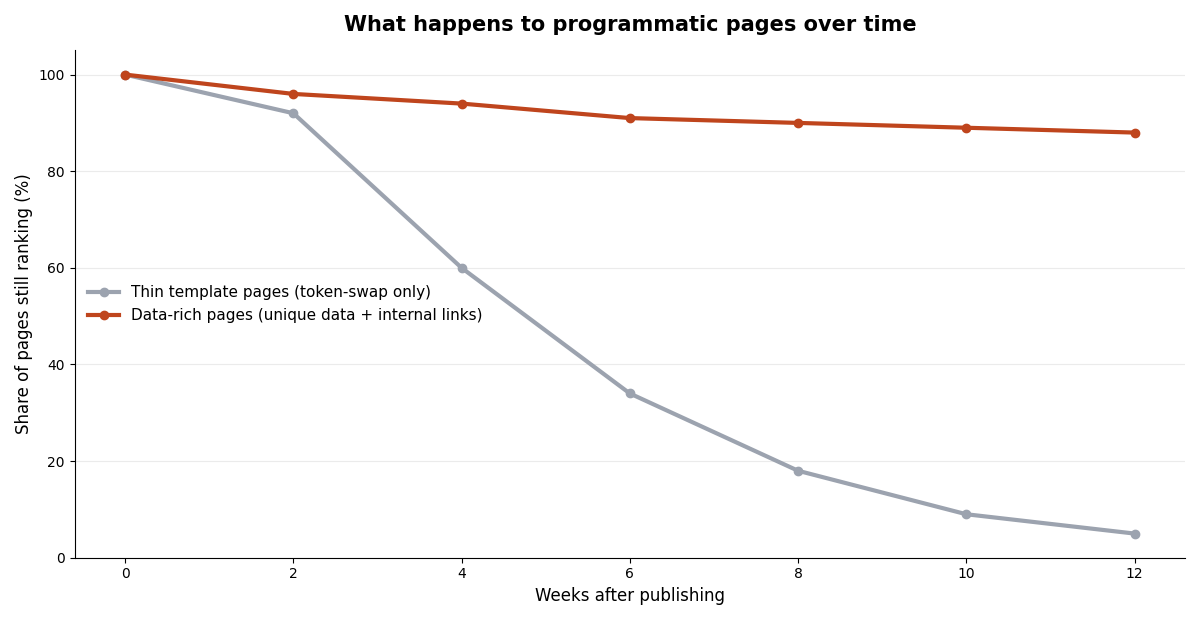
The enforcement pattern is quieter than a manual penalty and easier to miss. Rather than slapping your whole site, Google increasingly just ignores the offending pages — they might technically stay in the index but stop ranking for anything. Founders watch a batch of programmatic pages get crawled, index, rank for a few weeks, and then slide to zero. The travel-site cautionary tale that gets passed around SEO circles is a site that generated tens of thousands of near-identical "hotels in [city]" pages and had the overwhelming majority deindexed within months. The pages were technically fine. They just didn't say anything.
There's a second-order risk that scares founders more: collateral damage to the rest of the domain. When a large fraction of your site is low-value template pages, it can drag the perceived quality of the whole domain, which is why the safe move is to keep programmatic pages behind a quality gate and noindex anything that doesn't clear it. Google's guidance on AI-generated content is consistent on this point: using automation to generate content is allowed, but using it to game rankings with low-value pages is not. The tool is neutral. The intent and the output are what get judged.
The data test: does each page earn its place?
Here's the practical filter I use before building any programmatic template: can I put at least three unique, useful data points on every single page, automatically, without writing prose by hand? If the answer is no, the template isn't ready and I don't build it.
"Unique data points" means something specific and different on each page — a real price, a real metric, a real comparison, a real screenshot, a genuine limitation. Not a rephrased sentence. Not the same paragraph with the city name changed. The table below is the mental model for the difference.
| Attribute | Thin template page | Page that earns its place | | --- | --- | --- | | What varies | The keyword and a noun or two | Real data: prices, specs, metrics, examples | | Unique data points | 0-1 | 3 or more per page | | Internal links | Orphaned or a single nav link | Linked from a hub, links to siblings + related posts | | First-party value | None | Your own data, tests, or product context | | Likely outcome | Ignored or deindexed in weeks | Indexed and ranking for months |
The founders who win at this treat each page as a small answer to a real question, not a keyword container. If you sell email software and you build a "[ESP] vs [ESP]" comparison template, every page needs the actual sending limits, the actual pricing tiers, the actual deliverability notes — data you've gathered — not "Both tools are great choices for growing businesses."
This is the same principle behind good landing pages, just applied at scale. In my guide to SEO for SaaS landing pages I make the case that structure and a direct answer up top beat volume of prose; programmatic SEO is that idea multiplied across a dataset. And it's why the narrow-and-specific logic that drives your first 100 customers shows up here too: you will never out-program the incumbents on broad terms, but you can own a few hundred precise, high-intent phrases they've ignored.
One more gate, borrowed from how I think about choosing a boilerplate: don't build the machine before you've validated one page by hand. Write a single page of the template manually. If that one page is genuinely useful and could rank on its own, the template is worth building. If the hand-written version is boring, automating it just produces boring at scale.
A safe rollout for a non-technical founder
The mistake that kills programmatic SEO projects is publishing everything at once. You generate 2,000 pages, submit the sitemap, and hand Google a giant batch of untested content to judge in one shot. If the template has a quality problem, you find out at maximum scale.
Do the opposite. Roll out in small batches, watch what happens, and only scale what holds. Here's the sequence I'd follow.
flowchart TD
    A[Build 1 page by hand] --> B{Genuinely useful on its own?}
    B -- No --> A
    B -- Yes --> C[Generate first 100 pages from template]
    C --> D[Submit sitemap, add internal links from a hub page]
    D --> E[Wait 4-6 weeks, monitor indexation + rankings]
    E --> F{Indexed and gaining impressions?}
    F -- No --> G[Fix data depth or noindex the batch]
    F -- Yes --> H[Scale to the next batch]
    H --> E
The monitoring window matters. Give each batch four to six weeks before you judge it, and watch two things in Google Search Central's coverage and performance reports: are the pages getting indexed, and are they picking up impressions for the queries you built them for. If a batch indexes but earns zero impressions after a month, the data isn't unique enough — that's your signal to deepen the template, not to publish more of the same.
Internal linking is the part founders skip and then wonder why nothing indexes. Crawlers find pages by following links; a flat pile of pages with no path between them gives the crawler no reason to keep going, and it abandons the crawl. Every programmatic page needs a hub page linking down to it, links across to sibling pages, and a link or two out to relevant blog posts. This is also where you connect the programmatic surface to the rest of your growth engine — the distribution channels I use on Reddit and X can seed the initial links and traffic that get a new batch crawled faster.
Keep a noindex tag ready as your safety valve. Any page that doesn't clear the three-data-point gate gets noindex until it does. It's better to have 120 indexed pages that all rank than 2,000 pages where the good ones are diluted by junk. Quality gating isn't caution for its own sake — it's how you protect the domain-level reputation that every one of your pages borrows from.
Programmatic SEO templates that work for SaaS
Not every dataset makes a good programmatic template. The ones that reliably work for SaaS share a trait: the founder already owns differentiated data, so the pages are useful by construction rather than by padding.
Comparison pages — "[Your tool] vs [competitor]" and "[Competitor A] vs [Competitor B]." These work because you can legitimately populate real feature grids, pricing, and honest tradeoffs. Buyers searching these terms are deep in evaluation. The data is naturally unique per page, and you can be more candid about limitations than the competitors are about their own.
Integration pages — "[Your product] + [tool] integration." If your product connects to fifty tools, each connection is a real page with real setup steps, real use cases, and a real reason someone typing "[your product] Slack integration" landed there. This template maps cleanly onto how I think about the marketplace of integration guides — each integration is a genuine page, not a keyword shell.
Use-case and role pages — "[Product] for [industry/role]." "Time tracking for law firms," "invoicing for freelance designers." Each page speaks to a specific segment's real concerns. The risk here is highest, because it's the easiest template to fill with generic filler, so hold the line on segment-specific data.
Location or data pages — anything where you have a genuine dataset: a statistics page per category, a template gallery, a directory built on data you've collected. Google explicitly treats data-backed pages that resolve real queries — store locators, statistics pages, comparisons — as legitimate programmatic content.
The templates that fail are the inverse: glossary pages that restate a dictionary definition, "best [tool] in [city]" pages with no local data, and any template where the honest hand-written version would be three sentences of nothing. If you can't fill it with something real, don't scale it.
Frequently asked questions
Is programmatic SEO against Google's rules?
No. Programmatic SEO is allowed and can rank well. What's against the rules is scaled content abuse — generating many low-value pages primarily to manipulate rankings. If each page delivers genuine, unique value, the fact that it was produced from a template is irrelevant to Google.
Can I use AI to generate programmatic pages?
Yes, but AI generation doesn't change the standard. Google judges the output, not the method — its policy explicitly says low-value scaled content is a problem "no matter how it's created." Use AI to assemble and format real data; don't use it to inflate thin pages into longer thin pages.
How many pages can I safely publish at once?
Start with about 100 and monitor indexation and impressions for four to six weeks before scaling. Publishing thousands in one batch hands Google a large, untested set to judge at once, and if the template has a quality problem you find out at maximum scale.
What's the minimum for a programmatic page to rank?
A rough working bar is three or more unique, useful data points per page, plus internal links in and out. If a page varies only by keyword and shares its body with hundreds of siblings, expect it to be ignored or deindexed.
How do I know if my pages got deindexed?
Watch Google Search Central's coverage and performance reports. The telltale pattern is pages that index and rank briefly, then slide to zero impressions while staying technically indexed — that's Google choosing to stop ranking them rather than issuing a visible penalty.
Should programmatic pages live on my main domain or a subdomain?
For most indie SaaS, the main domain is fine and benefits from your existing authority — but only if the pages clear the quality gate. If a large share of your pages are thin, they can drag the whole domain, which is the real argument for gating aggressively rather than for hiding them on a subdomain.
Where this leaves you
Programmatic SEO for SaaS is a real channel with a narrow safe path. Build the template on data you actually own, put three unique data points on every page, link everything into a hub, and roll out in batches you monitor for a month before scaling. Do that and you compound a few hundred high-intent pages that keep earning traffic; skip it and you hand Google a batch of thin pages to quietly ignore. The line is not "AI or not" — it's "useful or not."
If you're building a SaaS with AI coding tools and want the marketing surface wired up the same careful way, Coding Capybaras is the free boilerplate I built for exactly this kind of founder — the blog, the pages, and the internal-linking structure ship in the box, so the SEO groundwork is already laid before you write your first template.