The SaaS Directory Submission List, Ranked by ROI
A SaaS directory submission list ranked by what actually converts — which directories drive buyer traffic, which are link farms, and a template to submit fast.
· Justin Boggs

Photo by Mathyas Kurmann on Unsplash
A useful SaaS directory submission list is short, not long. The directories worth an hour of your time are the ones that either send buyer-intent traffic you can convert or carry enough authority that the listing shows up when someone searches your category — and there are maybe a dozen of those, not three hundred. Everything else is a link farm charging you attention for a listing nobody visits. The move is to submit to the ten or so directories that actually match your product and buying motion, do each one well, and skip the spray-and-pray lists entirely. This post is that shortlist, ranked, plus a submission template so you can knock out the good ones in an afternoon.
TL;DR
- A SaaS directory is a third-party site that lists software so buyers can find, compare, and review it. The good ones send qualified traffic; the bad ones just want your listing to pad their own page count.
- Rank by intent, not count. Product Hunt, G2, and Capterra sit at the top because they either drive a traffic spike or reach buyers with a card already out. A focused 10–15 directory pass beats a 300-directory blast every time.
- Most directory links are nofollow — they won't move your Google rankings directly, but the referral traffic and category visibility are the real payoff.
- G2 is consolidating the review market. In early 2026 it agreed to acquire Capterra, Software Advice, and GetApp from Gartner, which changes where your listing effort compounds.
- Use one template. A tight product description, screenshots, and consistent metadata make submitting to a dozen directories a single afternoon's work.
What a SaaS directory actually is (and what you're buying)
A SaaS directory is a third-party website that lists software products so buyers can discover, compare, and review them. Some are review platforms (G2, Capterra), some are launch stages (Product Hunt), some are curated maker communities (Indie Hackers), and some are alternative-finder sites (AlternativeTo, SaaSHub). They look similar from the outside — a logo, a description, a category — but they pay you in very different currencies.
I wrote a whole post on this currency idea for launch channels in AppSumo vs Product Hunt vs BetaList, and it applies just as cleanly to directories. Before you submit anywhere, get clear on which of three things you're actually buying: a spike of referral traffic, standing category visibility in search, or a backlink for SEO. Most founders submit hoping for all three and get disappointed when a listing delivers none.
Referral traffic is the most honest payoff. A strong Product Hunt day sends a real, measurable wave of visitors to your site in 24 hours. A G2 or Capterra profile sends a slower trickle of buyers who are actively comparing tools in your category — lower volume, much higher intent.
Category visibility is the compounding one. When someone Googles "best [your category] software," the directories that rank on page one are the ones a listing puts you in front of. You're not buying their traffic directly; you're renting a slot on a page Google already trusts.
The backlink is the one people overrate, and we'll get to why in a minute. The short version: treat it as a bonus, never as the reason. If a directory's only pitch is "dofollow backlink," it's usually a link farm, and Google has spent years getting better at ignoring exactly those.
The shortlist: directories worth an hour each
Here's the honest ranked list. I've grouped them by what they're good for, because "best" depends entirely on whether you sell B2B, run a consumer app, or just want early adopters. The table below ranks the ones I'd submit to first.
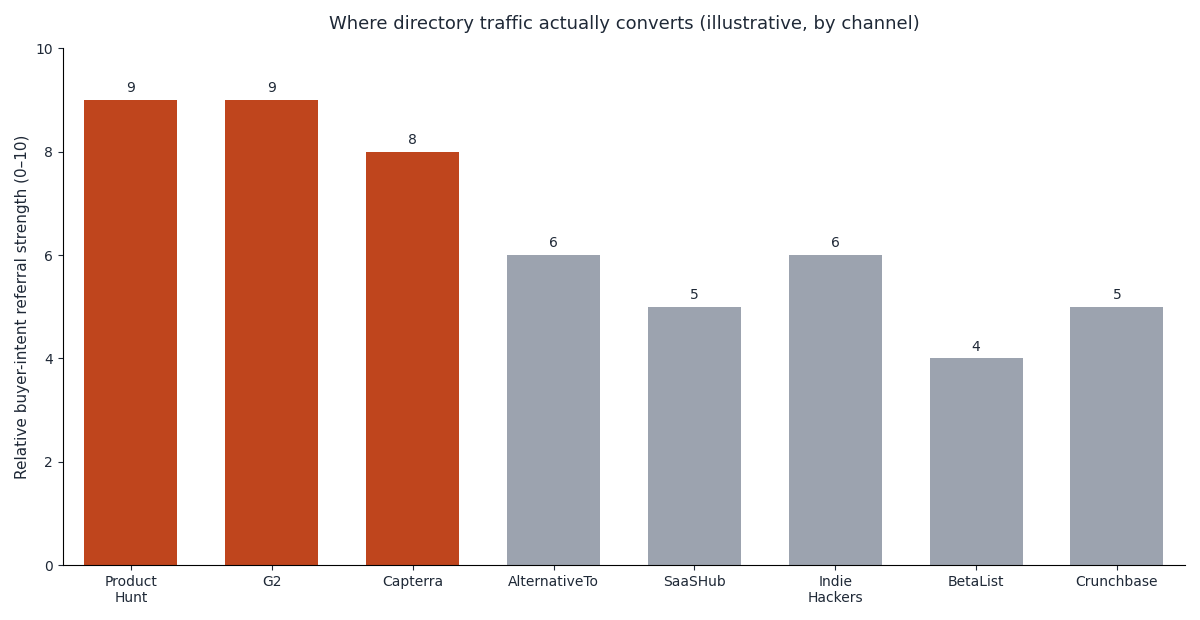
| Directory | Best for | Cost | Link type | What you're really getting | | --- | --- | --- | --- | --- | | Product Hunt | Launch day | Free | nofollow | A 24-hour traffic spike + credibility badge | | G2 | B2B software | Free tier | Mixed | High-intent buyer traffic + a reviews page | | Capterra | Business software | Free listing | Dofollow | Comparison-stage buyers ready to purchase | | AlternativeTo | Any category | Free | nofollow | Long-tail "X alternative" discovery | | SaaSHub | Pure SaaS | Free | nofollow | Category browsing + alternatives traffic | | Indie Hackers | Indie/maker tools | Free | nofollow | Engaged founder audience + story reach | | BetaList | Pre-launch | Free/paid | nofollow | Early-adopter email signups | | Crunchbase | Any startup | Free tier | nofollow | Credibility + investor/press discovery |
If you sell B2B, start with G2 and Capterra. These are the platforms enterprise buyers check before they sign anything, and a profile with even a handful of real reviews does more for a sales conversation than any amount of your own marketing copy. This is also where the market is shifting: in early 2026, G2 agreed to acquire Capterra, Software Advice, and GetApp from Gartner, consolidating the four biggest B2B review platforms under one roof. The combined properties reach more than 200 million annual software buyers, so a listing effort there increasingly compounds across what used to be separate sites.
If you're a solo maker shipping a tool for other makers, Indie Hackers and Product Hunt punch above their weight — the audience overlaps almost perfectly with early adopters. And if you're still pre-launch, BetaList is the cheap way to collect a first batch of beta emails before you have any audience of your own, a tactic I leaned on when gathering my first 10 testimonials.
There's also a second tier worth a mention: the niche directories specific to your category. Almost every vertical has one or two — a directory of AI tools, of no-code apps, of developer utilities, of design resources. These rarely have the domain authority of a G2, but the audience is exactly the buyer you want, and the competition for attention is thinner. If a niche directory in your space has a real audience (a newsletter, an active community, visible traffic), it can outperform a giant general directory for a narrow product. Find yours by searching "[your category] directory" and "[your category] tools list," then apply the same incognito-window test I describe at the end of this post.
Notice what's not on this list: the "submit to 300 directories" packages. A focused pass through the directories that match your product beats a 300-site blast, because the long tail is mostly automated listing sites that no human ever browses.
Why the "dofollow backlink" pitch is mostly a trap
Half the directory-submission industry sells one promise: dofollow backlinks that boost your Google ranking. It's worth understanding why that promise is weaker than it sounds, because it'll save you from wasting money.
Most reputable directories mark their outbound links nofollow, sponsored, or ugc. Those attributes tell Google not to treat the link as a full ranking endorsement. Back in 2019, Google introduced the sponsored and ugc attributes specifically to give sites a cleaner way to flag advertising and user-generated links — and directory listings are, by definition, user-submitted. Google now treats all three as "hints" rather than absolute rules, but the practical effect is the same: a link from a listing you submitted yourself carries far less weight than an editorial link someone chose to give you.
So when a directory's entire sales pitch is "get a dofollow backlink from our DR 80 site," be skeptical. If the site lists anyone who pays, with no editorial filter, Google has strong signals that the links are low-value regardless of what attribute they carry. Piling up hundreds of those can, at the margin, look like exactly the manipulative pattern Google's link-spam systems are built to discount.
That doesn't mean directory links are worthless. A nofollow link from a genuinely trusted, relevant, high-traffic directory still does two useful things: it sends real referral visitors, and it contributes to a natural-looking link profile where your brand shows up in the places a legitimate company would. The value is the traffic and the visibility, not the PageRank.
The reframe that keeps founders sane: submit to directories for the buyers who browse them, not for Google's crawler. If a directory has an audience you want to reach, list on it. If its only asset is a domain-rating number, skip it. Your ranking will come from the content and product work I cover in SEO for SaaS landing pages, not from a listing farm.
How to submit to a dozen directories in one afternoon
The reason directory submission feels like a slog is that founders treat each one as a fresh writing task. Don't. Build a single submission kit once, then paste from it. Here's the exact kit I use.
Start with your product metadata, written once and reused verbatim so your listings stay consistent (consistency also helps buyers recognize you across sites):
- Product name exactly as it appears everywhere else.
- One-line tagline under 60 characters. This is the hook that shows in category lists.
- Short description, 2–3 sentences, benefit-first. What it does and who it's for.
- Long description, ~150 words, for directories that allow it. Lead with the problem, then the product.
- Category — pick the single most accurate one. Miscategorizing to reach a bigger list backfires; you show up next to tools you don't compete with.
- 5 screenshots at consistent dimensions, plus a logo in square and horizontal formats.
- Pricing stated plainly. Buyers filter on it, and vague pricing gets skipped.
With that kit ready, work top-down through the shortlist. Do the high-value ones (G2, Capterra, Product Hunt) carefully, because those listings matter and some have review or approval steps. For the rest, paste your kit, upload your five screenshots, pick your category, submit. Twenty minutes each, tops.
One sequencing note: don't fire off a Product Hunt launch as just another directory submission. It rewards a real launch-day effort — the maker's first comment, a warm audience, assets prepared in advance. Product Hunt's own launch guide makes the point that preparation, not spend, drives the outcome. I broke down the day-of cadence in the Product Hunt launch playbook; treat that one as an event, and everything else on the list as a checklist item.
Finally, track what you submit. A simple spreadsheet — directory, date submitted, live URL, referral clicks after 30 days — tells you within a month which listings sent real visitors and which were dead weight. That data is worth more than any generic ranked list, including this one, because it's about your product and your buyers. Distribution is a system you build over time, the same way you build toward your first 100 customers.
What to skip, and the signals that give it away
You'll get pitched constantly. Here's how to spot the directories that waste your time in the first ten seconds on their site.
Skip anything that lists tens of thousands of "products" with no categories, no reviews, and no visible traffic. These exist to sell you a listing and to inflate their own page count for their own SEO. You are the product, not the audience.
Skip directories whose homepage is a wall of "DR 90 dofollow backlink" language with no actual buyers in sight. As covered above, that's optimizing for a signal Google increasingly ignores, and it's a tell that no humans browse the site.
Skip paid listings unless you can point to a specific audience you're buying access to. Paying for placement on a directory people actually use (a niche community newsletter, a well-trafficked review site) can be fine. Paying $49 to be link number 40,000 is not.
Be cautious with directories that require reciprocal links back to them. A badge on your site is fine; being forced to link back from your footer to boost their rankings is the sign of a scheme, not a service.
The honest test for any directory: open it in an incognito window and ask, "Would a buyer in my category ever end up here?" If you can picture a real person browsing it to find a tool like yours, submit. If you can only picture other founders submitting to it for backlinks, close the tab.
Frequently asked questions
How many SaaS directories should I actually submit to?
Ten to fifteen, chosen to match your product and buyer. A focused pass through directories that fit your category beats submitting to hundreds. The long tail is mostly automated listing sites with no human traffic, so more submissions past the shortlist adds effort without adding visitors.
Do directory backlinks help my Google ranking?
Rarely on their own. Most directory links are nofollow, sponsored, or ugc, which Google treats as hints rather than ranking endorsements. The real payoff is referral traffic and category visibility, not PageRank. Submit for the buyers who browse the directory, not for the link.
Are G2 and Capterra worth it for a brand-new SaaS?
For B2B, yes — even a free listing with a few genuine reviews gives you a page enterprise buyers check before purchasing. With G2's 2026 acquisition of Capterra, Software Advice, and GetApp, effort on these platforms increasingly compounds across the biggest review network in the market.
Should I pay for directory submission services?
Usually no. Services that blast your product to 100–300 directories are optimizing for link count, which is the metric that matters least. You're better off spending that money on a single well-targeted paid placement or, more often, keeping it and doing the shortlist yourself.
What's the difference between a directory and a launch platform?
A directory (G2, Capterra, AlternativeTo) is an evergreen listing buyers browse over time. A launch platform (Product Hunt) is a one-day event that rewards preparation and drives a traffic spike. Treat directories as a checklist and launches as a planned event, not the same task.
How do I track whether a directory listing was worth it?
Keep a spreadsheet with the directory name, submission date, live listing URL, and referral clicks after 30 days. Within a month you'll see which listings sent real visitors. That per-product data beats any generic ranked list for deciding where to spend future effort.
The one-afternoon takeaway
Directory submission is one of the few growth chores where the winning move is to do less, more carefully. Build your submission kit once, work down a shortlist of ten to fifteen directories that actually match your product, do the top three properly, and track the results for a month. Ignore the 300-directory packages and the dofollow-backlink pitches entirely — they optimize for a number that doesn't convert.
If you're a non-technical founder building your SaaS with AI coding tools, Coding Capybaras is the free boilerplate I built for exactly this workflow, and the marketplace has copy-paste prompts for wiring in the analytics you'll want to track which of these directories actually sent buyers your way.