Stripe vs Lemon Squeezy vs Paddle for Indie SaaS (2026)
Stripe vs Lemon Squeezy vs Paddle compared for indie SaaS in 2026 — real fees, the merchant-of-record tax question, and which one fits a solo founder.
· Justin Boggs

For most indie SaaS founders in 2026, the Stripe vs Lemon Squeezy vs Paddle decision isn't really about payment processing — it's about who handles sales tax. Stripe is a payment processor: cheapest headline rate (2.9% + 30¢), but you're the legal seller, so you own VAT and sales-tax compliance in every country you sell to. Paddle and Lemon Squeezy are merchants of record: they charge more (around 5% + 50¢), but they become the legal seller and handle global tax filing for you. The right answer depends on how many countries you sell into and how much tax paperwork you're willing to own. Here's how I'd think it through.
TL;DR
- Stripe is a payment processor at roughly 2.9% + 30¢. You stay the seller of record, so global sales tax is your job (Stripe Tax is a paid add-on that calculates but doesn't file).
- Paddle and Lemon Squeezy are merchants of record at roughly 5% + 50¢. They become the legal seller and handle VAT/sales-tax collection and remittance worldwide.
- The extra ~2% you pay an MoR is buying tax compliance, not better checkout. If you sell mostly to one country, that premium is hard to justify.
- Lemon Squeezy was acquired by Stripe in 2024 and its team now also builds Stripe Managed Payments — Stripe's own MoR product. That matters for where the ecosystem is heading.
- For a non-technical founder shipping with AI tools, start with the one whose tax exposure you actually understand, not the one with the lowest sticker fee.
What's the actual difference between these three?
The single most important concept here is merchant of record (MoR), and almost every "which is cheapest" comparison skips it.
A merchant of record is the legal entity that sells the product to your customer. When you use Stripe directly, you are the merchant of record. Your business name is on the receipt, the customer is buying from you, and you are legally responsible for collecting and remitting sales tax, VAT, and GST in every jurisdiction where you have a tax obligation. Stripe just moves the money.
When you use Paddle or Lemon Squeezy, they are the merchant of record. The customer technically buys from Paddle; Paddle then pays you. Paddle's name is on the receipt, Paddle calculates the right tax for that customer's country, Paddle collects it, and Paddle files it. You get a single payout and a clean revenue number, and you never register for VAT in Germany.
That's the whole tradeoff in one sentence: Stripe is cheaper because it does less, and an MoR costs more because it absorbs your tax compliance.
This is a different axis than the one I used when picking the rest of the stack. Choosing a database (see Supabase vs Firebase) is a technical decision. Choosing a payment provider is a legal and operational decision wearing a technical costume — the integration is the easy part, and the tax obligations are the part that quietly compounds.
How do the fees actually compare?
Here are the published 2026 list rates, then the part nobody puts in the headline.
| Provider | Model | Headline fee | Sales tax / VAT | Best fit | | --- | --- | --- | --- | --- | | Stripe | Payment processor | ~2.9% + 30¢ (US cards) | Your responsibility; Stripe Tax add-on (~0.5%) calculates only | Selling mostly into one country | | Paddle | Merchant of record | ~5% + 50¢ | Handled and filed for you, globally | Global B2B/B2C SaaS, no tax team | | Lemon Squeezy | Merchant of record | ~5% + 50¢ | Handled and filed for you, globally | Digital products, solo founders |
Per Stripe's pricing page, the standard online rate is 2.9% + 30¢ for domestic cards, with surcharges layered on for international cards and currency conversion. Paddle's pricing and Lemon Squeezy both sit around 5% + 50¢ for that all-in MoR bundle.
So the gap looks like a brutal ~2 points. But two things narrow it.
First, Stripe's headline rate is the domestic rate. The moment you take an international card, Stripe adds roughly 1.5% for the cross-border card and another ~1% if currency conversion is involved. Add the Stripe Tax add-on at around 0.5% to even calculate the right tax, and a US founder selling to a customer in France is paying closer to 5% — before anyone has actually filed a tax return.
Second, the MoR fee is doing real labor. Filing VAT returns across the EU, tracking US economic-nexus thresholds state by state, and handling the paperwork when a customer's country changes its digital-services tax — that's the work you're offloading. If you priced your own time at even $50/hour, the compliance you'd do manually eats the savings fast.
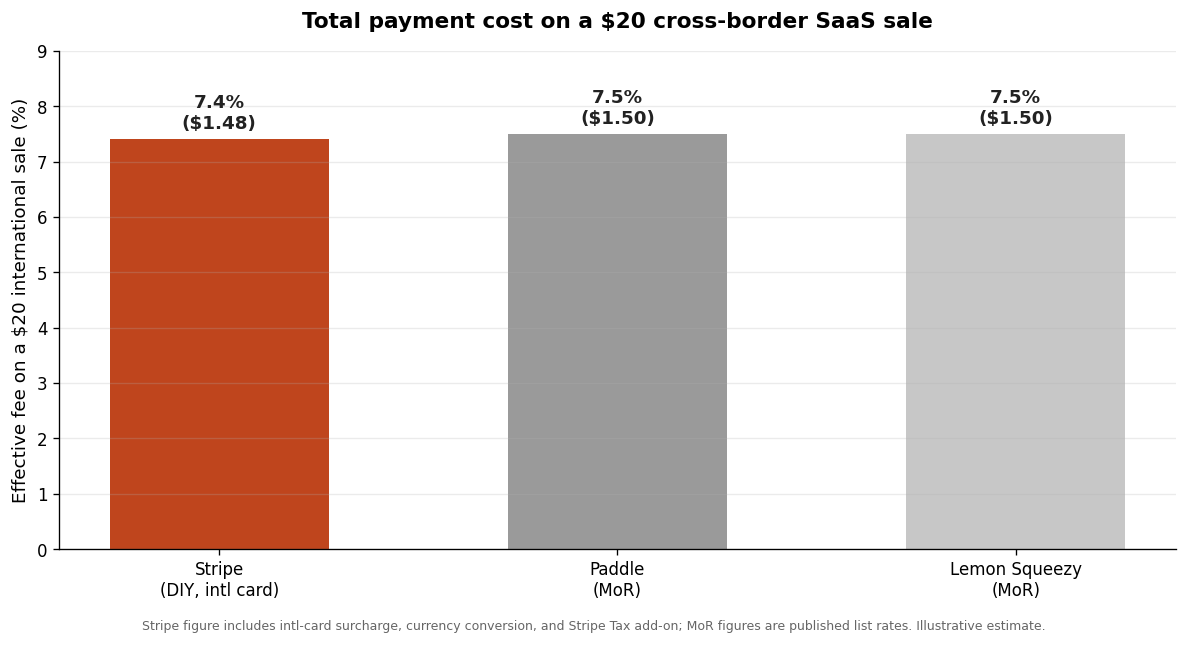
The chart above is my own estimate built from each provider's published 2026 list prices for one illustrative case: a single $20 international sale. On a small-ticket cross-border sale, the all-in costs land remarkably close — the MoR isn't the obvious loser the 5% sticker suggests. Where Stripe pulls clearly ahead is domestic, high-volume sales: a US company selling mostly to US customers pays 2.9% + 30¢ and keeps the spread. The honest summary: Stripe wins on price when your tax exposure is simple; an MoR wins on sanity when it isn't.
What changed when Stripe bought Lemon Squeezy?
This is the part of the 2026 landscape that confuses people, so it's worth being precise.
Stripe acquired Lemon Squeezy in July 2024. Lemon Squeezy still operates as its own product — its own dashboard, its own pricing, its own MoR infrastructure — and as of 2026 you can still sign up and sell through it. But the Lemon Squeezy team is now also building Stripe Managed Payments, Stripe's own merchant-of-record offering.
In Lemon Squeezy's own 2026 update, co-founder JR Farr was candid that the acquisition came with tradeoffs for existing customers: "slower support responses and less frequent product updates" while the team focused on the Stripe MoR product. He also framed Managed Payments as the future and said the goal is to give Lemon Squeezy users "an easy way to migrate" over.
What does that mean for you, practically? Two things.
If you're choosing today, Lemon Squeezy is a real, working option — especially for digital products, where its storefront, license keys, and affiliate tooling are genuinely nice. But you should choose it knowing the company's energy is visibly shifting toward Stripe Managed Payments, and that a migration is something the team is openly steering toward.
And if you're already deep in the Stripe-based stack — like the Coding Capybaras boilerplate is — Stripe Managed Payments is worth watching, because it promises MoR tax handling without leaving the Stripe API surface you already integrated. Per Stripe's documentation, it's being rolled out across a growing list of countries and is enabled from within Stripe Checkout rather than as a separate platform.
Which one should a non-technical founder actually pick?
Forget the comparison tables for a second. The real question is: which tax situation can you live with?
Pick Stripe directly if you're a US (or single-country) founder selling mostly to customers in your own country, at least early on. Your tax obligation is comprehensible, you keep the lowest fees, and Stripe is the most battle-tested payment infrastructure on earth. You can add Stripe Tax later for calculation help, and you can layer an MoR on top if you go global. This is the path the boilerplate takes by default, because most first-time founders launch into one market and the 2% premium is real money when you have ten customers.
Pick Paddle or Lemon Squeezy if you're selling globally from day one, your customers are spread across the EU and beyond, and the phrase "register for VAT in every member state" makes you want to close your laptop. The MoR premium buys you the right to never think about that. For a solo founder with no finance team, that's often worth more than the fee delta — burnout is a bigger threat to most indie SaaS than payment fees.
Pick Lemon Squeezy specifically if you're selling digital products or info products and want the storefront, checkout overlays, and license-key delivery baked in — just go in clear-eyed about the Stripe migration direction above.
There's a real wiring cost to switching later, which argues for thinking past launch day. Webhooks, subscription state, and your billing logic all couple tightly to whichever provider you choose. Migrating providers mid-flight means re-plumbing the part of your app that touches money — the highest-stakes code you own. I'd rather pick deliberately now than re-architect billing at 200 customers.
One thing AI coding tools change here: the integration difficulty that used to favor "whichever has the simplest SDK" matters far less. Pasting a clear spec into Claude Code or Cursor gets you a working Stripe or Paddle integration in an afternoon. (If you want the patterns for writing those specs well, the prompt engineering guide covers exactly that.) The decision is back to being about economics and taxes, where it belongs — not about which API is friendlier.
How do reach, payouts, and recurring billing compare?
Fees and tax get the headlines, but three operational details decide how the provider actually feels to run day to day.
Global reach and payouts. Stripe supports the widest set of countries for accepting payments, but where you can receive a payout depends on where your business is incorporated — Stripe pays out to bank accounts in a long list of supported countries, and if yours isn't on it, you're stuck. This is the quiet reason a lot of founders outside the US/EU end up on an MoR: Paddle and Lemon Squeezy pay out to a broader set of locations, which can be the deciding factor before fees even enter the conversation. Lemon Squeezy's own founder pointed founders in unsupported countries toward incorporating a US entity via Stripe Atlas — a real signal that "where can I get paid" still gates the decision in 2026.
Currency conversion margins. Both MoR providers (and Stripe) take a margin on currency conversion, typically a couple of points above the mid-market rate. If you sell in euros but get paid in dollars, that conversion spread stacks on top of the headline fee. It's the most-overlooked line item in every "which is cheapest" post, and it's why I tell founders to model their actual customer geography, not the sticker rate.
Recurring billing and subscriptions. All three handle subscriptions, but the surrounding machinery differs. Stripe gives you the most granular control — metered billing, proration, usage records, the full Billing API — which is power you'll grow into but also rope you can hang yourself with. Paddle and Lemon Squeezy abstract more of that away, which is friendlier for a solo founder but less flexible if you later need exotic pricing. Whichever you pick, the subscription lifecycle is where webhook reliability matters most: a missed subscription.updated event is a customer who keeps access after they cancel, or loses it after they pay. That's the same hard-won lesson behind the lifecycle email sequences — the events your payment provider fires are the backbone of everything downstream, from access control to receipts to dunning.
The meta-point: the provider you choose isn't just a checkout button, it's the source of truth for your revenue state. Treat that integration as core infrastructure, not a plugin. When I evaluated the boilerplate landscape, how cleanly each one wrapped its payment provider was one of the things I weighed most — because that wrapper is what keeps you from coupling your whole app to one vendor's webhook shape.
Frequently asked questions
Is Stripe cheaper than Paddle and Lemon Squeezy?
On headline rate, yes — Stripe is ~2.9% + 30¢ versus ~5% + 50¢ for the merchants of record. But once you add international card surcharges, currency conversion, and the Stripe Tax add-on, the gap on cross-border sales narrows to roughly a point. Stripe is clearly cheapest for high-volume domestic sales.
What is a merchant of record, in plain terms?
It's the legal entity that sells your product to the customer. With Stripe, that's you, so global sales tax is your responsibility. With Paddle or Lemon Squeezy, it's them — they appear on the receipt and handle tax collection and filing worldwide, which is what the higher fee pays for.
Is Lemon Squeezy shutting down after the Stripe acquisition?
No. As of 2026 it still operates with its own dashboard and pricing. But its team is now building Stripe Managed Payments, and Lemon Squeezy's own update frames a migration path to that product as the direction of travel. Choose it knowing the company's focus is shifting toward the Stripe MoR offering.
Do I need Stripe Tax if I use Stripe directly?
If you sell into multiple tax jurisdictions, you'll want help. Stripe Tax (around 0.5% per transaction) calculates the correct tax at checkout, but it does not file returns for you — that's still your obligation. If you want filing handled too, that's the case for a merchant of record.
Can I switch payment providers later?
Yes, but it's one of the more painful migrations because your webhooks, subscription state, and billing logic all couple to the provider. Plan to re-test every money-touching path. It's far easier to choose deliberately at launch than to re-plumb billing once you have paying customers.
Which is best for selling to EU customers?
A merchant of record (Paddle or Lemon Squeezy) is usually the saner choice for heavy EU sales, because EU VAT obligations are complex and they file on your behalf. With Stripe directly you'd be responsible for VAT registration and remittance yourself, even with Stripe Tax handling the calculation.
The bottom line
The Stripe vs Lemon Squeezy vs Paddle question comes down to one honest self-assessment: do you understand your tax exposure, and do you want to own it? If you're launching into one market, Stripe's lower fees and unmatched reliability are hard to beat. If you're going global on day one, paying a merchant of record ~2% to make international tax disappear is often the better trade for a solo founder who'd rather build than file VAT returns.
Whichever you choose, wire it in carefully — billing is the code you least want to get wrong. If you're shipping a SaaS with AI coding tools, Coding Capybaras is the free boilerplate I built for exactly this workflow; it ships on Stripe by default, and the marketplace has copy-paste prompts for the integrations around it.