Why I Priced My SaaS at $97 One-Time, Not $20/Month
Why I chose one-time pricing for Coding Capybaras Pro at $97 instead of a monthly SaaS subscription — the reasoning, the math, and what other boilerplates charge.
· Justin Boggs
Photo by Angèle Kamp on Unsplash
I priced Coding Capybaras Pro at $97 one-time instead of a monthly subscription because the product is a boilerplate, not a service — you download a codebase and own it, so charging rent for it never made sense. One-time pricing matches how the product actually delivers value, it matches what every serious competitor in this category charges, and it sidesteps the subscription fatigue that's making buyers warier of recurring charges every year. This post is the full reasoning: the math behind $97, why recurring would have been the wrong call, and the tradeoffs I accepted by choosing a one-time price.
TL;DR
- Coding Capybaras Pro is $97 one-time because you own the downloaded codebase; a subscription would charge rent on something you already have.
- Every major Next.js boilerplate — ShipFast, MakerKit, supastarter, Achromatic — uses one-time pricing, so it's the category norm, not a gamble.
- A $20/month subscription passes the $97 one-time price in month five; over two years it costs nearly 5x as much, which buyers can see.
- The real tradeoff is revenue predictability: one-time pricing means no MRR, so I have to keep acquiring new buyers rather than coasting on renewals.
What one-time pricing actually means here
One-time pricing means the customer pays once and keeps what they bought forever, with no recurring charge. For a SaaS product that's unusual, because most SaaS is a hosted service you rent by the month. Coding Capybaras isn't that. It's a boilerplate — the complete Next.js, Supabase, Stripe, and Resend codebase that runs this very site — and you download it, deploy it, and own it.
That distinction drives the whole pricing decision. When you sell access to servers you run, a subscription is honest: the customer keeps consuming a cost you keep paying. When you sell a codebase someone downloads once, the ongoing cost to me is close to zero. Charging $20 a month in perpetuity for a file the customer already has on their machine would be charging rent on a house they bought.
The free tier is the entire boilerplate. The $97 Pro tier unlocks the "Built by Coding Capybaras" attribution removal, ongoing boilerplate updates, and a growing set of Pro features. Founding-price buyers keep their price forever, even as I raise it. So the paid tier is real, but it's structured as a purchase, not a lease.
There's a category question underneath this that's easy to get wrong. If you're building a hosted, multi-tenant service — the classic SaaS shape — one-time pricing usually is the wrong call, because your costs scale with usage and a flat fee eventually loses money on heavy users. My reasoning here is specific to a downloadable product. Match your pricing model to how your product actually delivers value, not to what "SaaS" implies by default. I dug into that general framing in my pricing framework for non-tech founders, and this post is the applied version of that thinking.
The math behind $97
I didn't pull $97 out of the air, and I didn't reverse-engineer it from a spreadsheet of unit economics either. It came from two anchors: what the alternative would cost a buyer over time, and what comparable products charge.
Start with the time-based comparison. Imagine I'd gone with a $20/month subscription instead. Here's what a buyer pays under each model as the months add up.
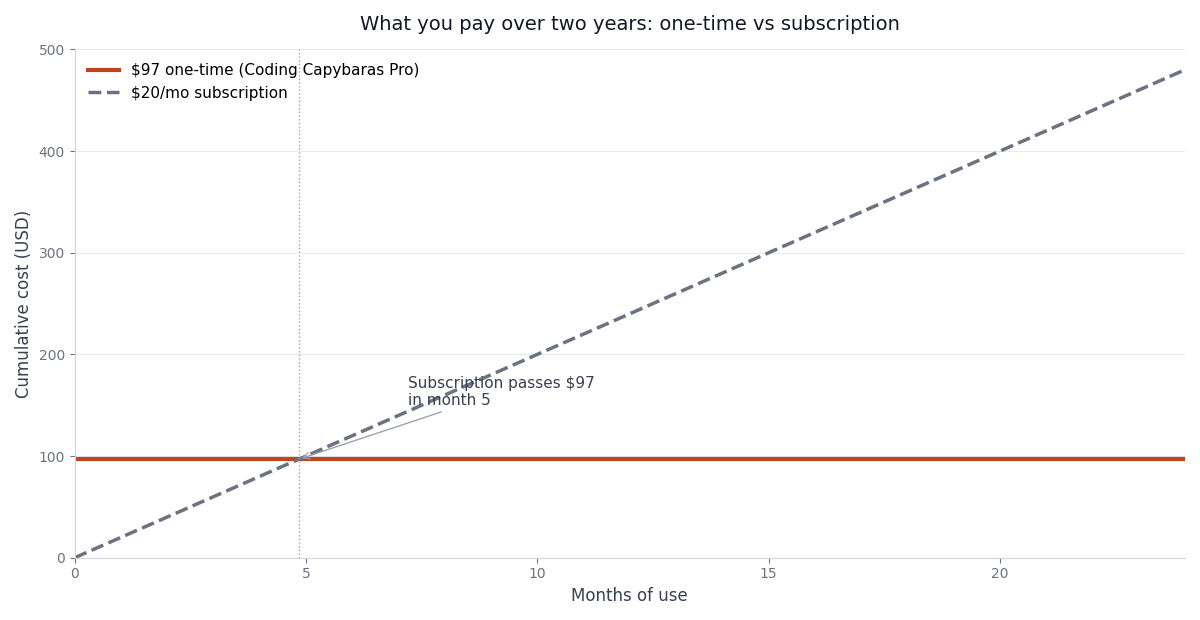
The one-time price is a flat line at $97. The subscription is a staircase that crosses it in month five and never looks back. By the two-year mark, the subscription buyer has paid $480 — almost five times the one-time price — for the same thing my one-time buyer already owns outright.
Founders sometimes counter that recurring revenue is worth more to the business, which is true, and I'll get to that tradeoff. But from the buyer's side, that chart is exactly the calculation a careful purchaser runs in their head. A boilerplate is a foundation you use for years. Attaching a meter to something with a multi-year useful life makes the buyer do this math and feel worse the longer they succeed with it. Punishing your best, longest-tenured customers is a strange way to run a business.
The $97 figure sits deliberately just under $100. That's not a trick so much as an acknowledgment that a sub-$100 purchase clears a psychological bar — it reads as a considered tool purchase rather than a capital expense that needs a second opinion. It's also honest about where the product is: this is v1 of a founding-price product, and I said openly it goes up as I build more. Early buyers are taking a small bet on a young product, and the price reflects that.
What the rest of the category charges
Pricing in a vacuum is guesswork. The useful move is to look at what buyers in your exact category already expect to pay, and the Next.js boilerplate market has a clear, verifiable answer.
Every major paid boilerplate uses one-time pricing. MakerKit's own 2026 comparison of the boilerplate landscape — written by a team that ships one, and with every price re-verified in July 2026 — lays it out. Here's how Coding Capybaras Pro sits against them.
| Product | Price | Model | Positioning | | --- | --- | --- | --- | | Coding Capybaras | Free + $97 Pro | One-time | Non-tech founders shipping with AI tools | | ShipFast | $199–$299 | One-time | Cheapest solo B2C entry | | Achromatic | $180 | One-time | Budget multi-tenant / AI SaaS | | supastarter | €349–€1,499 | One-time | Multi-framework B2B | | MakerKit | $349 / $649 (free lite) | One-time | Multi-tenant B2B, teams and RBAC |
Two things jump out. First, nobody in this category charges a subscription — one-time is the settled norm, and any listing that claims a major kit bills annually is out of date. Choosing one-time pricing wasn't a bold contrarian move; charging monthly would have been the anomaly that made buyers suspicious.
Second, at $97 Coding Capybaras is the lowest-priced paid tier on the board, and that's intentional. The others are excellent products aimed largely at working developers and B2B teams — I've said before that most boilerplates aren't built for non-technical founders, and their pricing reflects a buyer with a bigger budget and a company behind them. My buyer is often a first-time founder spending their own money to find out if an idea works. $97 is priced for that person's wallet and that person's risk tolerance, and the free tier means they can ship a real, paying business without paying me anything at all.
I'm not claiming $97 is "correct." Pricing is never solved, only revised — which is why I treat it as an ongoing experiment rather than a decision I made once. But anchoring to a category where every competitor validated one-time pricing, then positioning below them for a more price-sensitive buyer, is a defensible starting point.
The subscription-fatigue argument
There's a market trend pushing in the same direction, and it's worth being precise about because it's easy to overstate.
Consumers are actively tired of subscriptions. Deloitte's Digital Media Trends work found that 41% of consumers had cancelled a streaming subscription in a six-month window, and that price is the dominant trigger — its 2026 reporting shows the majority of cancellations are driven by price increases more than any other factor. That research is about streaming video, not developer tools, so I won't pretend it maps one-to-one onto a boilerplate purchase. But the underlying instinct it measures — a growing wariness of one more recurring line item, and a sharp sensitivity to recurring price creep — absolutely carries into how people evaluate any monthly charge.
For a developer-tooling buyer, that instinct is if anything stronger. The audience I'm selling to already juggles subscriptions for hosting, their database, email, analytics, and their AI coding tools. Those recurring costs stack up quietly into a monthly infrastructure bill that surprises founders. Adding my boilerplate to that pile as yet another subscription would put me on the list of charges they scan when they're trimming spend. A one-time purchase never appears on that list again. It's paid, it's done, it's theirs.
It also changes the emotional shape of the purchase. A subscription asks the buyer to make a small, repeated decision every month — a recurring "is this still worth it?" that they can answer "no" to at any renewal. A one-time purchase asks for one decision, once. For a product a founder commits to at the very start of a project, before they've shipped anything, removing that monthly reevaluation is a feature, not a concession. They can bet on the foundation and then stop thinking about the cost of it entirely, which is exactly the mental state I want a new founder in when they're trying to focus on their actual product.
So subscription fatigue isn't the reason I chose one-time pricing — the product's nature is the reason. But it's a real tailwind. When the market is drifting toward resenting recurring charges, offering a clean one-time purchase is both the honest model for a downloadable product and the one that reduces friction at exactly the moment a buyer is deciding whether to trust you.
The tradeoff I accepted
I want to be straight about the cost of this decision, because one-time pricing has a genuine downside and pretending otherwise would be dishonest.
The downside is revenue predictability. Subscription businesses have monthly recurring revenue — MRR — which is the number that makes SaaS the darling of investors and the sanity-saver of founders. If you understand how MRR and the rest of the subscription metrics work, you know their appeal: a subscriber base is a floor. You start each month already knowing roughly what you'll earn, and growth compounds on top of a stable base.
One-time pricing throws that floor away. Every month I start at zero. There is no renewal cushion, no compounding base of subscribers quietly paying while I sleep. To earn $1,000 this month, I have to sell roughly ten Pro licenses this month, and then do it again next month from scratch. That's a treadmill, and it's the honest price of the model. It's also why so many businesses that could sell one-time deliberately choose subscriptions instead — the recurring model is easier to run and worth more per customer over time, which is a real argument I'm choosing to forgo. There's a reason the annual-vs-monthly billing question is usually framed as "which subscription cadence," not "subscription or not."
I made the trade with eyes open for three reasons. One, it's the correct model for a product you download and own — correctness matters more than optimizing my revenue chart. Two, it builds trust with a buyer who's been burned by subscription creep, and trust is the scarce resource for a brand-new product. Three, it keeps my incentives clean: I earn by making the product good enough that new people keep buying it, not by making it hard to cancel. The version of this business that maximizes MRR is not the version I'd want to run.
I'll also be honest that this decision isn't permanent scripture. If the treadmill becomes unsustainable — if new-buyer acquisition can't cover the cost of building the Pro features I've promised — the right response isn't to bolt a subscription onto a downloadable product. It's to add a genuinely recurring service alongside it: hosting, a managed deployment, priority support, something that actually incurs an ongoing cost and therefore earns an ongoing fee. That would be a new product with its own honest pricing, not a retroactive meter on the boilerplate people already bought. Keeping those two things separate is how I avoid the trap of quietly turning a purchase into a subscription and eroding the exact trust the one-time price was meant to build.
Frequently asked questions
Is one-time pricing better than a subscription for SaaS?
Neither is universally better — the right model depends on how your product delivers value. If you run a hosted service with costs that scale per user, a subscription aligns your revenue with your costs. If you sell a product the customer downloads and owns, like a boilerplate or a template, one-time pricing matches the value delivery and avoids charging rent on something they already have.
Why is Coding Capybaras Pro $97 specifically?
It's anchored to two things: the boilerplate category, where paid tiers run roughly $180 to $649 one-time, and the price-sensitive non-technical founder I'm selling to. Sitting below every competitor at a sub-$100 price makes it a low-risk purchase for a first-time founder spending their own money. It's also a founding price that rises as the product matures, and early buyers keep their price forever.
Doesn't one-time pricing leave money on the table versus a subscription?
Yes, in pure lifetime-revenue terms it usually does — a $20/month subscription overtakes a $97 one-time price by month five and keeps climbing. I accepted that tradeoff deliberately. For a downloadable product, one-time pricing is the honest model, it builds trust with subscription-weary buyers, and it keeps my incentive on making the product worth buying rather than hard to cancel.
What do other Next.js SaaS boilerplates charge?
As of mid-2026, all the major paid ones use one-time pricing: ShipFast is $199–$299, Achromatic is $180, MakerKit is $349–$649 with a free open-source lite version, and supastarter runs €349–€1,499. There is no widely used subscription-priced boilerplate in this category, which is why one-time pricing was the safe, expected choice rather than a risky one.
How do you handle updates without a subscription?
Ongoing boilerplate updates are part of what the one-time Pro purchase unlocks, delivered through a clean sync workflow from the codebase that powers this site. Because the marginal cost of shipping an update to a downloadable codebase is low, I can include updates in the one-time price rather than gating them behind a recurring fee.
Will the price stay at $97?
No — $97 is a founding price and it will rise as I add Pro features and the product matures. Anyone who buys at the founding price keeps that price permanently, so the earlier you buy, the better the deal you lock in. That's the one place where buying sooner genuinely saves money.
Pricing is a decision you keep making
Choosing $97 one-time wasn't a clever growth hack. It was the model that honestly fits a product you download and own, priced for a founder spending their own money, in a category where one-time pricing is already the norm. The tradeoff — no MRR, a fresh start every month — is real, and I took it on purpose because trust and correct incentives matter more to a young product than a tidy revenue chart. It's the same decision that made my first $97 customer feel like a fair trade rather than the start of a meter running.
If you're weighing your own pricing model, the honest answer is that it depends on how your product delivers value — and you can see exactly how I made the call on the Coding Capybaras pricing page, where the free tier ships the complete boilerplate and Pro is the one-time $97 I've spent this whole post explaining.