SaaS Build vs Buy: Components to Never Build Yourself
A build vs buy framework for SaaS founders: which components to buy (auth, payments, email), which to build, and how to tell them apart fast.
· Justin Boggs

Photo by Barn Images on Unsplash
The SaaS build vs buy decision comes down to one question: does this component make your product different, or does it just need to work? You build the parts that only you can build — your core feature, your domain logic, the workflow that made someone want to sign up. You buy everything else, and authentication, payments, and transactional email are the three you should almost never build from scratch. They're commodity infrastructure: solved problems with regulated edges, where a homegrown version costs you weeks up front and a long tail of security and maintenance debt forever. The rest of this post is a framework for telling the two categories apart before you spend a month on the wrong one.
TL;DR
- Never build from scratch: authentication, payment processing, transactional email deliverability. The risk and maintenance dwarf the savings.
- Always build: your core product feature, your domain logic, the UX that defines why you exist.
- The decision axis isn't "can I build it" — with AI coding tools you probably can. It's "does building it make my product more valuable, or just busier."
- A hybrid stack — buy the plumbing, build the product — is what most successful indie SaaS companies actually run.
- When you "buy," you're usually wiring in a well-documented API, not paying a license. The cost is integration time, not just dollars.
The only build vs buy framework you need
Most build vs buy advice drowns in spreadsheets — total cost of ownership models, five-year projections, weighted scoring matrices. For a solo or first-time founder, that's overkill. The decision is simpler and more honest than that.
Ask two questions about any component:
Does it differentiate my product? If a customer would never notice or care how this part was built — they just expect it to work, the way they expect a light switch to work — it's commodity. Login is commodity. Sending a receipt email is commodity. The clever thing your app does that nothing else does is not commodity. That's your moat, and it's the only thing worth your scarce hours.
Does it carry regulated or security-critical risk? Some components aren't just tedious to build — they're dangerous to build badly. Anything touching passwords, payment cards, or personal data sits in this bucket. A bug in your core feature is a bug. A bug in your auth layer is a breach.
If a component is commodity and risky, buying it is close to mandatory. If it's differentiating and low-risk, building it is the whole point of your company. The interesting cases live in between, and that's where judgment comes in. A hybrid approach — as one founder's decision framework puts it — means buying infrastructure, authentication, analytics, and payments while custom-building the algorithms, domain logic, and UX that define your value. That single sentence is most of the framework.
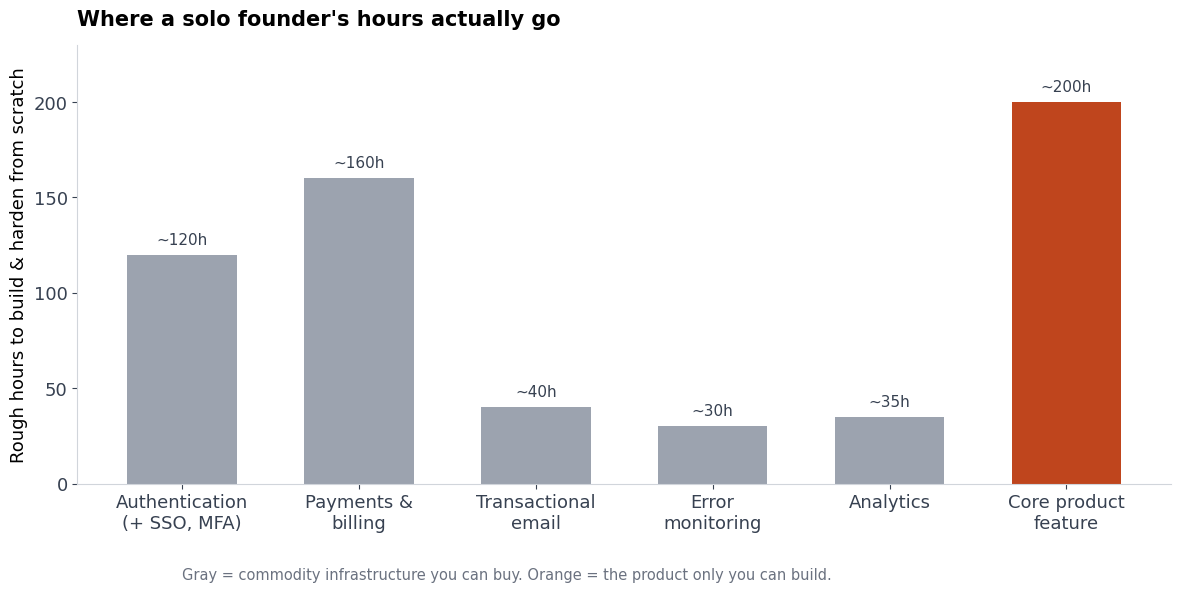
The chart above is the framework made visual. Every gray bar is time spent on something a customer takes for granted. The orange bar is the only one that grows your product's value. When you build auth from scratch, you're not adding the gray bar's hours to your timeline — you're subtracting them from the orange one.
Authentication: the textbook "never build it" case
Authentication looks deceptively simple. Store a username, store a password, check them at login. Founders look at that and think "I can do that in an afternoon." Then reality arrives.
A production authentication system isn't username plus password. It's salted password hashing, email verification, password reset flows, session management, rate limiting against brute-force attacks, and — the moment you have a paying B2B customer — single sign-on, multi-factor authentication, and eventually SCIM provisioning. Authentication in 2026 is not in the "simple" category anymore. Passkeys and WebAuthn alone bring device attestation, cross-platform compatibility quirks, and browser inconsistencies that are a project unto themselves. The Prefactor build vs buy analysis lays out just how far the surface area has expanded.
Then there's the security exposure. Authentication failures are perennially near the top of the OWASP list of application risks — broken authentication and session management have been flagged for over a decade as one of the most commonly mis-implemented, most heavily exploited parts of any app. When your auth is weak, you're not shipping a bug. You're handing attackers your users' credentials.
And it never stops needing attention. Maintaining a robust auth system is effectively a full-time job: tracking new standards, patching library vulnerabilities, responding when something breaks. Every hour spent there is an hour not spent on your product.
This is why I didn't write a line of auth logic for Coding Capybaras. The boilerplate uses Supabase Auth — email/password, OAuth providers, session handling, all maintained by a team whose entire job is getting this right. If you're weighing the database side of that decision too, I went deep on it in Supabase vs Firebase for first-time founders. The short version: rolling your own auth is the most common expensive mistake I see first-time founders make, and AI coding tools make it more tempting, not less, because the happy path looks so easy to generate. The happy path is never the problem. The reset-token expiry edge case at 2am is the problem.
Payments: where "just add an API" becomes a compliance project
Payments are the second component you should never build from scratch, and the reason is sharper than auth: payments are a regulated operating model, not a feature.
The moment you store, process, or transmit cardholder data, you fall under PCI DSS — the Payment Card Industry Data Security Standard. According to Stripe's PCI compliance guide, this applies to any business that accepts cards, from a single-location shop to a fast-growing SaaS company. PCI compliance is a shared responsibility: Stripe is certified annually by an independent assessor as a PCI Level 1 Service Provider — the most stringent tier — and your business attests to compliance on your side.
Here's the leverage. By processing payments through a provider's tokenized integration — Checkout, Elements, a mobile SDK — your application never touches raw card data. That single architectural choice collapses your PCI scope from "audit the entire system that handles cards" to "fill out the simplest self-assessment questionnaire." Build your own card form that posts numbers to your server, and you've just opted into the full, expensive version of compliance for no product benefit whatsoever.
And card handling is the easy part. Real payment infrastructure means subscription lifecycle, proration, failed-payment retries (dunning), tax calculation across jurisdictions, dispute and chargeback handling, and refund logic. If you embed and monetize payments yourself, "just adding a payments API" quietly becomes merchant underwriting, anti-money-laundering monitoring, and ongoing compliance obligations.
Buy this one. The honest tradeoff is which provider, not whether — I compared the main options in Stripe vs Lemon Squeezy vs Paddle, and the "merchant of record" model (Paddle, Lemon Squeezy) takes even more off your plate by handling sales tax and VAT as the seller of record. Whatever you pick, the webhook layer is where the real implementation work lives, and it has its own swamp of edge cases — I documented every one I hit in Stripe webhook hell.
The components where building is the right call
Buying everything would be the wrong lesson. There's a category where building is not just acceptable — it's the entire reason your company exists.
Your core feature. Whatever your product actually does — the scheduling engine, the analysis, the editor, the matching algorithm — is yours to build. No vendor sells it, because if they did, you wouldn't have a business. This is where every hour you reclaimed from auth and payments should go.
Your domain logic and data model. How you model your customers' world is differentiation. The specific entities, relationships, and rules that match your niche better than a generic tool — that's defensible, and only you understand the domain well enough to build it right.
The UX that defines your product's feel. Off-the-shelf components are fine for a login screen. They're a liability for the one screen your users live in all day. That's where polish and opinionated design earn retention.
Notice the pattern: you build the things that only you can build, and you build the things where being generic would make you worse. Everything else — the plumbing every SaaS needs and no customer chooses you for — you buy. This is also the line a good boilerplate draws for you. When I describe the anatomy of a 2026 indie SaaS stack, every named piece (Supabase, Stripe, Resend, Vercel) is a "buy," deliberately, so the founder's hours land on the product instead.
There's a subtler trap here too: building a commodity component badly is worse than not building it. A half-finished auth system isn't a feature — it's a security liability you now have to maintain. The "build" column should be short and intentional.
A quick reference table for the common components
Here's the framework applied to the components nearly every SaaS needs. "Buy" here usually means wiring in a documented API — the cost is integration time, not necessarily a license fee.
| Component | Recommendation | Why | | --- | --- | --- | | Authentication | Buy | Security-critical, regulated edges (SSO/MFA), endless maintenance | | Payments & billing | Buy | PCI DSS scope, dunning, tax, disputes — a compliance project, not a feature | | Transactional email | Buy | Deliverability is a dark art; reputation and DKIM/SPF are vendor-solved | | Error monitoring | Buy | Sentry-class tooling is mature, cheap, and instant to wire in | | Product analytics | Buy | Event pipelines and dashboards are commodity; insight is yours | | Hosting / deploy | Buy | Vercel/Netlify/Railway solved this; don't run your own pipeline | | Core product feature | Build | The only thing customers actually chose you for | | Domain logic & data model | Build | Differentiation lives here; no vendor sells your niche | | Signature product UX | Build | Generic = worse on the screen users live in |
Transactional email deserves a callout because founders underestimate it the way they underestimate auth. Getting a "welcome" email into the inbox instead of spam involves domain authentication, IP reputation, bounce handling, and list hygiene — none of which is your product. Providers like Resend solve it; I compared them in Resend vs Postmark vs Mailgun. Error monitoring is the same story: wiring in Sentry takes about ten minutes and replaces a logging system you'd otherwise babysit.
How AI coding tools change (and don't change) the math
There's a new wrinkle in 2026: AI coding assistants will happily generate an entire auth system or a custom payment form if you ask. So the old objection — "a non-technical founder can't build auth" — is weaker than it used to be. You can. The question is whether you should.
The framework doesn't change; the temptation does. AI makes the happy path of any component cheap to produce, which makes building feel free. It isn't. The generated auth flow handles login and signup beautifully and silently omits rate limiting, the reset-token expiry window, the session-fixation defense, and the SSO path your first enterprise customer will demand. You don't know what's missing because the code looks complete. That's the trap: AI lowers the cost of the 80% that's easy and hides the 20% that's dangerous.
So the rule for AI-assisted founders is: use AI to integrate bought components fast, not to replace them. Pasting "wire Supabase Auth into this Next.js app" into Claude Code is the dream workflow — you get a battle-tested system, installed in minutes, maintained by someone else. Pasting "build me a custom authentication system" is how you ship a liability you don't have the expertise to audit. The boilerplate approach leans hard into the first pattern: the commodity components come pre-wired, and the AI prompts in the integration marketplace add the rest by integration, never by reinvention.
Frequently asked questions
What does "buy" actually mean for a bootstrapped founder with no budget?
Usually not a purchase. Most of the components you should "buy" — Supabase Auth, Stripe, Resend, Sentry — have generous free tiers that carry you well past your first paying customers. "Buy" here means "use the managed service and wire in its API" rather than "build and maintain it yourself." The cost is integration time, which is far smaller than build-and-maintain time.
Isn't relying on third-party services a risk if they shut down or raise prices?
It's a real tradeoff, and an honest framework names it. Vendor lock-in and price changes are genuine risks. You mitigate them by choosing widely-adopted, well-funded providers with standard interfaces (OAuth, standard SQL, SMTP) so migration is possible if you ever need it. That residual risk is still far smaller than the security risk of running your own auth or the compliance risk of handling cards yourself.
Where's the line between a boilerplate and building it myself?
A boilerplate is the build vs buy decision made for you by someone who already hit the walls. It bundles the "buy" components, pre-wired, so you inherit good defaults and spend your time on the "build" column. You can still swap any piece. I compared the main options honestly in the SaaS boilerplate comparison, including where each one isn't the right fit.
How do I decide on components that aren't auth, payments, or email?
Run the two-question test: does it differentiate my product, and does it carry regulated or security risk? Search, notifications, file storage, and analytics almost always score "commodity, low differentiation" — buy them. Anything that encodes your specific domain knowledge scores "differentiating" — build it. When a component is genuinely 50/50, default to buying for v1 and revisit only if it becomes a bottleneck.
Does building my own component ever make sense for cost reasons?
Rarely, and almost never early. The math that occasionally favors building is high volume at scale, where a vendor's per-unit pricing eventually exceeds the cost of running your own. That's a problem you solve when you have the revenue and the team to maintain what you build. Pre-product-market-fit, your scarcest resource is time, not infrastructure dollars, and the time math favors buying every time. Pricing strategy is its own topic — I covered it in SaaS pricing for non-tech founders.
The bottom line
Build vs buy isn't really about cost. It's about where your finite hours create value. Authentication, payments, and transactional email are solved problems with dangerous edges — building them adds risk and maintenance, not value, so you buy them. Your core feature, your domain logic, and your signature UX are the only things customers chose you for — so you build those, and you protect the time to do it well. The hybrid stack that results, buy the plumbing and build the product, is what nearly every successful indie SaaS actually runs.
If you're shipping a SaaS with AI coding tools and want the build-vs-buy line drawn for you, Coding Capybaras is the free boilerplate I built for exactly this — the commodity components come pre-wired, and the marketplace has copy-paste prompts to integrate the rest without reinventing any of it.